



Over the past several days, the relationship between Solana-based decentralized finance protocols Kamino and Jupiter has evolved from healthy ecosystem competition into a sharp, highly visible public dispute. The tensions broke into the open following a series of strategic maneuvers and counter-maneuvers centered around user migration and automated refinancing within the Solana money market sector.
The immediate catalyst for the dispute occurred on November 27, when Jup Lend introduced a dedicated refinancing tool directly on its user interface. Designed to streamline user acquisition, the feature allowed traders to migrate their looping positions—leveraged lending and borrowing strategies—from Kamino Multiply directly into Jup Lend using a seamless single-click operation. Under the hood, this automated refinance operation executed a complex atomic transaction designed to clear out old debt positions on one platform and immediately establish new ones on the other.
Just days later, on December 2, Kamino responded decisively by updating its smart contracts to actively block Jupiter’s program. The technical patch effectively neutralized the one-click refinancing pipeline, forcing users who wished to switch platforms to do so through manual repayment and withdrawal processes.
The move immediately drew sharp criticism from the Jupiter and Fluid development teams. Because Jup Lend relies on Fluid for its backend infrastructure, representatives from both projects quickly framed Kamino’s smart contract update as overtly anti-competitive and fundamentally opposed to the core ethos of open-finance principles, which traditionally champion interoperability and composability across decentralized applications.

The public debate intensified on December 6 when Kamino’s co-founder stepped forward to publicly explain the technical and strategic rationale behind blocking Jup Lend’s migration tool. According to the co-founder, the decision was prompted in large part by misleading marketing claims from Jupiter regarding asset safety. Specifically, Jupiter had repeatedly suggested to users that borrower collateral on Jup Lend was fully isolated, implying it was neither rehypothecated nor exposed to cross-contamination risks. However, Kamino’s leadership pointed out that this representation was inaccurate, a reality underscored when even Fluid’s co-founder publicly acknowledged that rehypothecation does indeed take place within Jup Lend.
Industry observers noted that Kamino’s defensive measure did not restrict user sovereignty entirely; users were never blocked from manually repaying their loans, withdrawing their capital from Kamino, and depositing it into Jup Lend on their own terms. Whether or not blocking the automated refinancing program crossed ideological lines regarding open finance, the maneuver was fundamentally a calculated business decision. Market analysts drew parallels to Jup Lend’s own strategic choices, such as its decision to keep its underlying code proprietary for the time being, despite stated plans to open-source it in the future.
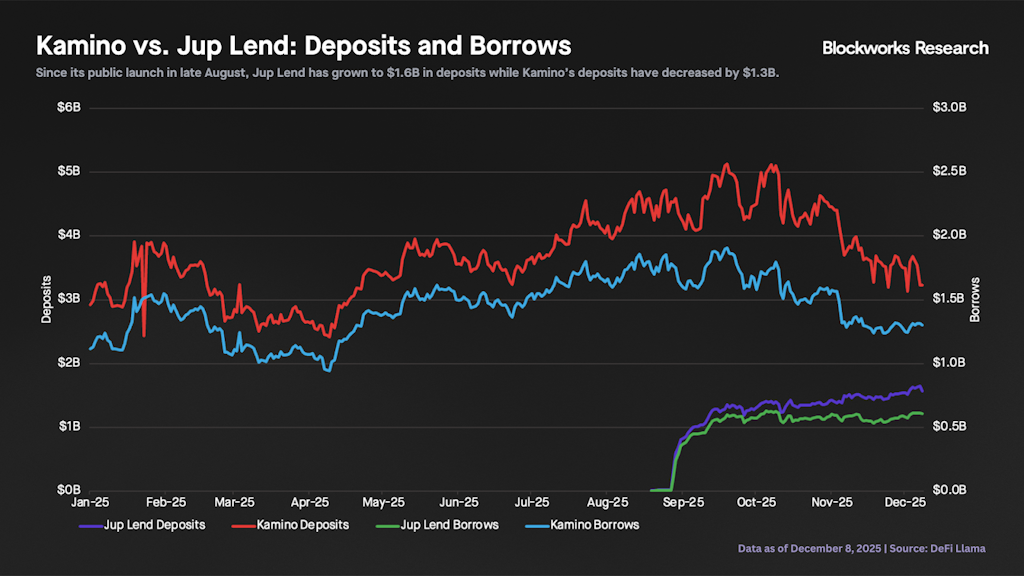
To fully understand the gravity of the dispute, it is necessary to examine the broader competitive dynamics that have played out between the two prominent money markets over the preceding months. Since its high-profile launch in late August, Jup Lend has experienced explosive growth, scaling rapidly to capture $1.6 billion in total deposits and $610 million in total borrows.
During the exact same timeframe, Kamino has felt the squeeze of this aggressive newcomer. Data tracking the protocol’s metrics shows that Kamino’s deposits and borrows have contracted significantly, dropping by $1.3 billion, or roughly 28 percent, and $460 million, or roughly 26 percent, respectively, since Jup Lend entered the market.
A closer look at asset-level metrics reveals where the capital has flowed. The top five assets driving deposit growth across the ecosystem since Jup Lend’s launch include USDC, which pulled in $485 million; JLP at $225 million; SOL at $206 million; syrupUSDC at $174 million; and jupSOL at $85 million. Over this period, Kamino experienced substantial outflows across nearly all of these major assets, with syrupUSDC serving as a rare exception. Even in the case of syrupUSDC, however, Jup Lend managed to attract roughly three times the volume of inflows compared to its competitor.
Faced with intense competition in core liquidity pools, Kamino’s recent growth strategy has increasingly pivoted toward assets that are not yet supported by Jup Lend. For instance, Kamino’s stablecoin inflows throughout the fourth quarter have been significantly bolstered by alternative assets, notably PYUSD, which brought in $42 million, and Phantom’s CASH, which accounted for $125 million in inflows. Furthermore, Kamino has maintained an aggressive posture in onboarding decentralized autonomous tokenized collateral liquid staking tokens, most notably dfdvSOL and, more recently, fwdSOL.
Looking ahead, Kamino is betting heavily on unique integrations to serve as a catalyst for net new inflows into its money market. A primary example is its integration with PRIME, a development designed to give users exposure to a regulated credit pool backed by United States real estate loans. These loans are originally sourced and serviced through Figure, providing a direct pipeline to a yield source that remains entirely uncorrelated from broader crypto market cycles. Protocol leadership hopes this institutional-grade access will help attract a fresh segment of borrowers who prioritize stability and real-world asset exposure.
As the dust settles on the recent public feud, industry stakeholders emphasize that competition between Kamino and Jup Lend is ultimately a natural driver of innovation that should benefit the end user. Nevertheless, prominent voices within the broader Solana ecosystem have urged a shift in perspective. As Solana Foundation leader Lily Liu recently noted, rather than engaging in localized turf wars, protocols like Kamino and Jupiter would be better served by focusing on expanding the overall market pie and capturing broader market share from competing blockchain networks and traditional finance. Combined, both Solana money markets still account for less than 10 percent of the total deposits held by industry giant Aave, underscoring that aggressive ecosystem expansion—supported by innovative real-world integrations—remains essential if the Solana ecosystem is to close the gap with legacy decentralized finance heavyweights.





Comments (0)