


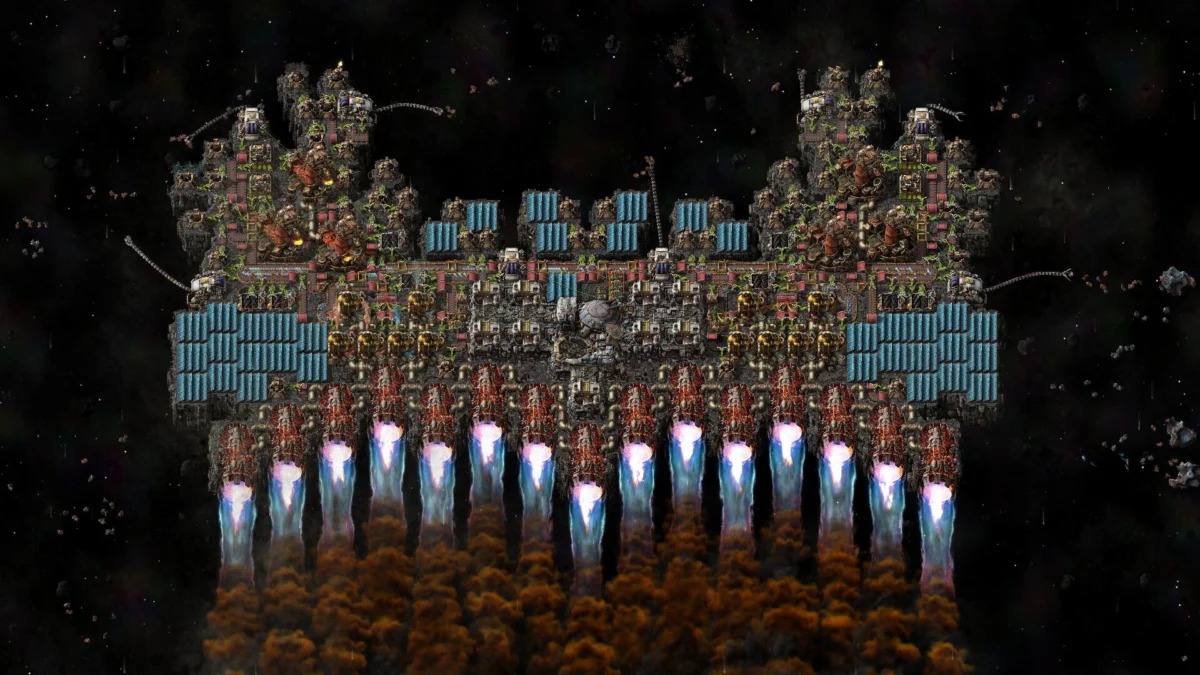
The milestone arrives following Wube’s announcement in May that update 2.1 would serve as the final significant patch for the genre-defining title. At the time, the studio reflected that the game had "reached a good place to conclude active game development." This monumental decision comes roughly two years after the release of Factorio: Space Age, a critically acclaimed expansion that dramatically altered the scope of the game by allowing players to launch their industrialization efforts into the stars, establishing supply chains and managing automated empires across four wildly distinct alien planets.
While some fans might have anticipated a massive, game-altering capstone akin to the Space Age expansion itself, Wube has consistently reined in those expectations. In a recent installment of the developer’s traditional Friday Facts blog, the team reiterated that update 2.1 is deliberately not about introducing entirely new planets, hostile alien lifeforms, or massive new research trees. Instead, the final patch focuses heavily on a robust collection of long-desired quality-of-life improvements, smaller features, deep technical polish, and various mechanical adjustments that the development team simply did not have the time to implement during the rollout of version 2.0.

Despite the absence of fresh celestial bodies to conquer, update 2.1 is packed with substantial changes that promise to significantly reshape how players interact with their automated worlds, particularly when it comes to the space logistics networks introduced in Space Age. Wube is streamlining the arduous process of ferrying goods into orbit and transporting resources between different planets. Most notably, rockets can now be loaded with multiple different items simultaneously rather than being restricted to a single cargo type. This crucial alteration dramatically simplifies the initial construction phases of orbital space platforms, removing frustrating bottlenecks that previously required overly complex logistical gymnastics.
Furthermore, these space platforms are receiving powerful new automation capabilities. Platforms in orbit will now possess the ability to transfer items directly between one another and automatically pull required goods from all available supply locations across a player’s interstellar network. Complementing these orbital logistics updates, Wube is introducing a brand-new constructable unloading bay that can be seamlessly attached to planetary landing pads. This addition allows mechanical inserters to extract items straight out of landing craft and place them directly onto conveyor belts, into waiting cargo trains, or into storage systems, smoothing out the often chaotic transition between interplanetary freight and local manufacturing lines.
Beyond the cosmic frontiers of the Space Age expansion, update 2.1 also delivers a wide array of quality-of-life adjustments that impact the core base-building experience on the home planet. Perhaps the most notable non-space change is a comprehensive overhaul to the game’s infamous native inhabitants, the Biters. Wube has recalibrated the mechanics so that biter expansion grouping now scales dynamically alongside the player’s technological evolution. The intention behind this adjustment is to ensure that clearing out hostile nests later in a playthrough feels like a meaningful strategic challenge rather than an endless chore of stamping out countless tiny, annoying outposts scattered across the map. Additionally, biters will now select more natural geographical locations to establish new habitats and will continue to expand their territory regardless of whether a player chooses to actively explore and map out the surrounding wilderness in the early stages of a game.

Other notable tweaks included in the final patch involve the reintroduction of fluid mixing prevention, which will save builders from the catastrophic headaches of contaminated pipe networks. Wube has also implemented fine-tuning adjustments to the intricate Quality system introduced in Space Age, alongside stunning visual overhauls for core industrial structures such as assembling machines, oil refineries, rocket silos, and heat exchangers. A particularly welcome addition is a new rendering system designed to simplify how fluid pumps connect to rail fluid wagons, an infrastructural pain point that has long tested the patience of even the most seasoned automation architects.
While the developer has noted that minor hotfixes and maintenance patches may occasionally roll out in the future, update 2.1 stands as the definitive conclusion of active development for Factorio. As for what lies ahead for Wube Software, the studio briefly mentioned back in May that it had begun exploring concepts for entirely new prototypes, though it explicitly stressed that there would be nothing concrete to share with the public for a long time. For now, the global community of engineers must content themselves with continuing to optimize, expand, and perfect one of the most celebrated and enduring titles in PC gaming history.





Comments (0)