



The digital asset ecosystem finds itself at a fascinating and somewhat paradoxical juncture. While short-term price charts display signs of a modest, localized recovery following a severe market-wide correction late last year, a broader examination of monthly performance metrics and market breadth reveals a prevailing bearish undertone. Market participants are currently weighing immediate price action against macroeconomic pressures and traditional finance benchmarks, attempting to decipher whether recent market behavior marks a definitive bottom or merely a temporary countertrend rally within a prolonged consolidation phase.
Beneath the surface volatility of spot prices, however, structural adoption metrics tell a fundamentally different story. Secular growth trends across decentralized finance infrastructure—particularly within the stablecoin economy and decentralized lending protocols—continue to demonstrate robust, multi-year expansion. These underlying pillars suggest that despite short-term headwinds, the foundational architecture of onchain finance is maturing at a pace that far outstrips past market cycles.

Following a brutal selloff in November that triggered widespread liquidations and suppressed risk appetite across the board, crypto markets have spent recent weeks attempting to establish a stable trading range. Bitcoin has managed a recovery from its recent correction low of $80,700, climbing back to hover around the $90,400 mark. This rebound has provided some breathing room for traders, though the pace of recovery remains uneven across different sectors of the digital asset economy.
Over shorter timeframes, specific narratives have managed to capture liquidity and drive localized outperformance. Over a recent 24-hour window, the artificial intelligence and modular blockchain sectors emerged as the primary winners of short-term capital rotation. Tokens such as Bittensor (TAO), which posted gains of approximately 6.4%, and Celestia (TIA), up around 6.2%, served as notable catalysts for this transient strength. Conversely, derivatives-focused segments faced downward pressure. The Perpetual Index registered as a top loser among sector indices, dragged down by tokens such as DYDX, which slipped 3.1%, and HYPE, which dipped 0.6%.
When zooming out to a monthly perspective, however, the macro environment for digital assets remains decidedly unfavorable. Traditional finance benchmarks—including gold, the Nasdaq, and the S&P 500—have maintained positive performance over the trailing month, reflecting resilience in legacy markets. In stark contrast, nearly every crypto index tracked by analysts measures negative returns over the same period.
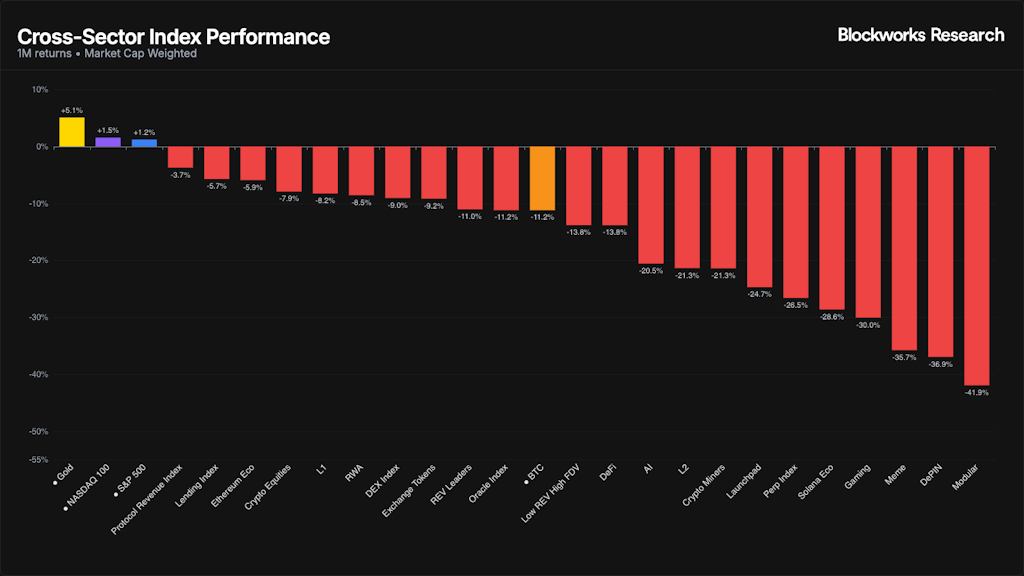
Market breadth has proven to be decisively negative across all major crypto indices over the monthly timeframe, leaving virtually no sector completely insulated from the downward pressure. Even so, internal relative strength has emerged in specific areas. Notably, the Protocol Revenue index has shown relative outperformance compared to other crypto sectors. This divergence suggests that capital is becoming increasingly selective, flowing toward decentralized protocols that boast strong fundamental positioning, sustainable fee generation, and clear utility, rather than speculative tokens devoid of underlying economic activity.
Despite these pockets of relative strength, analysts remain divided on the broader trajectory. It remains an open question whether the current recovery rally represents a countertrend bounce within a larger, extended downtrend or if the market has successfully carved out a definitive cyclical low that will support prices for the remainder of the year.
Amid the noise of spot price volatility and shifting market breadth, analysts emphasize the importance of keeping sight of the broader structural evolution taking place within decentralized finance. A retrospective look at the depths of the previous bear market highlights the staggering scale of adoption that has occurred over a relatively short temporal window.
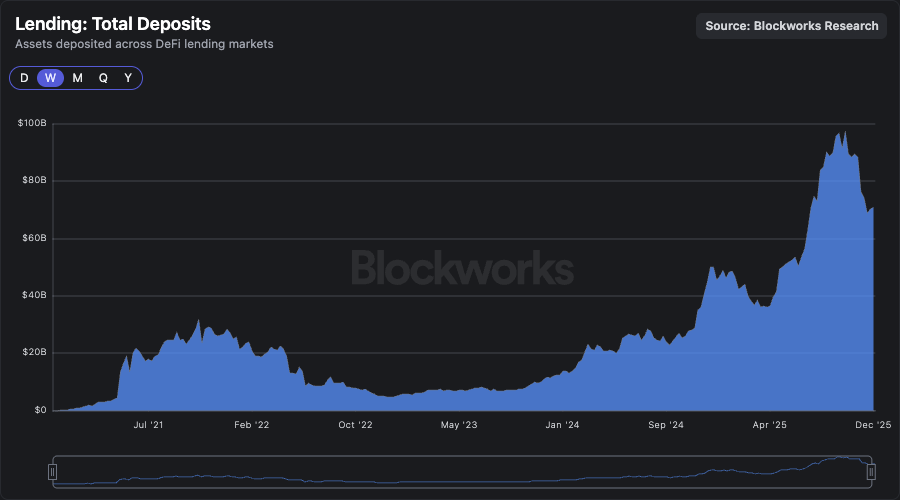
At the absolute trough of the bear market, decentralized lending applications accounted for a mere $5 billion in aggregate deposits—a figure that amounted to little more than a rounding error within the context of the broader global financial system. In the years since that low, however, that capital base has exploded, growing to $71 billion in active deposits after having recently pushed toward the milestone of $100 billion.
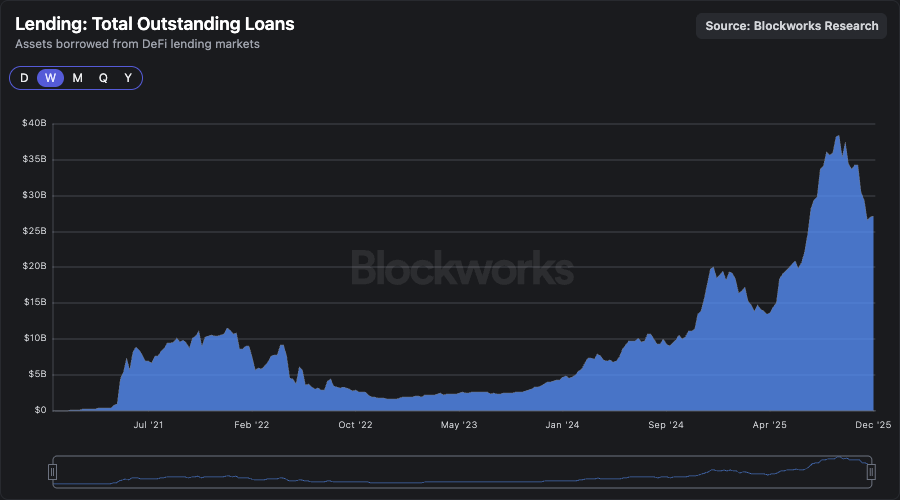
A similar trajectory is observable in the volume of active loans issued through these decentralized applications. At the bear-market low, total outstanding loans stood at a modest $1.6 billion. Since then, active loans have climbed steadily, currently resting above $27 billion after recently surpassing a peak of $38 billion. These figures have scaled to a level that demands attention from traditional financial institutions and macroeconomic analysts alike, moving well beyond the confines of niche crypto-native speculation.
While financial markets are inherently cyclical and variance can cut aggressively in both directions—impacting key utilization metrics and spot prices alike—the roughly twentyfold growth in topline metrics over just a few years indicates that the sector is still a considerable distance away from its terminal growth rate. The structural demand for decentralized borrowing and lending facilities has proven resilient, weathering multiple market cycles and regulatory shifts.
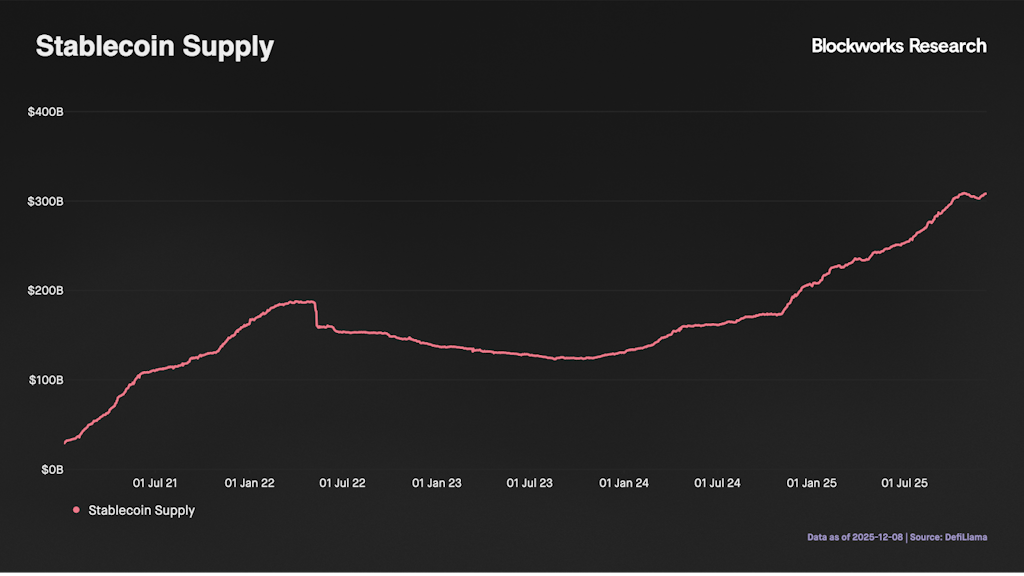
Mirroring the expansion in lending markets, the aggregate stablecoin supply has staged a remarkable recovery following a temporary contraction. After experiencing a period characterized by approximately $10 billion in net outflows, the total supply of stablecoins has rebounded sharply, retracing all the way back up to its all-time high of $310 billion.
The sustained growth in stablecoin issuance and adoption is a secular trend that continues to defy broader bearish market sentiments. Onchain money markets and decentralized lending platforms stand out as the primary beneficiaries of this expanding stablecoin liquidity, serving as the foundational applications for capital utilization. Within these environments, stablecoin holders seek predictable yield on their idle capital, while active borrowers look to leverage their positions or secure liquidity without selling underlying crypto assets. While spot asset prices will inevitably remain volatile, the underlying demand for digital dollars and onchain credit facilities provides a persistent and durable tailwind for the broader decentralized finance ecosystem.
This expansion in stablecoin supply and liquidity, however, is unfolding against a backdrop of comparatively modest onchain yields. Benchmark supply rates across major decentralized lending applications currently hover around 3.6%. Interestingly, this figure represents a slight discount when compared to traditional legacy benchmarks, such as the Secured Overnight Financing Rate (SOFR), which sits at roughly 3.9%.
This yield dynamic introduces a nuanced challenge for the sector. The growing depth of onchain stablecoin liquidity may continue to exert downward pressure on the upside potential of supply rates. In the absence of a material risk premium over legacy traditional finance rates, the momentum behind growing stablecoin utilization within onchain money markets could face friction as sophisticated capital weighs the smart contract and protocol risks of decentralized platforms against the safety of traditional short-term fixed-income yields. As the market continues to navigate these competing forces, the interplay between macroeconomic interest rate policy, stablecoin expansion, and decentralized protocol adoption will undoubtedly dictate the next phase of growth for the digital asset economy.





Comments (0)