


Federal Bureau of Investigation agents have arrested a high-ranking executive from a Canadian cybersecurity firm in Pennsylvania, marking a significant escalation in the ongoing, high-stakes investigation into the ShinyHunters cybercrime syndicate. The suspect’s apprehension comes on the heels of a devastating security breach orchestrated by the hacking group, which successfully compromised sensitive personal and professional data belonging to thousands of federal law enforcement agents.
Multiple sources familiar with the matter confirmed the arrest to KrebsOnSecurity, aligning with reports first published by The New York Times indicating that a Canadian national had been taken into custody in Pennsylvania on suspicion of providing illicit assistance to ShinyHunters. Neither The Times nor FBI Director Kash Patel, who acknowledged the arrest in a brief public statement on X, formerly known as Twitter, initially identified the individual by name.
According to a source close to the federal investigation, the Canadian executive had traveled to Pennsylvania to attend a prominent cyber insurance industry conference. The suspect’s professional background centered heavily on handling complex ransomware negotiations and extortion advisories on behalf of corporate clients facing intense pressure from international cybercrime cartels. Another source familiar with the case noted that operational control and oversight of the sprawling ShinyHunters investigation have recently been centralized at a primary FBI field office in Texas, signaling a coordinated federal push to dismantle the network from top to bottom.
Publicly available records and conference schedules indicate that the Cyber Risk Summit was held at the Loews Philadelphia Hotel from October 5 through October 7. While the event featured numerous corporate sponsors, summit documentation lists its premier, highest-tier sponsor as Cypfer, a prominent Canadian cybersecurity firm.
Corporate and professional networking profiles on LinkedIn previously identified Edward Dubrovsky as an early founder of Cypfer. Dubrovsky is currently associated with another Canadian security enterprise and conference sponsor, CyberSteward. Approximately one month prior to his arrest, Dubrovsky published a post on LinkedIn announcing his intention to attend the Philadelphia Cyber Risk Summit alongside his colleagues from the CyberSteward team, looking forward to continuing strategic industry discussions regarding compliance-driven coercive advisory and settlement services.

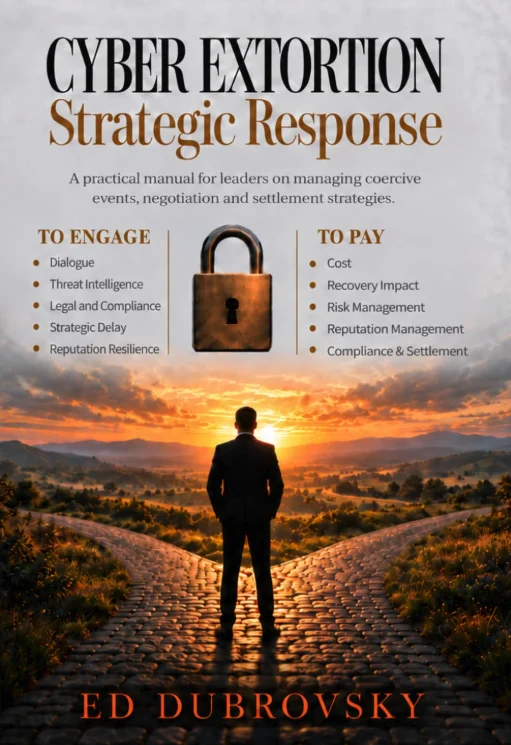
Following public inquiries and breaking developments, a spokesperson for Cypfer clarified that Dubrovsky was never a founder or co-founder of the firm, contrary to claims on his professional profile, but instead served as a managing director prior to his resignation in December 2025. Dubrovsky’s professional background also includes authoring a 252-page textbook titled Cyber Extortion Strategic Response, which purports to guide organizations through the complex decision-making processes required to manage ransomware incidents, evaluate recovery options, and protect vital assets.
Promotional material for Dubrovsky’s book emphasizes a nuanced distinction in the realm of crisis management: communicating with an active cybercriminal is fundamentally distinct from negotiating a financial settlement, and engaging in dialogue does not inherently constitute a commitment to pay a ransom demand. Instead, the text argues that structured engagement can serve alternative defensive objectives, such as testing the veracity of a threat actor’s claims, gathering actionable intelligence, buying valuable time, and preserving tactical options while an organization evaluates its broader response strategy.
Federal court documents reveal that an individual named Edward Dobrovsky—noting a slight typographical variation in the spelling of the surname—was formally arrested in Pennsylvania on October 8 on charges of cyber extortion and conspiracy. While several core documents, including the primary criminal complaint, remain heavily sealed by the court, a subset of filings has been indexed publicly through legal monitoring platforms such as CourtListener.
The available court summaries charge the defendant with conspiracy to threaten to impair the confidentiality of information with the intent to extort money, alongside charges related to the interference with commerce by threats. Inmate locator databases maintained by the U.S. Bureau of Prisons confirm that a 54-year-old Edward Dubrovsky is currently being held at a federal detention facility in Philadelphia. However, court records also reflect a transfer order filed on October 9 moving the case jurisdiction to the U.S. District Court for the Eastern District of Texas, corroborating insider accounts that point to Texas as the central hub for the federal government’s ongoing ShinyHunters probe. Representatives for the FBI declined to comment on the specifics of the ongoing litigation.
At the time of his initial court appearances, available case dockets indicated that Dubrovsky had not yet retained private legal counsel, nor had the court formally appointed a public defender to represent him. Attempts to reach Dubrovsky directly for comment were unsuccessful, and representatives for CyberSteward did not immediately respond to requests for statements regarding the arrest.
The ShinyHunters hacking collective has established a notorious reputation within the cybersecurity landscape by systematically employing sophisticated phishing campaigns and stolen credentials to infiltrate corporate environments, particularly targeting data stored within software-as-a-service providers. Once inside, the group extracts proprietary information and leverages the threat of public exposure to coerce victims into paying multi-million-dollar ransoms. According to federal estimates, the syndicate has successfully extorted more than $70 million from various corporate and institutional victims over the course of the year.

The arrest of the Canadian cybersecurity executive represents only the latest milestone in an aggressive, international law enforcement crackdown targeting the infrastructure and associates of ShinyHunters. Sources indicate that federal investigators have spent weeks meticulously analyzing digital devices seized last month by Dutch law authorities during the arrest of Pepijn van der Stap, a reformed cybercriminal apprehended abroad in connection with the same multi-jurisdictional inquiry. Intelligence gathered from those devices, combined with ongoing cooperation from other detained actors, is widely expected to yield additional criminal charges against principals at other specialized ransomware negotiation and incident response firms.
The pressure on the ShinyHunters organization has intensified dramatically following Van der Stap’s arrest. Seizing control of the group’s operations, a new faction leader operating under the pseudonym "Rey" quickly emerged and began brazenly taunting federal investigators. The online taunts centered on a massive data breach affecting the FBI’s own online recruitment portal, which exposed sensitive internal records detailing individual agents’ unit assignments, operational specializations, and confidential medical and psychiatric histories.
Investigative reports published by Reuters identified "Rey" as a teenager named Saif Al-din Khader. Law enforcement authorities soon tracked down and detained Khader, who is now reportedly cooperating fully with federal investigators. Early October disclosures detailed how Khader was apprehended just as the cybercrime group attempted to execute an extortion scheme against a digital aviation and navigation unit that had been divested by aerospace giant Boeing in late 2025.
As federal authorities continue to untangle the web of relationships connecting corporate incident responders, ransomware negotiators, and the cybercriminals they ostensibly oppose, the investigation remains fluid, with further developments and legal filings anticipated in the days ahead.





Comments (0)