


For years, the mainstream experience of artificial intelligence has been defined by a simple, transactional loop: a human types a prompt into a text box and waits for an answer. This chat-based paradigm, while revolutionary in popularizing generative models, represents only the opening act of the AI revolution. The next chapter belongs to autonomous agents—software systems designed not just to answer questions, but to actively chase solutions to complex, multi-layered problems with patience and tenacity. Unlike traditional interactions bounded by a single turn of conversation, these agents are constrained only by the compute and context they are given, operating independently across hours, days, or even months to achieve their objectives.
While the market demand for sophisticated, long-running AI agents has surged exponentially across industries, the underlying infrastructure required to run them ambitiously has largely lagged behind. Traditional cloud architectures and inference setups are optimized for fast, short-lived API requests rather than persistent, resource-intensive agentic workflows. To bridge this critical gap, a new platform called Sail has emerged to provide the specialized infrastructure needed to run agents at scale. Founded by industry veterans and designed from the ground up to support tireless machine intelligence, Sail is aiming to become the new north star for AI infrastructure.
A New North Star for AI Infrastructure
Sail is fundamentally building for a world in which AI agents operate continuously to solve humanity’s most complex engineering, security, and analytical problems. To make this vision a reality, the company has purpose-built an inference platform designed to operate across a remarkably wide range of compute resources while flexing seamlessly to handle long-running, demanding tasks. Rather than relying on rigid, traditional cloud setups, the Sail team is aggressively pushing forward on two foundational technology pillars: a radically reimagined inference stack and a persistent workspace environment known as Sailboxes.
The first pillar is Sail’s proprietary inference stack, the underlying machinery that executes machine learning models. Guided by the pragmatic mantra that "there are no bad chips, only bad prices," the engineering team took the traditional inference stack completely apart and rebuilt it to extract significantly more efficiency out of every piece of hardware. Instead of letting specialized workloads bottleneck on a single high-end provider, Sail intelligently distributes work across a diverse ecosystem of providers so that compute pipelines never stall.
This approach allows the platform to tap into underused data-center capacity that would otherwise sit idle, particularly hardware clusters that are too small, too old, or too unconventional for mainstream providers to monetize effectively. Furthermore, Sail is consistently among the first organizations to test and integrate new hardware accelerators as they hit the market, continuously searching for innovative ways to find a productive place for emerging silicon within their execution engine.
By squeezing maximum performance and economic value out of diverse hardware, this improved inference stack fundamentally alters the economics of autonomous operations. It allows AI agents to think longer and harder, consuming billions of tokens on a single complex task while maintaining a fraction of the traditional cost. This cost-efficiency is what transforms the theoretical potential of long-horizon reasoning into an economically viable reality for modern development teams.

The second core technological pillar is Sailboxes, engineered specifically as persistent workspaces for agents that need to run indefinitely. Sailboxes fluidly scale CPU and memory resources to precisely match the dynamic needs of the user, ensuring that an agent waiting idly on an external event or a long-running tool call is billed almost nothing for that downtime. Because of this architectural efficiency, customers routinely leave Sailboxes running for months at a time, treating them essentially as immortal digital environments.
These persistent workspaces already underpin a diverse array of demanding real-world use cases. From powering always-on security checks and monitoring every physical product distributed across the web to maintaining a hyper-competitive chess leaderboard that has been running continuously inside the Sail office for months, Sailboxes demonstrate the practical viability of truly persistent background intelligence.
Building for Performance at Scale
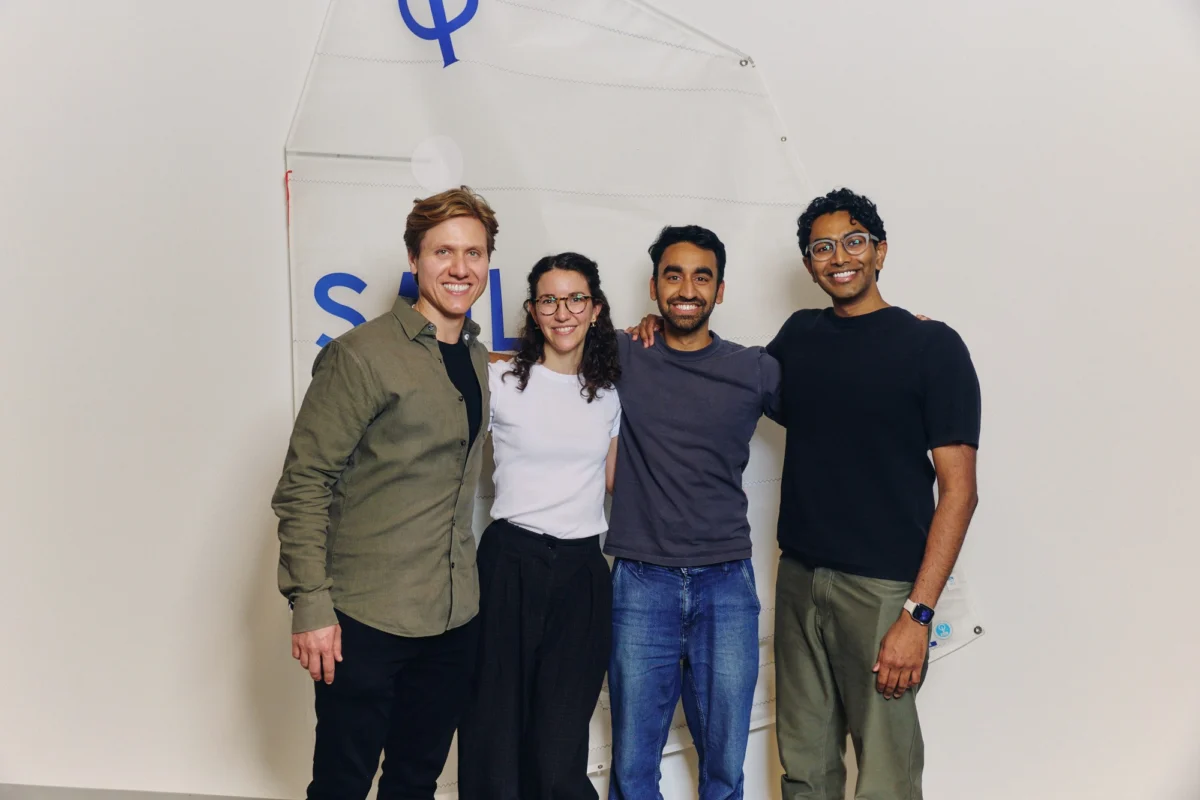
The technical ambition behind Sail is deeply rooted in the extensive backgrounds of its founding team, who are no strangers to the grueling demands of high-performance compute infrastructure. Co-founder Neil Movva began his career at NVIDIA, where he pushed graphical processing units to their physical limits. He subsequently applied that same expertise to new generations of specialized AI accelerators at Apple, before coming full circle back to GPUs at Together AI. Alongside him, co-founder Samir Menon brings critical systems-engineering experience from Apple, where he architected and maintained extraordinarily reliable systems operating at the massive scale of billions of global users.
This is a leadership team deeply steeped in the culture of performance engineering—professionals who understand the silicon at a fundamental level and are committed to chasing computational efficiency to its absolute limits. Yet, despite the high-intensity nature of building bleeding-edge infrastructure, the company culture maintains a distinct personality. The Sail office blends rigorous technical brilliance with an environment that features the occasional unicyclist intermission, alongside a fiercely contested office chess leaderboard where new hires continuously battle for the top spot. Supported by a growing team of talented engineers and researchers, the company is rapidly expanding its footprint.
Making Intelligence Abundant
At its core, Sail’s raison d’être is simple yet profound: to make intelligence abundant. Every strategic and architectural decision made by the company—ranging from optimizations at the bare-metal chip level down to the developer-facing API—is driven by a singular mission to provide engineering teams with the tokens, computational scale, and persistent runtimes required to build autonomous agents without artificial boundaries. Having established deep partnerships from day zero, the team is positioning itself at the forefront of the next great wave of artificial intelligence development. As the industry transitions from passive chat interfaces to active, autonomous agents, Sail is fully prepared to help developers set sail into uncharted territory.





Comments (0)