


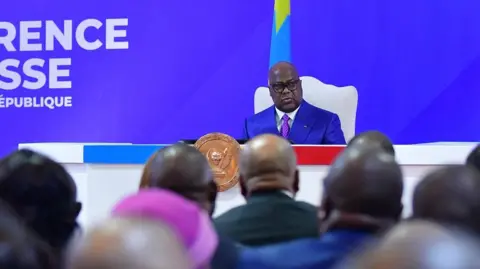
Democratic Republic of Congo President Félix Tshisekedi has signaled a willingness to pursue a third presidential term, conditioning any future run on the approval of the nation’s electorate through a constitutional referendum. The announcement, delivered during a press conference on May 6, immediately drew sharp scrutiny from opposition groups and political analysts who view the maneuver as a classic playbook tactic aimed at eroding democratic term limits.
Under the current legal framework of the Democratic Republic of Congo, the constitution strictly limits the head of state to two terms in office. President Tshisekedi’s second and final mandate is legally scheduled to expire in 2028. Consequently, any viable path toward securing a third term would necessitate rewriting the foundational rules of the nation’s political system while the incumbent administration is actively in power.
The declaration instantly reverberates across a fragile political landscape, introducing profound uncertainty regarding the country’s governance trajectory over the next four years. While framed as an exercise in popular sovereignty, the proposal revives long-standing debates regarding the sanctity of constitutional boundaries across the African continent.
The Statement and What It Actually Means
During the May 6 news conference, which was closely monitored and covered by regional outlets such as Africanews, President Tshisekedi carefully positioned the concept of a third term not as a personal political ambition, but as an expression of the popular will.
“I did not seek a third term, but I’m telling you: if the people want me to have a third term, I will accept,” Tshisekedi told reporters.
This rhetorical framing is hardly novel. Throughout recent political history, leaders across Africa, Latin America, and various other regions have frequently relied on the "the people demand it" narrative to justify constitutional amendments that conveniently prolong their tenure. In political science circles, this recurring phenomenon is widely recognized and studied as the "third-term problem."
On the surface, conditioning a historic constitutional change on a public vote sounds inherently democratic. However, political analysts emphasize that the procedural mechanics of a referendum are deeply consequential. The integrity of any such vote relies heavily on who is responsible for organizing the electoral infrastructure, how the ballot questions are framed, and who ultimately oversees the tabulation of votes. In a nation grappling with the governance deficits characteristic of the DRC, these logistical and administrative details represent monumental hurdles rather than minor footnotes.
Executing a credible nationwide constitutional referendum is an extraordinary undertaking in a country roughly the size of Western Europe. The DRC suffers from severely constrained physical infrastructure, active and intense armed conflict in its eastern provinces, and a historical legacy marked by disputed electoral outcomes.
The Political Backdrop Is Messy
The current political reality in Kinshasa is built upon a foundation of contention. President Tshisekedi initially assumed the presidency following the December 2018 general elections, a contest that was immediately mired in controversy. His victory over the regime of long-standing leader Joseph Kabila was openly challenged by rival opposition candidates and drew skepticism from international election observers.
According to comprehensive analysis published by the Institute for Security Studies, this disputed electoral outcome left Tshisekedi with severely restricted leverage and parliamentary influence during the formative years of his initial presidential mandate. To govern effectively, he was compelled to forge uneasy political alliances and navigate a fractured legislative environment.
Although Tshisekedi subsequently secured a second term in subsequent elections, the foundational questions surrounding his administration’s political legitimacy have never fully dissipated. Floating the possibility of extending his rule beyond 2028 injects an additional layer of severe tension into an already volatile political atmosphere.
Opposition figures and civic organizations have responded with immediate alarm. Reports from outlets such as Africa Briefing indicate that various opposition factions have formally accused the president of orchestrating a calculated strategy to consolidate and indefinitely extend his grip on power. Critics have issued stark warnings that pursuing constitutional revisions could ignite widespread public unrest in a nation that has historically experienced significant episodes of political violence.
The DRC’s modern history is defined by the absence of smooth political transitions. Since gaining independence from Belgium in 1960, the country has navigated a turbulent path characterized by military coups, devastating civil wars, and deeply contested successions of power. Whenever a sitting head of state publicly signals an intention to remain in office past their mandated departure date, it invariably raises the political temperature across the entire nation.
Compounding these domestic political strains is the persistent humanitarian and security catastrophe unfolding in the eastern provinces. Eastern Congo remains deeply engulfed in a multifaceted armed conflict involving dozens of domestic militia groups, foreign-backed rebel factions, and government military forces. This protracted violence has successfully displaced millions of citizens and generated one of the most severe humanitarian crises observed globally.
This ongoing regional conflict introduces severe practical complications for any prospective national election timeline. Observers note that the instability and active fighting in the eastern territories could easily serve as a formal justification for postponing the scheduled 2028 presidential elections. If a complex constitutional referendum is added to the national calendar ahead of those polls, the logistical burden on the nation’s electoral commission becomes exponentially more difficult to manage.
Opposition leaders have already flagged a concerning hypothetical scenario wherein the persistent eastern conflict is weaponized as a convenient pretext to delay national elections indefinitely while sweeping constitutional changes are quietly pushed through parliament and the courts. Whether this represents the explicit intent of President Tshisekedi remains unknowable at this stage. Nevertheless, the underlying structural incentives for such a maneuver are clearly visible, drawing intense scrutiny from domestic and international watchers alike.
Why This Matters Beyond the DRC
The geopolitical significance of the Democratic Republic of Congo extends far beyond its domestic borders. As the largest country in sub-Saharan Africa by land area and one of the most resource-abundant nations on the planet, its stability is of paramount international concern. The DRC’s vast reserves of critical minerals, particularly cobalt, make it an indispensable pillar of the global economy. Cobalt is an essential chemical component required for the manufacturing of lithium-ion batteries, which power everything from consumer electronics to the rapidly expanding global fleet of electric vehicles.
Consequently, political instability or civil unrest within the DRC does not remain locally contained. Shocks to the nation’s governance ripple outward, directly impacting regional security dynamics across Central and East Africa, disrupting global commodity supply chains, and complicating international diplomatic and humanitarian efforts. Whenever the political trajectory of Kinshasa appears uncertain, international markets and foreign policy capitals take immediate notice.
For observers tracking broader governance trends across the African continent, President Tshisekedi’s recent remarks fit neatly into a recurring historical pattern. Over the past decade, multiple African leaders have actively sought—and in several instances successfully achieved—constitutional reforms designed to lengthen their time in executive office. While a few of these transitions occurred through relatively peaceful legal channels, others triggered precisely the type of acute instability, institutional decay, and violent resistance that opposition leaders routinely warn against.
The upcoming 2028 election cycle in the DRC was already projected to be one of the most closely monitored political events on the continent. It now carries the heavy burden of additional uncertainties: whether the national vote will proceed on schedule, whether the foundational constitutional framework will be radically altered before citizens cast their ballots, and whether the entire electoral and referendum process will ultimately be viewed as credible by the domestic population and the international community.
With approximately two years remaining before his current mandate officially concludes, President Tshisekedi possesses a sufficient window of time to organize a constitutional referendum, provided the requisite political will is mobilized. Simultaneously, that exact same timeframe affords opposition movements adequate space to organize political resistance, allows international actors to weigh in diplomatically, and leaves room for the security situation in the eastern provinces to either improve or deteriorate further.
None of these critical variables can be predicted with certainty at this juncture. What remains entirely predictable, however, is that the coming years of Congolese politics have just grown significantly more contentious and high-stakes.
The bottom line: President Tshisekedi’s expressed openness to pursuing a third presidential term, artfully cloaked in the traditional democratic language of a popular mandate, sets the stage for a fierce constitutional battle. The confrontation takes place within a nation already buckling under the weight of active armed conflict, systemic governance deficits, and profound public skepticism toward state institutions. While framing the move around a national referendum carries a veneer of democratic participation, the actual execution and administration of the process will ultimately determine whether it represents genuine democratic engagement or a consolidation of unilateral power.




Comments (0)