



As the cryptocurrency market navigates the final stretch of the year, a comprehensive look at capital flows reveals a decisive shift in investor strategy. Market participants are increasingly rotating into large, proven crypto infrastructure assets while simultaneously pulling back from speculative sectors that dominated earlier narratives. This year-end recalibration is characterized by a stark divergence between traditional macro assets and digital currencies, as well as a severe reckoning for the vast majority of token generation events that took place over the course of the year.
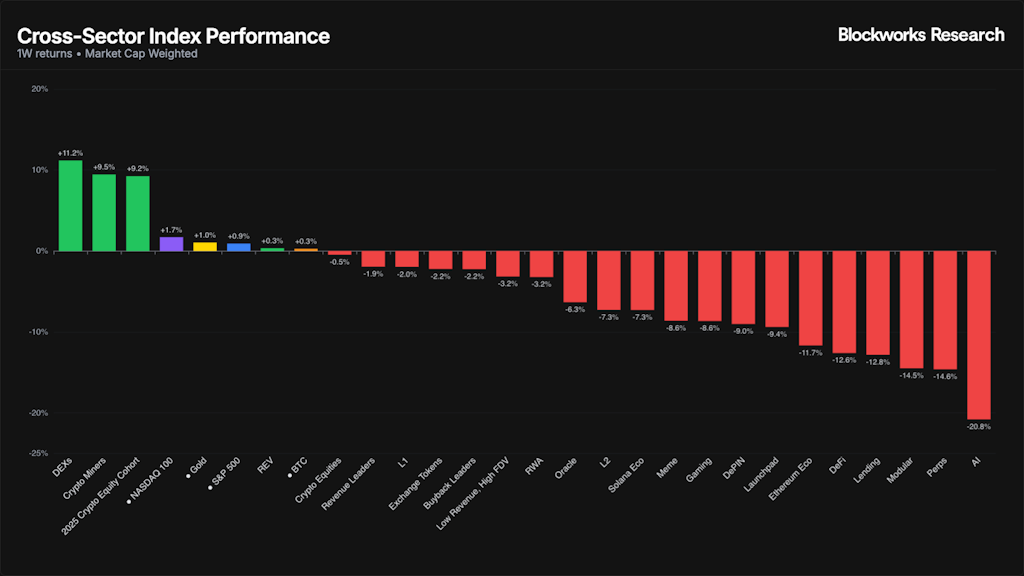
A closer examination of weekly index readings highlights this ongoing trend. While traditional financial benchmarks experienced positive momentum, the broader digital asset market faced a more subdued environment. Bitcoin, the industry’s bellwether, remained essentially flat over the trailing seven-day period, recording a marginal gain of just 0.3 percent. This performance notably underperformed traditional macroeconomic benchmarks. During the same timeframe, the NASDAQ index advanced by 1.7 percent, gold gained 1.1 percent, and the S&P 500 moved up by 0.9 percent.

The divergence between crypto and traditional equities became particularly pronounced around December 18. Mid-week trading sessions saw most cryptocurrency sectors experience a sharp sell-off, while global equities managed to hold their ground. Market analysts point to this decoupling as evidence of a crypto-specific risk-off movement rather than a reaction to broader macroeconomic weakness. Instead of capital fleeing financial markets entirely, liquidity within the digital asset ecosystem appears to be concentrating in select, high-conviction areas while speculative risk appetite cools down significantly.
Sector Performance and Diverging Indices
Despite the flat performance of Bitcoin and minor contractions seen across layer-1 networks and exchange tokens, certain segments of the digital asset market managed to register robust gains. Decentralized exchanges led all major crypto indices with an impressive 11 percent increase over the week. This outperformance was spearheaded by Uniswap’s native token, UNI, which surged by 15.4 percent. The rally followed the successful passage of the high-profile UNIfication governance vote on-chain, which saw massive engagement from the community with 69 million UNI tokens participating in a resounding "yes" vote, comfortably surpassing the 40 million token quorum requirement.
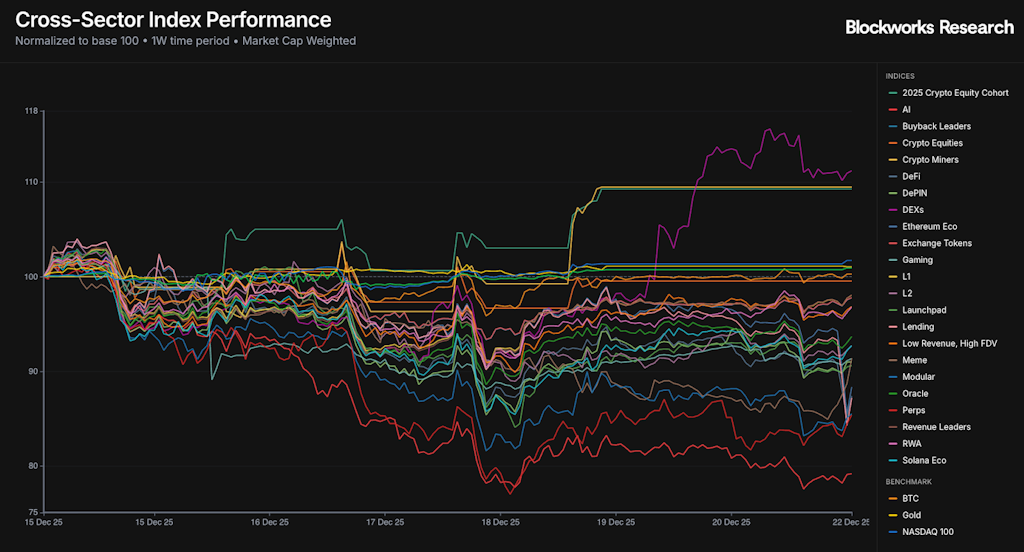
Following closely behind decentralized exchanges were crypto miners, which posted gains of 9.5 percent, and the 2025 crypto equity cohort, which rose by 9.2 percent. These movements underline a persistent appetite for equity-like exposure and infrastructure plays that benefit directly from network activity and security operations. Conversely, layer-1 blockchains experienced a modest decline of 2 percent, while exchange tokens dipped by 2.2 percent.
The most dramatic underperformance, however, came from the artificial intelligence token sector, which plummeted by 21 percent over the week. This steep correction was heavily influenced by TAO, the native asset of the Bittensor network, which also dropped 21 percent. The weakness in TAO and the broader AI token complex is widely attributed to a classic "sell-the-news" market reaction surrounding Bittensor’s inaugural halving event, which occurred around December 14. While the halving successfully cut daily token issuance in half, it failed to generate immediate incremental demand to absorb the circulating supply, prompting a broader de-risking phase across AI-themed digital assets.
Quantifying the Damage Across 2025 Token Launches
As the year draws to a close, market participants are also taking stock of the broader landscape for new token issuances, revealing a remarkably challenging environment for venture-backed and public token generation events. Recent data shared by market observer Ahboyash has put hard numbers behind the intuition shared by many traders and investors regarding the performance of assets introduced to the market over the past twelve months.
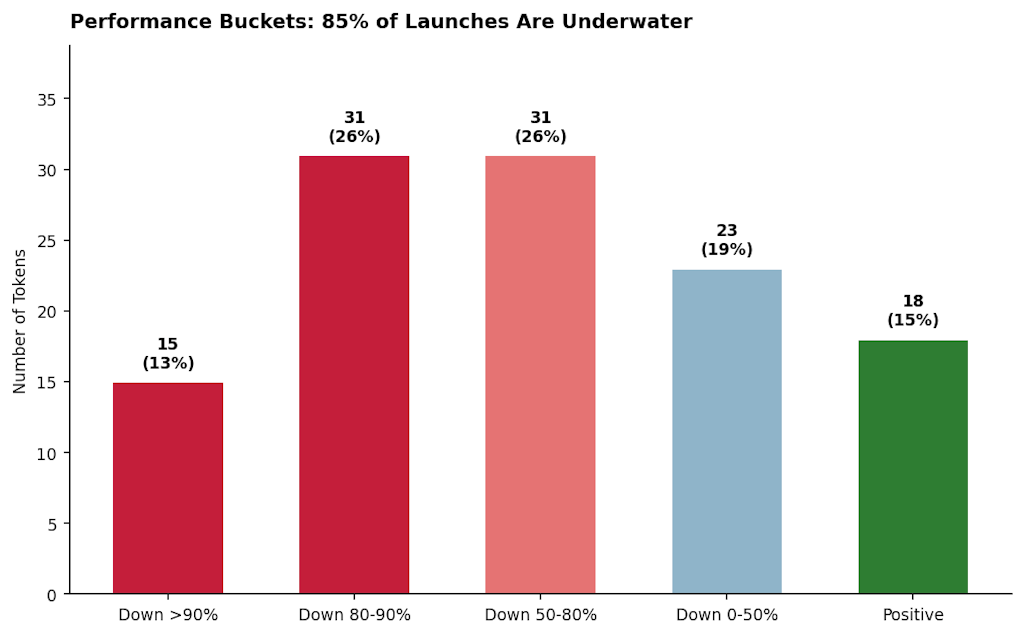
An analysis of 117 distinct tokens launched in 2025 demonstrates that returns have been overwhelmingly negative. The median token from this cohort is currently trading down roughly 71 percent compared to its fully diluted valuation at the time of listing. Out of the 117 projects evaluated, a mere 17 tokens—representing just 15 percent of the total sample—are currently trading above their initial launch valuations. Furthermore, approximately 40 percent of the tokens issued this year have suffered severe drawdowns exceeding 80 percent from their listing prices.
The breadth and severity of the downside pressure are striking. A full 100 out of the 117 tokens, or 85 percent of the cohort, are currently underwater. The distribution of these losses clusters most heavily in the 50 to 90 percent drawdown range, which accounts for the largest share of 2025 listings. At the extreme tail of this distribution, 15 tokens have experienced catastrophic declines of more than 90 percent. This group of severe laggards includes several high-profile launches that generated substantial industry hype earlier in the year, such as Berachain, which fell 93 percent; Animecoin, which dropped 94 percent; and Bio Protocol, which declined by 93 percent.
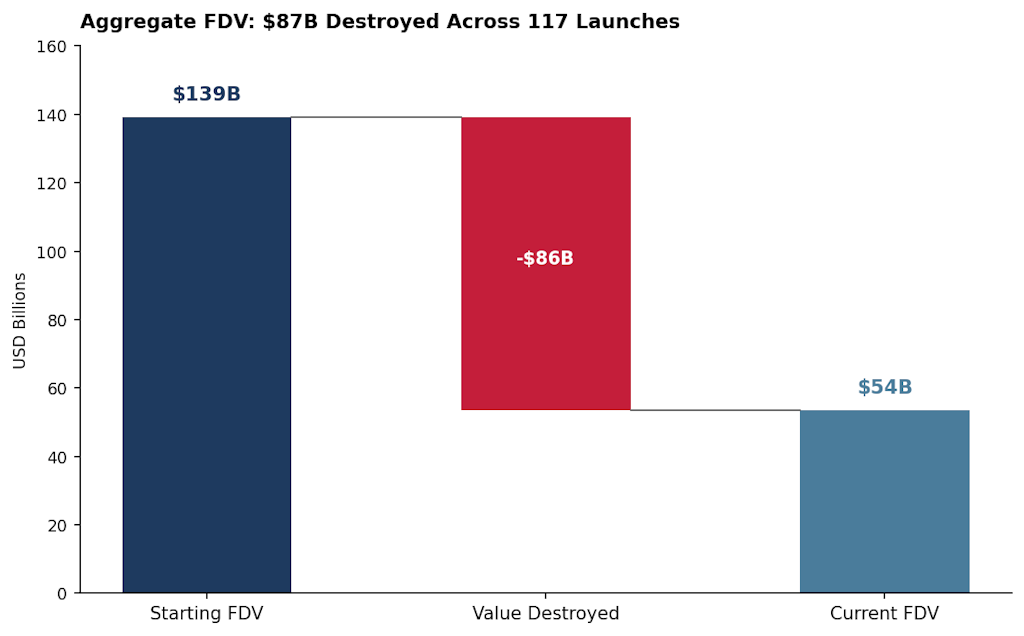
In aggregate, the financial impact of this market correction is staggering. The total fully diluted valuation of the entire 2025 token cohort has compressed dramatically from $139 billion at their respective initial listings down to $54 billion. This represents an estimated $87 billion, or 59 percent, in paper fully diluted valuation destruction across the group, a figure that excludes projects that have effectively seen their token values drop to zero.
Despite the pervasive weakness across the broader cohort, there remains a distinct dispersion of returns, particularly among outliers on the positive side of the ledger. The worst-performing assets heavily skew toward infrastructure and gaming initiatives, with projects like Syndicate and Animecoin leading the downward trajectory with losses exceeding 93 percent. Conversely, the standout winners tend to be late-stage projects that launched during the second half of the year with more modest, realistic starting valuations. These resilient performers include Aster, which gained 745 percent; Yooldo Games, which rose 538 percent; and Humanity, which secured a 323 percent increase from its initial market debut.





Comments (0)