



The era of consecutive, explosive double-digit price surges for Bitcoin may be a thing of the past, as a more mature market driven by Wall Street traders and profit-taking whales fundamentally reshapes the cryptocurrency landscape. According to Markus Thielen, the founder of 10x Research and author of the industry history Crypto Titans, the modern market behaves vastly differently from the volatile cycles of the past.
Appearing on the latest episode of Cointelegraph’s Trade Secrets podcast, Thielen explained that institutional participants systematically selling call options following market rallies have effectively capped Bitcoin’s traditional, violent price explosions. As financial professionals increasingly integrate crypto assets into sophisticated derivatives strategies, the mechanics of how Bitcoin rallies and consolidates have shifted significantly.
Reflecting on his research for Crypto Titans, Thielen noted a recurring pattern across successive crypto market cycles: each generation brings a distinct class of promoters, and those promoters invariably attract a different breed of investor. In the early days, retail advocates and tech enthusiasts drove adoption. Today, the new wave of promoters hails directly from Wall Street, bringing traditional financial metrics, macroeconomic sensitivity, and a heavy reliance on central bank policy decisions into the ecosystem.
Because of this institutional influence, Thielen expects future price action to unfold in distinct phases. Bitcoin is likely to experience rapid, news-driven upward spikes, followed by extended periods of sideways movement—colloquially known as "crab walking"—across the charts as the market awaits the next major macroeconomic catalyst.
Who’s Really Buying Bitcoin?
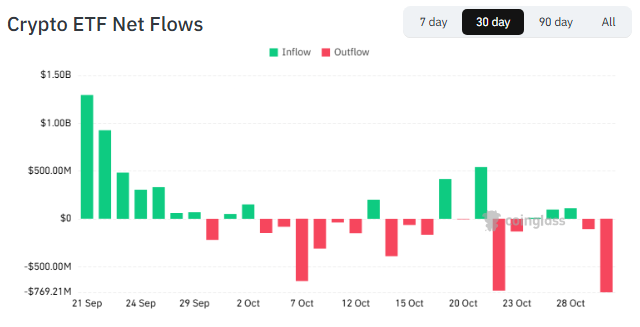
A closer examination of the underlying capital flowing into the ecosystem reveals that retail enthusiasm is only part of the story. Thielen estimates that market makers account for as much as half of the massive $60 billion in net spot Bitcoin ETF inflows he has analyzed. Rather than making outright, directional bets on Bitcoin’s long-term appreciation, these institutional firms frequently hold ETF shares as a necessary hedge for their complex options trading desks.
"So in the end it was not outright buying," Thielen observed, pointing to insights drawn from a meticulous review of Form 13F filings, which publicly disclose the quarterly securities holdings of major investment managers.

Despite the heavy presence of hedging strategies, the early wave of exchange-traded fund adoption also captured significant retail capital flowing through institutional wrappers and corporate vehicles, with some investors even willing to pay substantial premiums over the net asset value of the underlying crypto holdings. Looking ahead, Thielen remains optimistic about future pools of capital entering the space. He believes that true long-term institutional allocators, including major sovereign wealth funds, have yet to make their definitive moves into the asset class.
Bitcoin Could Reach $90,000 by Year-End
Even with the damping effect of Wall Street options strategies, Thielen maintains a constructive longer-term price outlook, forecasting that Bitcoin could climb to $90,000 by the conclusion of the year. However, he cautions that a temporary retracement into the mid-to-high $70,000 range could materialize first.
Recent market action has already tested those lower levels. Bitcoin recently slid to approximately $76,100 following a major security breach involving a Binance-linked wallet that suffered a potential $6.3 billion exploit. According to data from Coinglass, these market pressures contributed to a 7.3% monthly decline for BTC.
Thielen draws a parallel between the current market sentiment and the conditions observed in early 2023, when Bitcoin rebounded from roughly $20,000 to $30,000. Just as it did back then, widespread doubt continues to linger as skeptical investors anxiously scan the order books for deeper price pullbacks and more attractive entry points. "I think everybody sort of missed it," Thielen noted. "So everybody wants to buy again."
A potential return to the $90,000 threshold will likely depend heavily on the trajectory of global monetary policy, specifically how much further the United States Federal Reserve chooses to push borrowing costs. The central bank raised its benchmark interest rate by a quarter of a percentage point in September, bringing the target range to between 3.75% and 4%.
During a subsequent meeting, the Fed opted to hold interest rates steady following a split vote that saw two officials advocate for another quarter-point hike. With the official policy statement indicating that inflationary pressures remain elevated, the door remains wide open for further monetary tightening. Thielen anticipates one more rate hike before the end of the year, followed by a more cautious and measured approach to future adjustments that could ultimately clear the path for a sustained year-end rally in Bitcoin.
Ethereum Needs to Show Holders the Money
While Thielen maintains a relatively bullish posture on Bitcoin, his outlook for Ether is far more critical. He expects Bitcoin to consistently outperform Ethereum, arguing that an unbalanced portion of the financial value generated by Ethereum network activity currently leaks away to layer-2 scaling solutions rather than accruing directly to the base asset.
"I look at it more as like a valuable utility, but nobody wants to pay for it," Thielen said.
Streamlining transactions and making layer-2 networks cheaper and faster has long been a core developmental objective for the Ethereum ecosystem. However, these efficiency gains have inadvertently complicated the traditional investment thesis for ETH. Ethereum’s tokenomic model involves burning a portion of the base transaction fees paid by users, effectively removing those coins from active circulation. When network activity is high and the total amount burned exceeds the issuance of new ETH to validators, the overall circulating supply decreases. When transaction fees are driven down significantly, however, less ETH is destroyed, slowing down the deflationary mechanism.
Thielen, who notes he has maintained a bearish perspective on Ether for over a year, likens the leading smart-contract platform to a public highway system. "Everybody wants the highway to be empty so you can go fast, and the roads need to be super, super clean and fixed and everything, but nobody wants to pay for it," he explained.
As a contrasting example, he pointed to decentralized platforms like Hyperliquid, where native trading activity generates tangible revenue that directly supports token demand. On that perpetuals exchange, the assistance fund actively converts accumulated trading fees into native HYPE tokens, which are subsequently burned to reduce supply. For Ethereum to regain broader favor among institutional investors, Thielen believes the network must establish a much stronger and more direct economic link between overall utility and the financial returns delivered to long-term token holders.





Comments (0)