


The cryptocurrency ecosystem faced a tense series of hours following a major security breach involving Binance, which prompted swift, coordinated interventions from major stablecoin issuers, decentralized finance (DeFi) protocols, and blockchain analytics firms. As the situation rapidly unfolded, industry leaders moved aggressively to trace suspicious outflows, block transactions, and safeguard user funds across multiple blockchain networks.
Binance Investigates $5.8 Billion Security Breach
The crisis began to unfold when blockchain researcher Spreek flagged suspicious activity on social media platform X. According to the initial posts, assets originating from a Binance-linked Ethereum wallet were funneled into a newly created address via a contract call allegedly funded through the privacy-focused tool Tornado Cash. Shortly after these initial transfers, security trackers noted that wallets connected to the movement had begun offloading Tether USDt (USDT) through various decentralized exchanges.
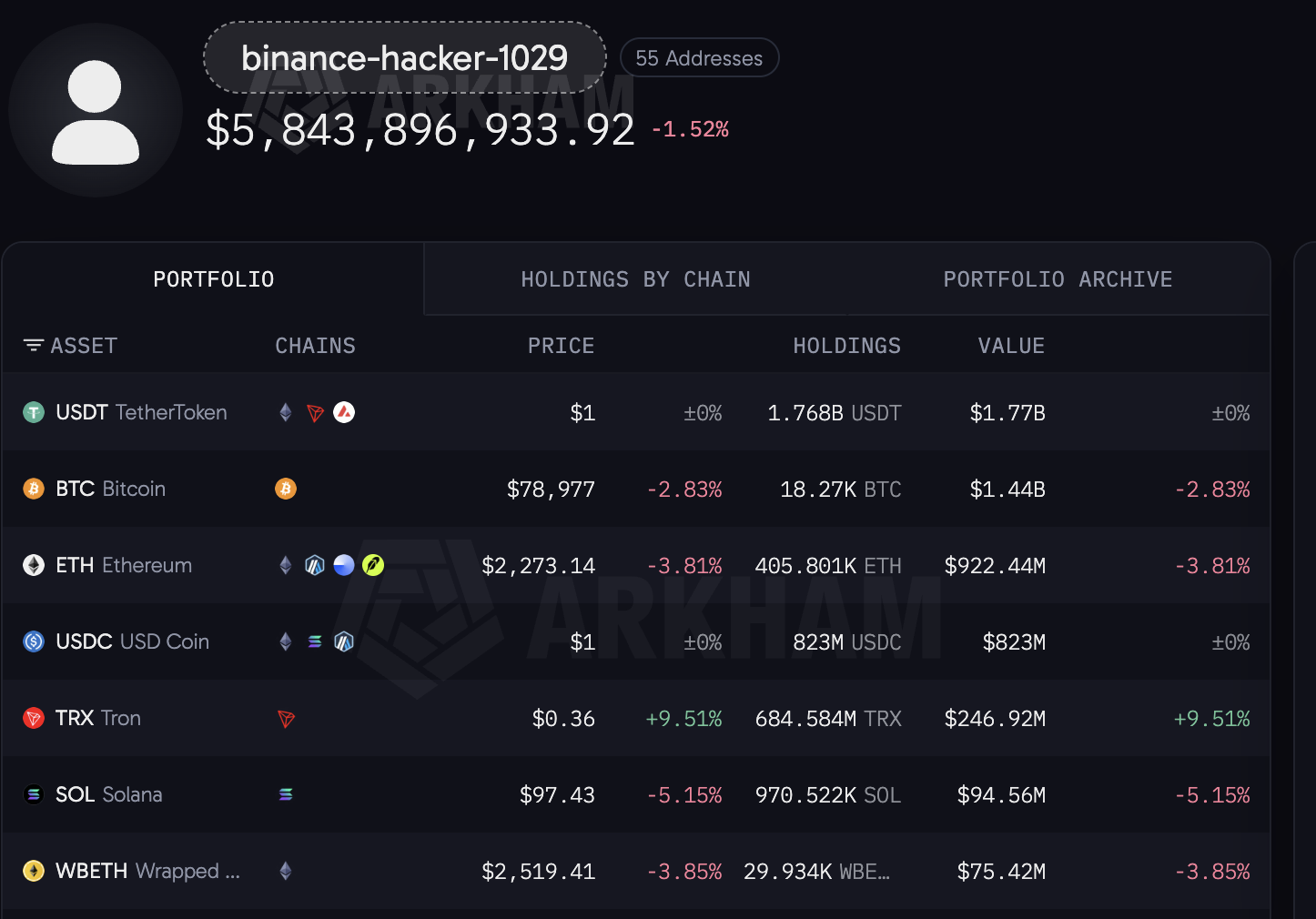
Blockchain analytics platform Arkham Intelligence subsequently identified a cluster of wallets labeled "binance-hacker-1029," which held roughly $5.84 billion in digital assets. While this massive figure represented the total reported holdings within those specific addresses rather than a definitive, finalized estimate of the stolen funds, it immediately alarmed the broader crypto market.
Blockaid, a prominent blockchain security firm, reported that its analytical teams had identified approximately $3.3 billion in suspicious transfers tied to Binance-linked wallets spanning across Ethereum, Arbitrum, and Avalanche. Binance co-founder Changpeng Zhao later acknowledged that the abnormal activity strongly resembled a coordinated hack. He noted that major stablecoin issuers Tether and Circle had already moved to freeze approximately $971 million and $823 million, respectively, while expressing confidence that all user funds would ultimately be fully covered.
A Binance spokesperson confirmed that the exchange’s security teams were actively reviewing the situation and collaborating closely with law enforcement agencies, industry partners, and intelligence firms to trace the illicit movements. Although the exact vector and total impact on user balances continued to be evaluated, the exchange committed to providing transparent updates as verified information became available.
Tether and Circle Freeze Over $2.36 Billion as Outflows Reached $3.3 Billion
In response to the sudden and massive outflow of funds, Tether and Circle—the market’s dominant stablecoin issuers—acted rapidly to stanch the bleeding. Within a remarkably short window following the first signs of the exploit, the two companies announced a combined freeze of more than $2.36 billion in digital assets connected to the suspicious transactions.
Circle CEO Jeremy Allaire confirmed that his company had successfully frozen more than $800 million in USD Coin (USDC). Allaire emphasized that the freeze was executed in direct coordination with law enforcement authorities as part of ongoing efforts to neutralize the threat and prevent the bad actors from liquidating the stolen capital.
Moments later, Tether CEO Paolo Ardoino announced that Tether had frozen over $1.567 billion in USDT linked to the unfolding exploit. Highlighting the cooperative nature of the emergency response, Ardoino stated on X that protecting the broader cryptocurrency industry and its foundational partners remained the company’s utmost priority.
The emergency actions taken by Tether and Circle coincided with broader market turbulence. Just hours prior to the Binance security incident, prediction market platform Polymarket was forced to temporarily suspend trading after a third-party provider suffered a compromise. Polymarket quickly restored its infrastructure, pledged to reimburse affected users, and confirmed that all platform systems had returned to normal operational status.
Aave Freezes v3 and v4 Lending Markets
As the stolen assets moved through the decentralized finance ecosystem, DeFi protocols were forced to take defensive measures. Decentralized lending giant Aave temporarily froze specific lending markets on its platform after malicious actors attempted to leverage the stolen capital within the protocol’s infrastructure.
According to Odysseus, the founder of Phylax Systems, a wallet linked to the ongoing hack had deposited 60 million USDT into Aave and subsequently borrowed 19,762 ETH. In response to the high-risk activity, Aave instituted emergency safeguards. A platform notice informed users that certain assets had been temporarily frozen or paused following decisions made by the Aave community governance structure.
The protocol clarified that while the freeze effectively halted further supplying, borrowing, or rate-swaps for the targeted assets, regular user withdrawals and debt repayments remained fully accessible. This measured approach allowed legitimate market participants to manage their positions while insulating the protocol from further systemic exposure to the compromised funds.
World Liberty Financial Freezes $27 Million in USD1
The containment effort extended to newer market participants as well. World Liberty Financial intervened to freeze $27 million worth of its US-dollar-pegged stablecoin, USD1, alongside $2 million in WLFI tokens, according to statements from Binance co-founder Yi He.
Zach Witkoff, co-founder and CEO of World Liberty Financial, detailed the proactive measures taken by the project. He confirmed that USD1 operators had successfully frozen the $27 million associated with the Binance hack through direct collaboration with digital asset custodian BitGo.
In an official statement published on X, World Liberty Financial reiterated its dedication to platform security and industry integrity. The project affirmed that it would cooperate fully with ongoing law enforcement investigations and support all collaborative efforts to hold the perpetrators accountable, emphasizing that protecting users remains the primary objective for the protocol.
Binance Says $2.54 Billion Frozen After Hack
As the investigation progressed into late October 29, Binance provided a comprehensive update regarding the total volume of neutralized assets. The exchange formally announced that the verified total of assets frozen across various networks and issuers in connection with the security breach had reached $2.54 billion.
The update was intended to bring clarity to the market amid a flurry of conflicting figures that had circulated publicly throughout the day, including earlier estimates referencing $1.8 billion. Binance noted that this frozen total was expected to rise further as its security teams continued working hand-in-hand with law enforcement agencies, token issuers, blockchain intelligence firms, and industry partners to track down and lock remaining accounts holding illicit funds. The exchange pledged to issue subsequent verification reports as new tranches of assets are officially secured.
Ripple Forces RLUSD Linked to Binance Hack
The cascading series of defensive freezes ultimately reached Ripple Labs. Jack McDonald, Ripple’s senior vice president of stablecoins, announced that the company was actively freezing holdings of its proprietary dollar-pegged stablecoin, RLUSD, that had been linked to the Binance hack.
McDonald stated that Ripple was actively intervening to freeze the affected funds while coordinating closely with relevant stakeholders to support the broader industry investigation. Although McDonald did not publicly disclose the exact monetary amount of RLUSD that had been frozen due to the ongoing nature of the probe, the move underscored the unprecedented, cross-industry level of cooperation mobilized to neutralize the exploit and deny the hackers access to their ill-gotten gains.





Comments (0)