



Tampered Ledger wallets cost Singapore users $2.7M: Police
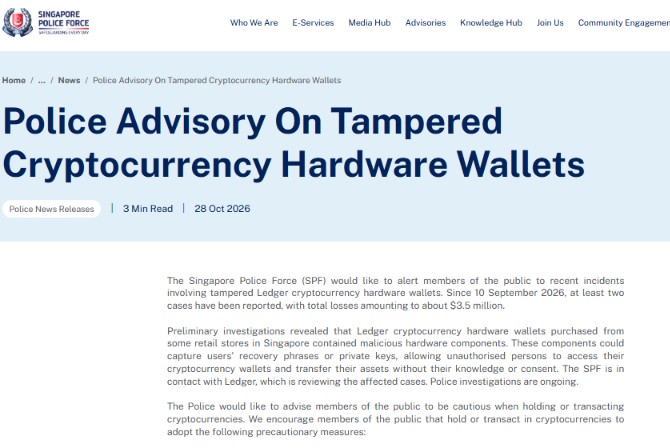
Singapore police have revealed that at least two separate cases involving tampered Ledger hardware wallets have been reported within the city-state since September 10, resulting in combined financial losses of approximately 3.5 million Singapore dollars, which translates to roughly $2.7 million. This disclosure places the first local report of the compromise almost a month before the broader supply chain security incident became public knowledge on an international scale.
The timeline released by authorities leaves several questions unanswered. It remains unclear from the October 28 consumer alert whether the initial September 10 case was reported to the Singapore Police Force at the exact time it occurred or if it was filed retrospectively. Should the report have been made in a timely manner, critical questions arise regarding whether hardware wallet manufacturer Ledger was immediately notified, or if law enforcement agencies were in a structural position to issue a public warning to investors at an earlier date. Nevertheless, the advisory issued on October 28 strongly suggested that the ongoing police investigation remained in its preliminary stages as authorities work to uncover the full scope of the compromise.
The localized reports in Singapore precede a wider global advisory issued by Ledger on October 9, which warned consumers that compromised Ledger devices had been systematically introduced into the CryptoBilis supply chain. The scale of the global security breach was substantial, with nearly $100 million reportedly drained from user wallets containing malicious spyware components embedded in the physical devices.
In response to the escalating crisis, Ledger announced on October 13 that it had formally requested electronics retailers and authorized distributors across Indonesia, Singapore, Thailand, the Philippines, Vietnam, Malaysia, and Hong Kong to temporarily suspend the retail sales of all Ledger hardware devices while comprehensive forensic investigations are conducted across the distribution network.
Malaysia, Thailand join Singapore’s cross-border stablecoin push
Regulatory cooperation in Southeast Asia took a significant step forward on Friday as Bank Negara Malaysia and the Bank of Thailand officially joined Singapore’s BLOOM initiative as policymaker members.
The collaborative program, officially known by its acronym BLOOM—standing for Borderless, Liquid, Open, Online, Multi-currency—operates as a public-private partnership designed to assist traditional financial institutions in integrating stablecoins and tokenized commercial bank deposits into mainstream cross-border payment architectures. Originally launched by the Monetary Authority of Singapore in October of last year, the initiative has steadily expanded its membership roster, which currently features major global financial and technology heavyweights including Airwallex, Mastercard, Ripple, Visa, and the World Bank Group.
DBS survey finds lots of corporate interest in tokenized money
Reinforcing the momentum behind digital asset adoption in corporate finance, a comprehensive survey published by Singapore-based bank DBS found that nearly 90% of the 422 global businesses surveyed are either actively adopting or expressing significant commercial interest in adopting tokenized cash solutions to accelerate cross-border and domestic payment cycles.
SOUTH KOREA
Groundhog Day as Korean lawmakers consider fourth delay of crypto tax
Government officials in South Korea are reportedly weighing yet another postponement of the nation’s controversial cryptocurrency taxation policy, which is currently scheduled to be officially implemented in January 2027.

According to a Monday report from domestic news outlet Newsis, the implementation of the anticipated crypto income tax could potentially be pushed back to 2029. This prospective delay is driven in part by technical and administrative timelines, as 2027 marks the earliest operational window in which regulatory officials will be fully prepared to seamlessly share bilateral information concerning digital asset exchange transactions with United States tax authorities.
The legislative framework in question would establish a flat 22% tax levy on cryptocurrency trading gains for individual investors whose annual profits exceed 2.5 million Korean won, equivalent to approximately $1,883.
Bithumb and two other firms report data breaches
Compounding regulatory headaches in the region, major domestic crypto exchange Bithumb publicly reported that its in-house mobile administrative system had been compromised by malicious actors, leading to an unauthorized leak of sensitive personal user information. Simultaneously, prominent brokerage firm Daishin Securities disclosed that approximately 38,000 customer records had been exposed in a separate cyber incident, while asset manager Mirae Asset Global Investments also confirmed a distinct network intrusion.
South Korea to regulate stablecoins as payment means, and require monthly balance reporting for cross border transfers
Amid these security developments, the South Korean government and the Bank of Korea are moving swiftly to draft comprehensive amendments to the Foreign Exchange Transactions Act before the conclusion of the year. These legislative changes aim to formally regulate stablecoins when utilized as consumer and commercial payment instruments. Furthermore, starting December 2, the central bank will mandate that all cryptocurrency transfer service providers submit detailed monthly reports concerning outgoing capital flows. These reporting obligations will retroactively extend back to mid-2024 to provide regulators with precise tracking on individuals moving capital out of the country.
NORTH KOREA
Chainalysis traces North Korean crypto cash-outs through Garantex
Blockchain analytics firm Chainalysis has successfully mapped out an extensive and long-running network of Russian financial intermediaries that allegedly facilitated the liquidation of millions of dollars in stolen cryptocurrency by North Korean IT workers operating abroad.
The investigative findings coincided with an enforcement action by the United States Treasury Department’s Office of Foreign Assets Control (OFAC), which announced sanctions on Wednesday targeting 10 individuals and one corporate entity. According to the official Treasury press release, the sanctioned parties were accused of directly supporting state-sponsored North Korean IT worker schemes designed to clandestinely generate revenue for the regime’s advanced weapons programs. Among the specific individuals designated in the sanctions package were Russian nationals Ilya Aleksandrovich Boykov and Vitold Viktorovich Obertas.
HONG KONG
Hong Kong names Nasdaq-listed Solana Company a strategic enterprise
The government of Hong Kong has officially designated Nasdaq-listed Solana Company under the ticker HSDT as a strategic enterprise, forming part of a broader municipal program specifically engineered to attract high-tech international businesses that support the territory’s long-term economic diversification.
Solana Company announced on Thursday that it was selected as part of the seventh cohort of enterprises vetted by Hong Kong’s Office for Attracting Strategic Enterprises, making it the sole blockchain infrastructure enterprise onboarded by the government office throughout the year 2026. The official government confirmation last week brought the total number of corporate participants in the strategic enterprise development scheme to 142.
China uses Hong Kong as a launchpad for the Digital Yuan
Reflecting deepening financial integration between the mainland and the special administrative region, the South China Morning Post reported that Beijing is actively utilizing Hong Kong as an international testing ground and primary launchpad to foster broader global adoption and transactional use of the digital yuan.
RedotPay plans a US IPO
In the commercial payments sector, Hong Kong-based cryptocurrency payments unicorn RedotPay is preparing to launch an initial public offering in the United States before the end of the year. The company has reportedly initiated a pre-existing funding round that values the fintech enterprise at approximately $4 billion.
CHINA
China targets 2030 for its national blockchain network buildout
The government of China has established an ambitious target year of 2030 to largely complete the construction and deployment of its unified national blockchain network, as outlined within a comprehensive five-year digital development plan published on Friday.
The newly released strategic roadmap explicitly calls for the establishment of stricter domestic blockchain technical standards while accelerating the application of distributed ledger technology across industrial data circulation and digital asset trading frameworks. While mainland China maintains a strict statutory ban on commercial cryptocurrency trading and related speculative business activities, it continues to aggressively promote foundational blockchain technology as a top-tier national development priority. Industry critics, however, have frequently argued that separating blockchain utility from native cryptocurrency incentives has historically faced significant structural hurdles.
THAILAND
Supreme Court recognizes Bitcoin as legal property
In a landmark legal development, Thailand’s Supreme Court has formally ruled that Bitcoin qualifies legally as property under the country’s criminal law framework. This judicial decision establishes a definitive domestic precedent that is widely expected to influence how Thai courts evaluate digital assets in future legal disputes. The ruling was handed down while the high court upheld a 10-year prison sentence in a severe robbery case that involved approximately $50,000 worth of Bitcoin.
Thailand launches crypto wallet for tourists
Seeking to capture value from international visitors, Thailand has rolled out a specialized digital consumer application named the WORPT digital wallet. The software allows foreign tourists to seamlessly convert stablecoins such as USDT or USDC into Thai baht to spend domestically via PromptPay QR code merchants. The rollout operates directly under the regulatory parameters of the nation’s Tourist DigiPay sandbox program.





Comments (0)