


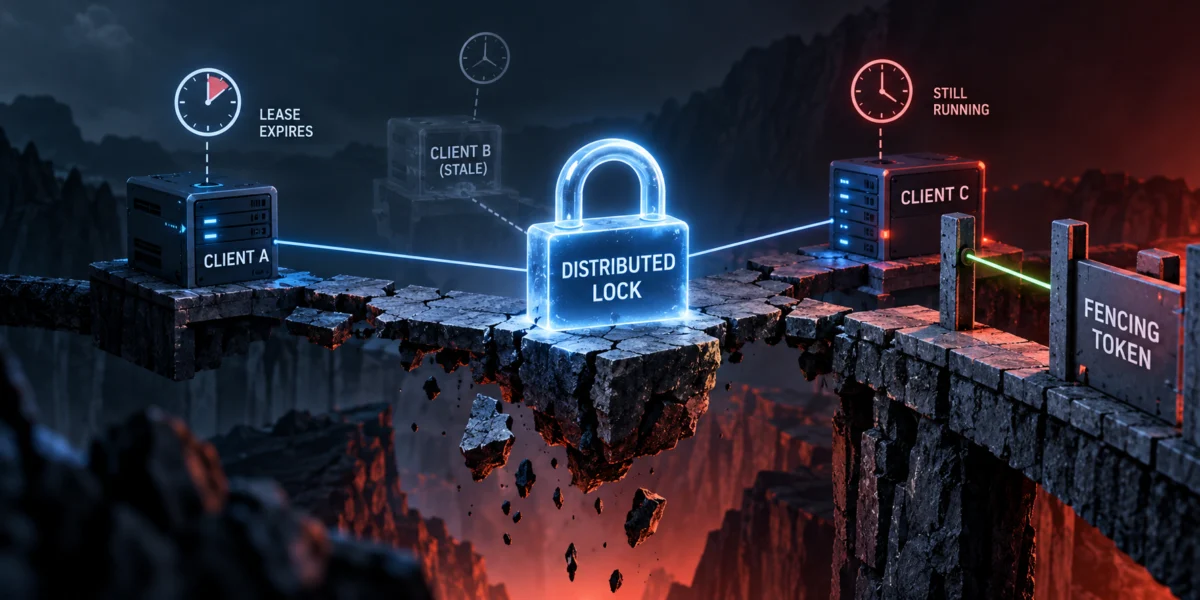
In modern systems architecture, engineers frequently reach for familiar mental models when designing large-scale distributed systems. Among the most dangerous of these cognitive shortcuts is the assumption that a distributed lock is simply the network-scale equivalent of a local mutex. They look deceptively similar at first glance: a process acquires the lock, performs a critical operation, and then releases it. But beneath that familiar veneer lies a fundamental architectural deception. A distributed lock is not a bigger mutex; it is an entirely different entity wearing the same costume, and that costume is what ultimately causes catastrophic system failures.
While a local mutex lives comfortably inside a single failure domain, a distributed lock spans complex processes, asynchronous networks, shifting clocks, and fragmented storage layers, complete with failure detectors that can fundamentally disagree with one another. A distributed lock service may correctly decide that ownership has changed while the previous holder is still running, temporarily paused, caught in a network partition, or quietly carrying delayed requests. The central, unforgiving question in distributed systems is whether an obsolete client can still produce side effects and alter state after its authority has officially ended. Software architect Martin Kleppmann famously framed this critical divide as the distinction between locks used strictly for efficiency versus locks used for true correctness. In efficiency scenarios, a duplicate execution represents wasted computational work. In correctness scenarios, however, duplicate execution results in outright data corruption.
A Lock Is Not a Critical Section
Consider a typical lease-backed lock wrapping around a database reconciliation job in a microservices environment. A service attempts to acquire a lease for a specific order identifier with a predefined time-to-live, executes the reconciliation routine within a try-finally block, and releases the lease upon completion. On paper, the code appears entirely reasonable and locally sound. Yet, in a distributed environment, it is globally unsafe.
Suppose a worker process pauses for an extended period—say, 30 seconds—immediately after acquiring the lease. This pause could be triggered by a garbage collection stop-the-world event, severe CPU starvation, memory paging, or an external system signal. During this pause, the lease naturally expires, another worker steps in and acquires the lock to perform the same task, and the original, paused process eventually resumes execution. Crucially, nothing inside the resumed process validates or proves that its operational authority still exists.
A delayed network request can trigger the exact same failure mode even if the underlying process never pauses for a single millisecond. Checking the validity of a lease immediately before executing a write operation fails to close the race condition, because execution can easily pause in the microsecond gap between the check and the actual write. Kleppmann highlights this stale holder problem to demonstrate why even a mathematically flawless lock service does not automatically make the access to protected resources safe.
Coordination systems frequently provide strong ownership semantics while failing to control the actual resource that matters to the business. Prominent coordination recipes, such as Apache etcd tying lock ownership to an active lease or Apache Zookeeper using ephemeral sequential znodes to grant locks based on sequence numbers, establish strict authority exclusively within the boundaries of the coordinator itself. They do absolutely nothing to prevent an old, disconnected process from writing data to an external database or storage bucket long after its ownership has been revoked or transferred.
Leases Trade Deadlock for Stale Ownership
Leases were originally introduced to solve a severe liveness problem inherent to permanent locks: a crashed owner could otherwise block system progress indefinitely. Introducing time-bounded authority allows another participant to eventually proceed after an expiration window lapses. However, this architectural trade-off means that time itself suddenly becomes an active and fragile part of the safety argument.
Distributed coordination tools navigate this time dependency in various ways. Redis Redlock, for instance, computes a remaining validity window derived from the elapsed acquisition time, assuming that local clocks progress at roughly the same rate with bounded drift relative to the time-to-live parameter. However, official Redis documentation explicitly warns that TTL expiration does not rely on a monotonic clock, meaning unexpected shifts in the system wall clock can quietly compromise consistency.
Similarly, Consul documents its session TTL as a lower bound for invalidation, noting that expiration will not occur before the TTL elapses, but it may occur considerably later depending on network conditions and clock skew. More fundamentally, Consul notes that failure detection mechanisms can easily produce false positives, mistakenly releasing a lock while the original owner is still healthy and operational. Disabling those aggressive checks improves safety at the expense of system liveness, while faster failure detection improves progress but dramatically raises the risk of overlapping authority windows.
Extending a lease via periodic renewal reduces the mathematical probability of expiration during a long-running operation, but it fundamentally cannot make unpredictable networks timely or process pauses bounded. Modern Redis guidelines now explicitly state that lock retention must never be assumed merely because the owning process is still alive, strongly recommending the use of explicit fencing tokens for any work that runs over an extended duration.
Fencing Moves Safety to the Resource
To solve the inherent dangers of stale ownership, engineers utilize a fencing token—a monotonically increasing value issued by the coordination service whenever ownership changes hands. Every single protected operation must carry this token. The downstream resource, such as a relational database, remembers the highest token it has ever successfully accepted and aggressively rejects any incoming request carrying an older, superseded value.
This architectural pattern cleverly converts an impossible timing problem into a manageable ordering problem. If a stale process resumes or an old remote procedure call arrives late due to network jitter, neither one can overwrite system state once a newer owner has already advanced the fence. The essential validation logic belongs directly at the write boundary, rather than relying solely on the lock client behaving correctly.
A database can perform this comparison and the subsequent state change atomically, ensuring that a request carrying an older token cannot modify a data row after a newer token has been committed. The token must be strictly ordered, durable, and scoped specifically to the protected resource, and it must never be casually reset when the underlying coordinator restarts. While a random lock identifier is useful for safely releasing a lock without accidentally deleting another client’s resource, it is not a fence, because randomness establishes raw identity rather than sequential order.
Several major coordination platforms expose native building blocks for this pattern. Consul increments a LockIndex upon acquisition, providing a triad of keys, indices, and sessions that can identify stale requests. ZooKeeper sequential nodes provide monotonically increasing suffixes, while etcd exposes creation revisions for leadership elections that support transactionally verifying that leadership is still current. The critical property is never which coordinator an engineering team selects, but rather whether the downstream resource actually enforces the ordering information.
Failure Modes Survive Correct Acquisition
Even when a distributed lock is acquired with absolute correctness, dangerous failure modes can still emerge. A network partition can easily prevent lease renewal while leaving the application thread’s access to the protected database entirely intact. A lock server can experience a failover event while an application thread remains paused. A simple retry mechanism can inadvertently duplicate a side effect that was never truly idempotent to begin with.
Furthermore, a fencing token can be generated perfectly by a coordinator and then subsequently ignored by a poorly implemented write path. It can be compared without atomicity, stored only in volatile memory, reused improperly after a system restore, or scoped to the wrong logical entity altogether. These represent fundamental protocol failures rather than bugs in the underlying lock library. Consul explicitly documents the advisory nature of its locks, noting that acquiring a lock does not inherently stop external clients from reading or writing the underlying key data without ownership.
Certain operations, such as delivering emails, interacting with third-party APIs, or communicating with legacy hardware, cannot naturally enforce fencing tokens because they do not expose conditional operations that reject lower sequence numbers. In these scenarios, the burden of correctness must shift entirely to boundaries capable of rejecting duplicates, such as idempotency keys or database uniqueness constraints. A distributed lock can never retroactively make an unfenceable side effect exclusive.
Comprehensive testing must therefore actively target stale authority rather than merely simulating lock contention. Useful fault injection strategies involve pausing a lock holder well beyond its TTL, partitioning the holder from the coordination service while maintaining its connection to storage, delaying writes until after ownership has been reassigned, and forcing coordinator restarts. The acceptance criterion must go beyond merely observing that only one lock owner was recorded at a time; the protected resource must actively and reliably reject effects originating from every superseded epoch.
The Lock Is Only Half the Protocol
Ultimately, distributed locks are at their safest when treated not as silver bullets, but as advisory coordination mechanisms paired with explicit effect safety protocols. While leases restore system liveness by allowing abandoned ownership to expire, that exact expiration mechanism is what gives rise to stale holders in the first place.
Consensus-backed coordinators improve authority decisions, but they remain powerless to erase a paused process or a delayed packet. Fencing tokens successfully close that critical gap only when the protected resource validates them atomically and durably. Where fencing is structurally impossible, alternative mechanisms like idempotency, transactions, or architectural redesigns must carry the correctness burden. The most dangerous distributed lock in production is never the one that occasionally fails to acquire; it is the one that reports success while obsolete authority continues to silently mutate reality.



Comments (0)