



Working in Anti-Money Laundering (AML) teaches professionals early in their careers that the two primary types of compliance mistakes carry vastly different costs. A false alert typically costs an analyst an afternoon of manual review, whereas a missed violation can result in severe regulatory findings, hefty penalties, and reputational damage. This lesson becomes starkly apparent when writing regulatory modules for banking clients or building artificial intelligence-enabled optical character recognition (OCR) and large language model (LLM) workflows for compliance review within major financial institutions like Capital One.
Deploying such workflows in production environments can successfully reduce manual review effort by roughly sixty percent. However, the majority of engineering time and operational friction does not go into the initial model setup. Instead, the real challenge lies in handling the cases where the model misreads a document, managing the downstream implications of those errors, and determining precisely what the automated system should do next.
Twenty Years of Reading Rules for a Living
Professionals working in this space often do not arrive via traditional machine learning backgrounds. Early career decades frequently involve enterprise integration and data work, including messaging systems, payment-messaging gateway migrations at major international banks, and complex AML scenario logic built on top of enterprise data marts. Years of hands-on experience in these areas reveal just how many core banking processes depend heavily on human workers reading dense documents and checking them against rigid regulatory rules.
While scaling customer-facing lending platforms and modernizing auto-lending and compliance platforms, engineering teams frequently encounter opportunities to implement OCR and LLM automation. Professionals often develop innovative approaches along the way, such as securing patents for applying artificial intelligence to external regulatory and enforcement information to spot emerging compliance risks. While reading regulatory text with machines became standard practice over the years, allowing an automated model to make the definitive call on a customer document represented a profound shift in operational risk.
Why Compliance Review Is a Hard Place for an LLM
The fundamental issue of error asymmetry breaks the standard metrics that most technical teams initially reach for. An automated system can achieve ninety-seven percent accuracy overall while still missing the critical violations that matter most to regulators, because aggregate accuracy numbers blend easy passes together with the rare, high-stakes failures that demand attention. True safety in a production environment requires tracking precision and recall on a rule-by-rule basis, treating recall on violations as a strict metric that can block a software release.
The second major hurdle is that every automated decision must remain fully explainable after the fact. Regulatory examiners can audit any cleared document from the previous year and demand to know precisely why the system cleared it. Explanations resting solely on the model’s reported confidence level will never satisfy an auditor. Organizations must be able to trace each decision directly to the exact text it relied upon and the specific system version that generated the verdict.

Furthermore, regulated companies face a distinct calendar problem that engineers frequently underestimate. Because customer documents cannot be sent to arbitrary external endpoints, model hosting, logging, and data handling must pass rigorous security and compliance reviews before anyone can test the system on real data. In many enterprise environments, this regulatory review cycle can easily take longer than building the initial technical prototype, meaning development plans that fail to account for this timeline inevitably slip.
The Prototype Everyone Builds First and Where It Breaks
Building an initial prototype often yields impressive early results during demonstrations. By selecting a dozen clean documents, developers can watch a model return sensible verdicts accompanied by eloquently written reasoning, quickly generating excitement across the room. Unfortunately, this demo-driven success hides almost every operational failure mode that will inevitably surface in production. This reality underscores why any compliance pipeline should operate in shadow mode alongside human reviewers long before it is trusted to make independent decisions.
Stronger base models do not inherently fix these structural vulnerabilities. A more advanced model cannot recover text that the optical character recognition engine failed to produce in the first place, and superior prose writing does not make an automated rationale verifiable.
Architecting for Failure and Accountability
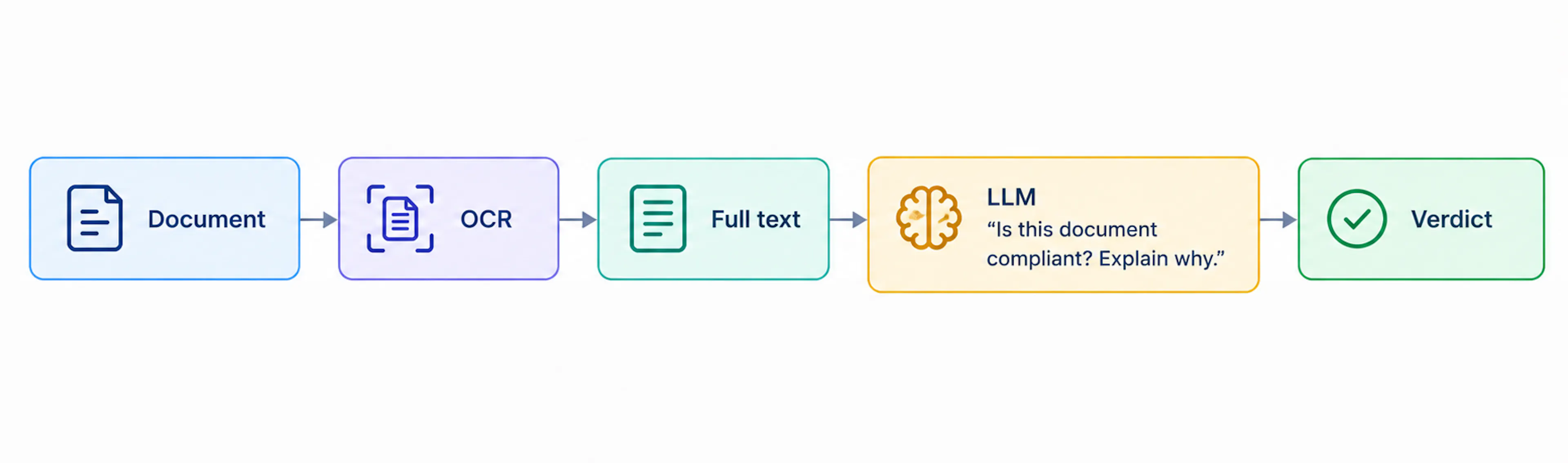
Designing a reliable production architecture requires starting with a single guiding question for every component: when this specific step fails, where does the document go? Page-by-page OCR confidence scoring is essential, as one bad page in a clean ten-page document barely moves the overall average. If any single page falls below a rigorously calibrated floor, the document must be routed to a human reviewer before the large language model ever evaluates it.
Additionally, implementing layout fingerprints built from structural features such as page counts, section headers, and the positions of key fields provides a robust safety net. Documents that fail to match any known template in the evaluation set automatically route to manual review, solving a significant portion of the long-tail problem without requiring changes to the model itself.
To maintain granular control, systems can replace broad questions of overall compliance with narrow, individual checks per rule, each returning structured output that undergoes immediate validation. Introducing an explicit "insufficient_evidence" verdict is critical. Without it, models are forced to choose between passing and failing even when documents lack the necessary information, leading them to guess with misplaced confidence. Allowing the system to declare that a document lacks enough information to decide ensures that ambiguous cases are safely routed to human professionals.
Scoping evaluations by individual rule also simplifies debugging, as misbehaving checks can be traced back to a single rule and its associated prompt. While this approach increases the total number of API calls per document, organizations can manage costs by sending each rule only the relevant section, running checks in parallel, and delegating simple field-presence rules to smaller, more efficient models.
Verification, Routing, and Human Oversight
Every automated pass or fail verdict must explicitly quote the document, and that quote must be verified against the extracted text before the finding is officially counted. Because exact string matching can be overly strict—where a minor OCR misread of a single character rejects an otherwise correct quote—systems must utilize flexible alignment and scoring windows tuned against real-world labeled examples.
Routing logic should be determined strictly by the cost of potential errors. The system should only finalize outcomes independently on low-risk documents that achieve a clean pass. Every other scenario, including low OCR confidence, unknown templates, unverified evidence, insufficient evidence, or potential violations, must be routed to human reviewers. Furthermore, giving reviewers the source document with the model’s cited evidence highlighted transforms the review interface from a tedious rubber-stamp checkpoint into an efficient verification workflow.
Collaboration with Compliance Professionals
The creation of evaluation sets must be led by compliance professionals rather than engineers. While technical teams can build the testing harness, the people legally and operationally accountable for regulatory outcomes must define what correctness means. Once compliance owns the validation labels, release conversations shift from tense negotiations over safety to constructive discussions about performance metrics.
Maintaining comprehensive audit trails is equally vital. Systems must record complete metadata for every decision, including document hashes, OCR versions, confidence scores, template fingerprints, rule set versions, model IDs, prompt versions, raw model responses, and individual findings. Storing raw model responses ensures that audits do not rely on models producing identical answers twice, while writing these records to append-only storage prevents historical tampering.
Finally, organizations must audit what nobody routinely reviews. Because unnoticed errors can accumulate within auto-cleared documents, sending a fixed percentage of them to blind human review every week provides a reliable estimate of the escaped-error rate in production—a vital metric that offline test sets cannot provide. As organizations continue to deploy artificial intelligence across customer servicing, insurance, lending, and anti-money laundering workflows, the ultimate measure of success remains focused on creating robust accountability structures around the models rather than relying on model accuracy alone.


Comments (0)