



Financial markets experienced a notable divergence in asset performance as traditional equities and digital assets reacted to a wave of macroeconomic and sector-specific catalysts. While traditional safe-haven assets and alternative markets managed to record positive momentum, major technology shares faced significant downward pressure following a disappointing quarterly earnings report from enterprise software giant Oracle. The resulting shift in investor sentiment rippled across both conventional stock exchanges and the digital asset ecosystem, highlighting the delicate interplay between macroeconomic technology trends and crypto-native market dynamics.
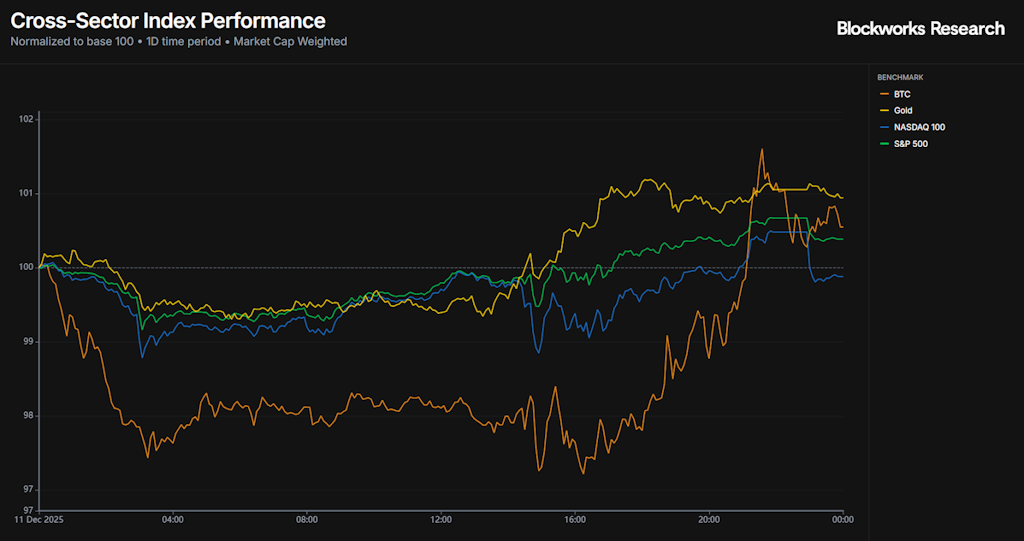
The broader market friction began when Oracle released its third-quarter financial results, revealing revenue figures that fell short of Wall Street expectations alongside higher-than-anticipated spending guidance. The unexpected miss sent Oracle shares tumbling 11% in a single session, immediately triggering a renewed wave of anxiety regarding the long-term durability and ROI of the artificial intelligence trade that has heavily propped up the equity markets over recent quarters. This sudden recalibration prompted a broader rotation out of high-flying technology equities and into more defensive or lagging corners of the traditional market. Consequently, while the tech-heavy Nasdaq slipped 0.12%, investors redirected capital toward foundational industrial names, pushing the Dow Jones Industrial Average to fresh record highs.

Across the broader traditional landscape, asset performance reflected this cautious yet opportunistic rebalancing. Gold continued its steady ascent, posting a 0.95% gain as investors sought traditional stores of value amid equity market volatility. Meanwhile, the S&P 500 managed a modest increase of 0.39%, buoyed by strength in non-tech sectors that absorbed the capital rotating out of software and semiconductor equities.
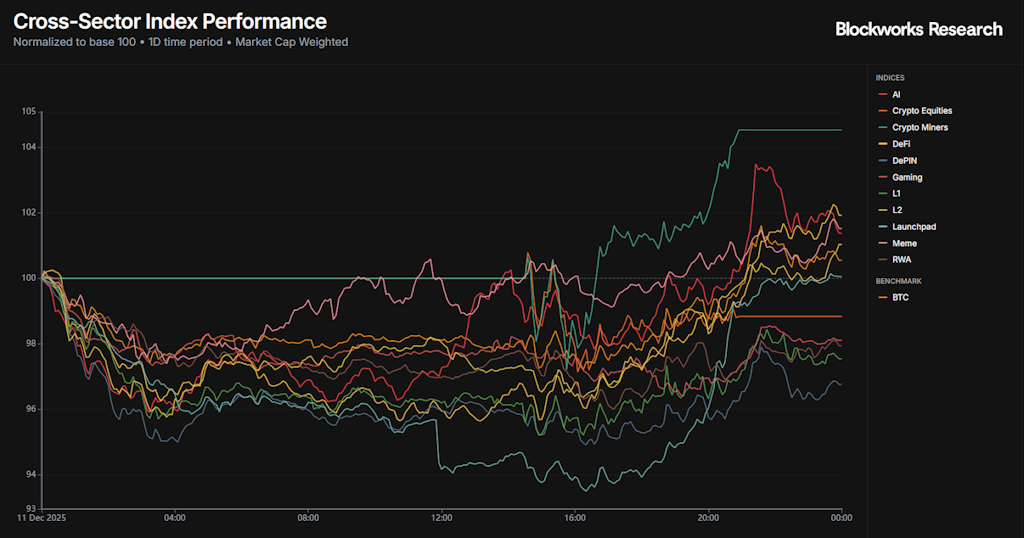
The uneven sentiment in traditional equities was closely mirrored within the digital asset economy, where crypto sector performance presented a fragmented tape rather than a unified directional move. Despite the underlying skepticism surrounding high-growth technology trades and their heavy reliance on AI infrastructure investments, crypto mining equities emerged as surprising and undeniable outperformers. The crypto mining sector surged 4.5% on the day, propelled heavily by strong individual performances such as IREN, which commands a 24% weighting in the index and recorded a robust 4.4% gain to anchor the sector’s upward momentum.
Decentralized finance protocols also demonstrated resilience against the broader macroeconomic headwinds. The DeFi sector advanced 1.93%, propelled by notable strength across major tokens including AAVE, ENA, and HYPE. Together, these three assets account for approximately 44% of the DeFi index, and their collective positive closes provided a solid foundation for the broader decentralized finance market.
However, not all segments of the digital asset ecosystem shared in the recovery. Decentralized Physical Infrastructure Networks, commonly known as DePIN, continued to experience prolonged downward pressure, sliding 3.2% over the session. The weakness in DePIN was heavily concentrated among its major constituent assets, with Filecoin (FIL) and Grass (GRASS) suffering steep declines of 6.2% and 7.2%, respectively, highlighting ongoing token-specific liquidity challenges and shifting retail interest.
In a more surprising development, Layer-1 blockchain tokens lagged significantly behind the broader market, dropping 2.5% on the day. Even as Bitcoin managed to hold onto positive territory, the majority of underlying Layer-1 assets finished the session firmly in the red. Tokens such as SEI and BERA bore the brunt of this selling pressure, each posting losses of approximately 9% as capital selectively exited various alternative base-layer networks.
Underpinning these sectoral shifts within crypto is a persistent headwind regarding institutional capital flows. After experiencing a brief resurgence characterized by a robust $346.2 million influx into spot crypto exchange-traded funds, institutional momentum faded almost as quickly as it had arrived. Yesterday’s data revealed significant net outflows across the largest digital asset investment vehicles. Bitcoin exchange-traded funds experienced net outflows of $154.2 million, while Ethereum investment products saw $42.3 million leave their respective funds.
Amidst these widespread outflows from the two largest digital assets, Solana-based investment products continued to serve as the lone bright spot in the institutional landscape. SOL ETFs maintained their steady streak of attracting capital, pulling in low single-digit to low double-digit millions in daily inflows and demonstrating a decoupled pattern of sustained institutional accumulation even as broader market sentiment turned defensive.





Comments (0)