



Diverges**

Traditional and digital asset markets experienced a notable divergence in performance as a wave of cautious sentiment washed over Wall Street, triggered by weaker-than-expected quarterly financial results from enterprise software giant Oracle. While safe-haven assets and select traditional indices managed to stay afloat, the broader technology sector faced immediate downward pressure, forcing investors to reassess valuations and rotate capital into alternative segments of both the traditional equities market and the digital asset economy.
The catalyst for the market shift unfolded when Oracle reported its third-quarter revenue figures, which fell short of consensus Wall Street expectations. Compounding the disappointment, the company also issued higher capital expenditure and spending guidance moving forward. The combined news sent Oracle shares tumbling approximately 11% during the trading session. More broadly, the miss served as a psychological blow to market participants who have spent the past several quarters heavily betting on the uninterrupted momentum of the artificial intelligence trade. Investors quickly began questioning the near-term durability and return on investment of aggressive AI spending infrastructure, prompting a swift rotation out of high-flying technology names and into lagging, value-oriented sectors of the market. This rotation ultimately propelled the Dow Jones Industrial Average to fresh record highs, even as the tech-heavy Nasdaq Composite slipped 0.12% for the day.
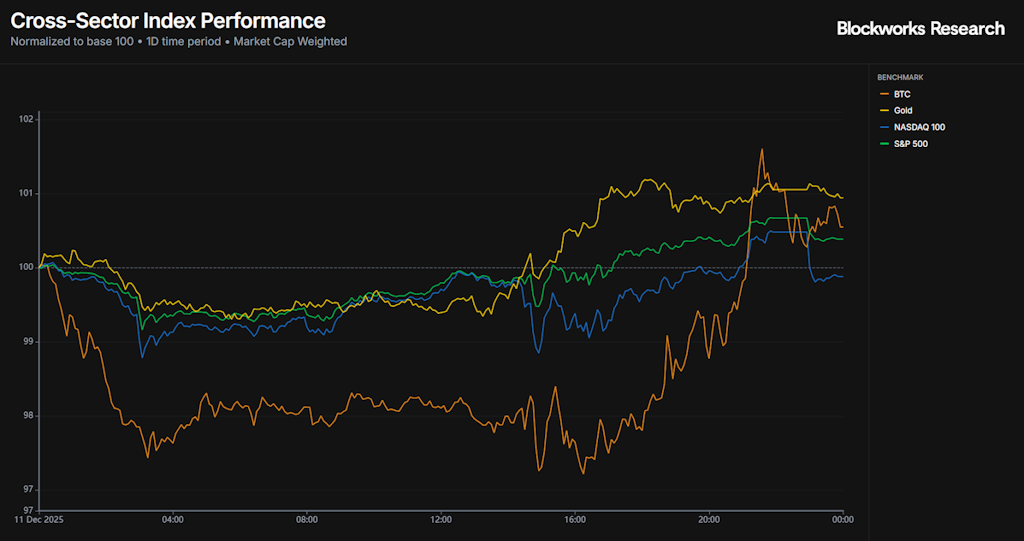
Amid this traditional market turbulence, performance across major cross-asset classes showed a similar split. Safe-haven and alternative assets posted modest gains, with gold climbing 0.95% and Bitcoin managing a 0.55% increase. The broader S&P 500 index also eked out a positive performance, gaining 0.39% as strength in non-tech sectors helped offset the drag from the technology index.
The uneven tape and shifting macro narrative quickly bled into the digital asset ecosystem, where performance varied drastically depending on the specific sector. Despite the renewed skepticism surrounding technology and AI-adjacent infrastructure, crypto mining equities emerged as the standout performers of the day within the digital asset landscape, rising an impressive 4.5% overall. This upward momentum was heavily spearheaded by IREN, a prominent player in the mining space that commands a significant 24% weighting within the index. IREN posted a robust 4.5% gain of its own, acting as a primary locomotive for the broader mining group. Decentralized finance tokens likewise demonstrated resilience, securing a 1.93% gain on the back of strong individual performances from protocol tokens such as AAVE, ENA, and HYPE. These three assets account for a substantial 44% of the DeFi index and all finished the session firmly in the green.
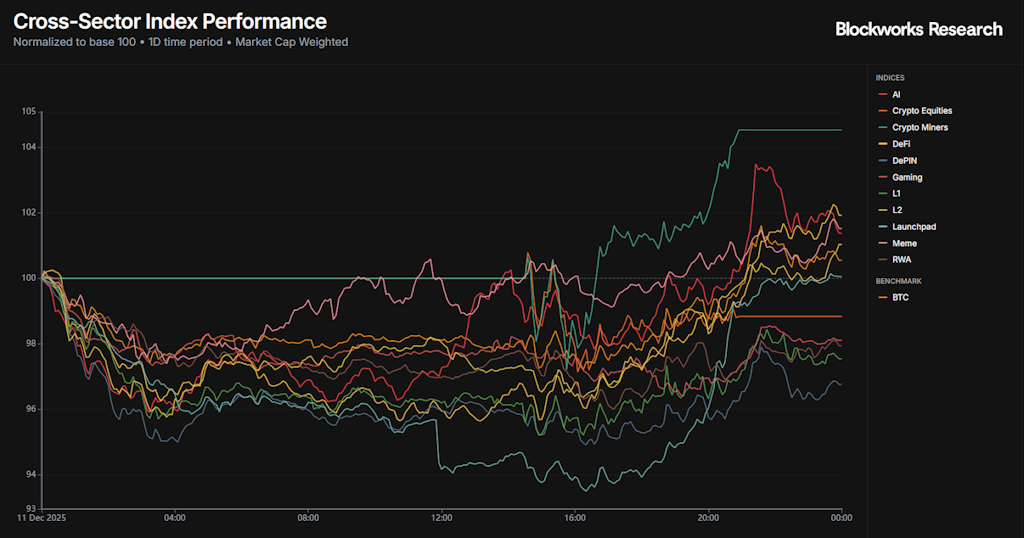
On the other end of the spectrum, decentralized physical infrastructure networks, commonly known as DePIN, continued to experience persistent downward pressure, falling 3.2% on the day. The sector was weighed down by significant pullbacks in prominent tokens like FIL and GRASS, which dropped 6.2% and 7.2%, respectively, reflecting ongoing challenges with token utility and speculative fatigue in that particular niche. Meanwhile, layer-1 blockchain protocols proved to be an unexpected laggard, shedding 2.5% across the board. Even with Bitcoin holding onto positive territory for the day, the majority of layer-1 constituents finished lower, with tokens like SEI and BERA absorbing severe losses of roughly 9% each.
Capital flows into digital asset investment products also continued to present a headwind for the market, highlighting a fragile institutional appetite. The sluggish momentum followed a brief burst of optimism on December 9, when spot crypto exchange-traded funds recorded a robust $346.2 million in net inflows. That momentum quickly evaporated the following day as institutional products reverted to net outflows. Spot bitcoin exchange-traded funds bore the brunt of the reversal, registering $154.2 million in net outflows, while spot ethereum exchange-traded funds experienced a net withdrawal of $42.3 million. The singular bright spot within the institutional ETF landscape remained Solana-based investment products, which continued to attract steady, albeit modest, inflows ranging from the low single digits to low double digits in millions of dollars daily, demonstrating a distinct pocket of sustained investor interest amidst the broader market recalibration.





Comments (0)