


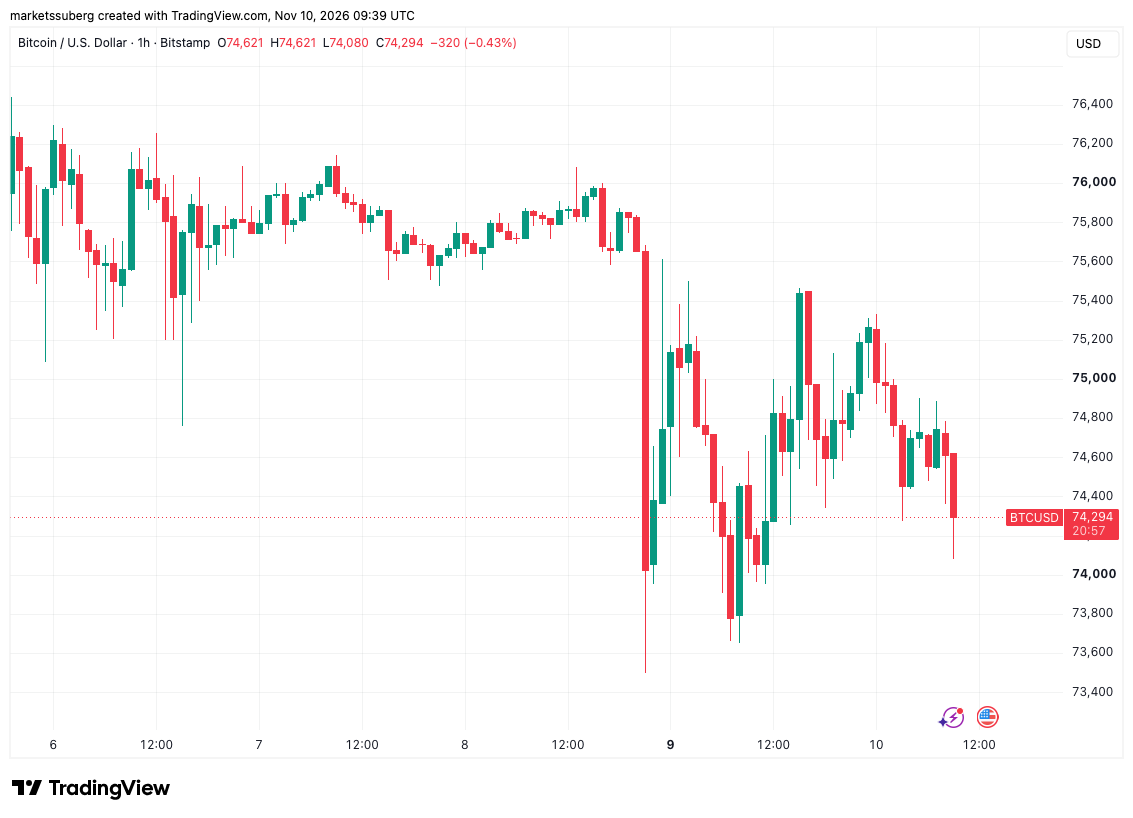
Bitcoin (BTC) pulled back toward the $74,000 threshold, while United States stock futures drifted lower as a senior Federal Reserve official voiced firm support for further tightening monetary policy by hiking interest rates before the end of the year. The macroeconomic shift sent ripples through traditional and digital asset markets alike, as investors recalibrated their expectations for upcoming central bank decisions.
Data from TradingView captured the immediate market reaction, showing the BTC/USD trading pair sliding to $74,080 on the Bitstamp exchange, marking a 1.3% decline on the day. The downward pressure in the cryptocurrency market mirrored broader macroeconomic jitters, with major US equity indices also feeling the weight of the central bank’s hawkish stance.
Waller Would Still Support December Rate Hike After Lower CPI
US stock market futures leaned lower following remarks from Federal Reserve Governor Christopher Waller, who stated that he would support hiking interest rates by 25 basis points at the upcoming meeting of the Federal Open Market Committee (FOMC) scheduled for December 9. At the time of writing, Nasdaq 100 futures were down 0.4%, reflecting a cautious mood across technology and growth stocks.
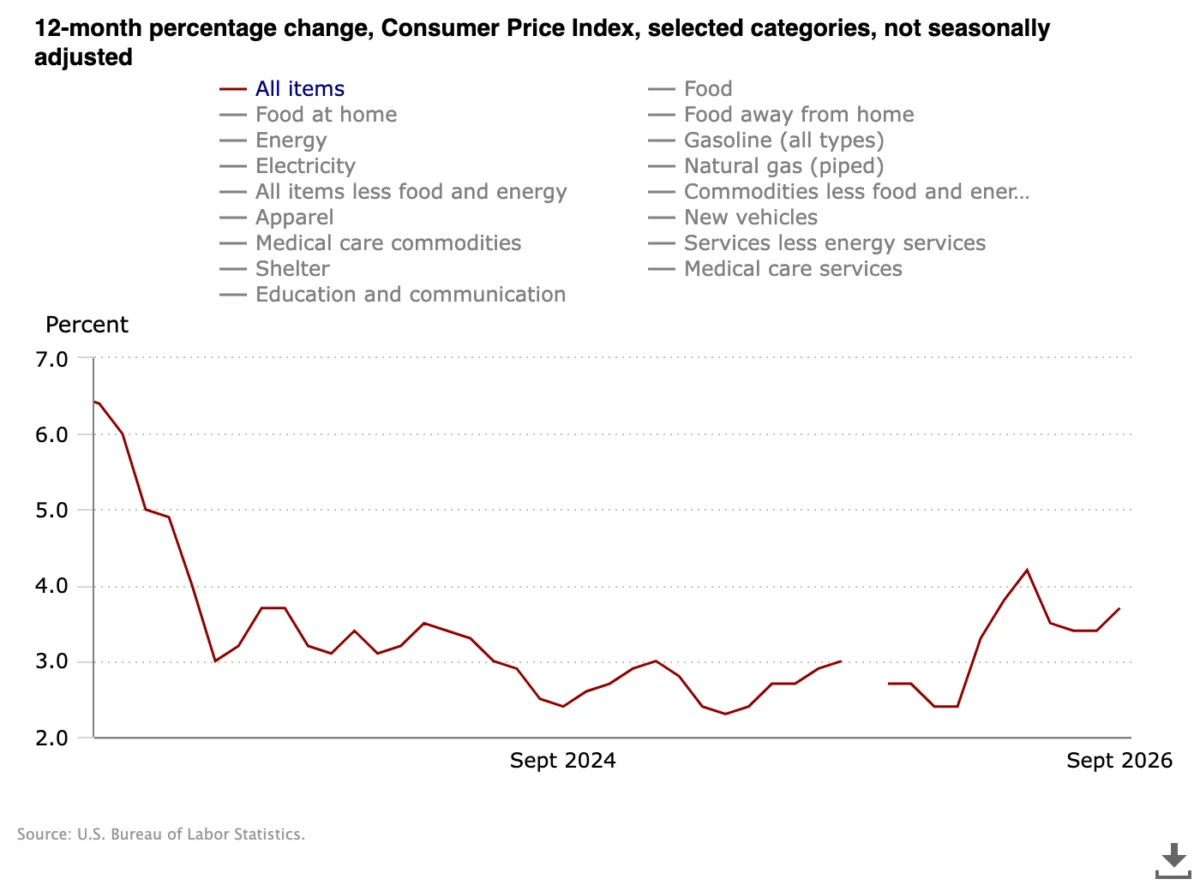
Crucially, Waller added that his policy stance would not be swayed by lower-than-expected inflation data for the month. The October prints of the US Consumer Price Index (CPI) were slated for release at 8:30 am Eastern time on Tuesday. Market analysts had projected a modest month-on-month increase of 0.3%, a cooling off from September’s 0.6% increase, which had been heavily driven higher by rising fuel costs and volatile energy markets.
"While I am hoping for an improvement over September, even if this occurs, I would still support a 25 basis point increase in the FOMC’s policy rate at our December meeting," Waller commented during a speech delivered at the Bank of England Watchers Conference in London.
Underscoring his commitment to combating lingering price pressures, Waller offered a stern warning about potential upside surprises in economic data. "However, if inflation comes in substantially higher than I expect, more robust action by the FOMC may be called for," he added.
While the Consumer Price Index is historically sensitive to fuel-price volatility and headline commodity swings, Waller also flagged persistently high readings from the Personal Consumption Expenditures (PCE) index. The PCE index is widely recognized as the Fed’s preferred inflation gauge, and Waller confirmed it remains the primary measure targeted by the FOMC in its long-term strategy.
"Let’s just say it. September’s inflation data were bad. There was no silver lining," Waller stated bluntly, referring to previous readings that showed the PCE rising 0.5% month-on-month and 3.7% year-on-year.
The impact of his remarks was swift and decisive across global financial markets. Following the speech, institutional and retail traders immediately repriced their expectations. According to data compiled from CME Group’s FedWatch Tool, the implied probability of a 25-basis-point interest rate hike at the December FOMC meeting jumped from 76.3% to a staggering 96.3%.
Financial policy tightening measures have historically acted as primary headwinds for cryptocurrencies and other risk-sensitive assets. Higher interest rates typically imply a reduction in systemic liquidity, tighter lending conditions, and a subsequent contraction in speculative capital inflows that often benefit digital currencies like Bitcoin.
Commenting on the underlying factors driving the anticipated slowdown in the October CPI figures, Christopher Hodge, chief US economist at Natixis CIB Americas, pointed to expected price corrections in both the fuel and shelter sectors.
"We think the slowdown in core CPI will stem from a reversion of shelter prices, primarily owners’ equivalent rents and lodging away from home. Similarly, the stabilization in diesel prices should help to quell price pressures in energy-intensive goods," Hodge wrote in a note highlighted by CNBC.
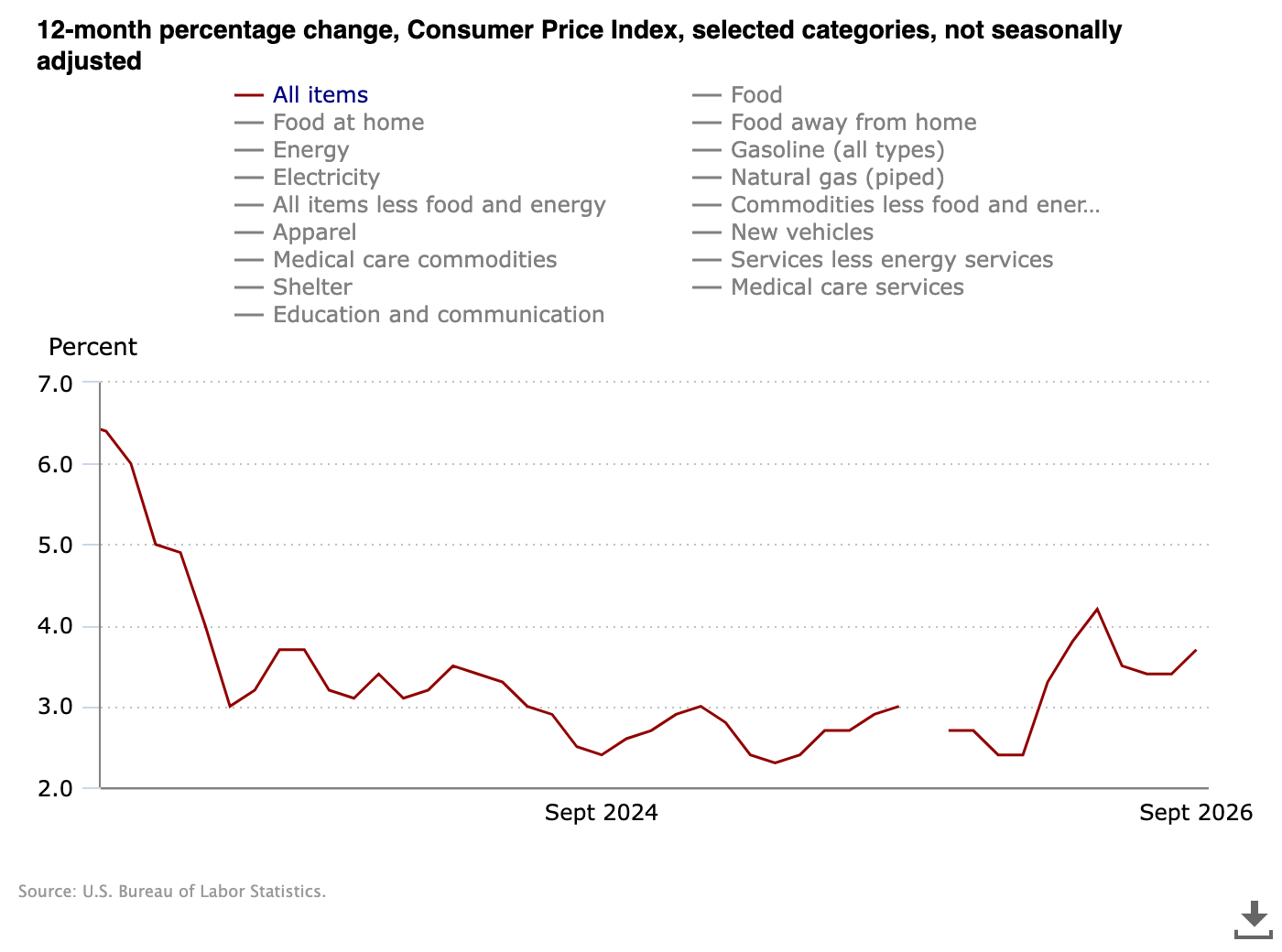
Adding a layer of complexity to the economic reporting, the Bureau of Labor Statistics (BLS), the federal agency responsible for publishing the CPI, confirmed that Tuesday’s scheduled release would include exclusively month-on-month statistics. The limitation was attributed to the 2025 US government shutdown, which severely restricted data collection capabilities and administrative availability. Market observers noted a similar disruption occurred in October 2025, when comprehensive CPI data was withheld or significantly delayed for the exact same administrative reasons.




Comments (0)