



Realities Check Crypto as Perp Wars Heat Up and Investor Relations Enter a New Era
Macroeconomic reality finally reminded the cryptocurrency market that it cannot operate in a vacuum. After weeks of optimistic momentum, digital assets felt the heavy hand of global monetary policy as investors confronted a shifting interest-rate landscape. Bitcoin’s early-week strength evaporated following the Federal Reserve’s latest policy decision, reinforcing a growing realization across financial markets: global liquidity is not opening up nearly as quickly as many participants had hoped.

Yet, macro headwinds are only part of the story. Beneath the surface of price charts, structural shifts are reshaping the digital asset landscape. The fiercely contested decentralized perpetual exchange sector—commonly known as the Perp Wars—is undergoing a dramatic evolution as legacy leaders face aggressive challenges from emerging protocols. At the same time, the broader crypto industry is confronting a fundamental operational contradiction: while protocols are generating unprecedented cash flows and scaling at record speeds, their investor relations and institutional disclosure infrastructure remain fragmented, antiquated, and difficult for traditional capital allocators to navigate.
Market Indices and the Macro Awakening
Traditional financial markets and digital assets saw a clear split during the mid-December trading sessions, highlighted by a divergence between Bitcoin and major macroeconomic benchmarks. While gold, the S&P 500, and the Nasdaq finished positive at 0.57%, 0.53%, and 0.22% respectively, Bitcoin slipped, closing down 0.73% as it continued to hover near the $90,000 threshold.
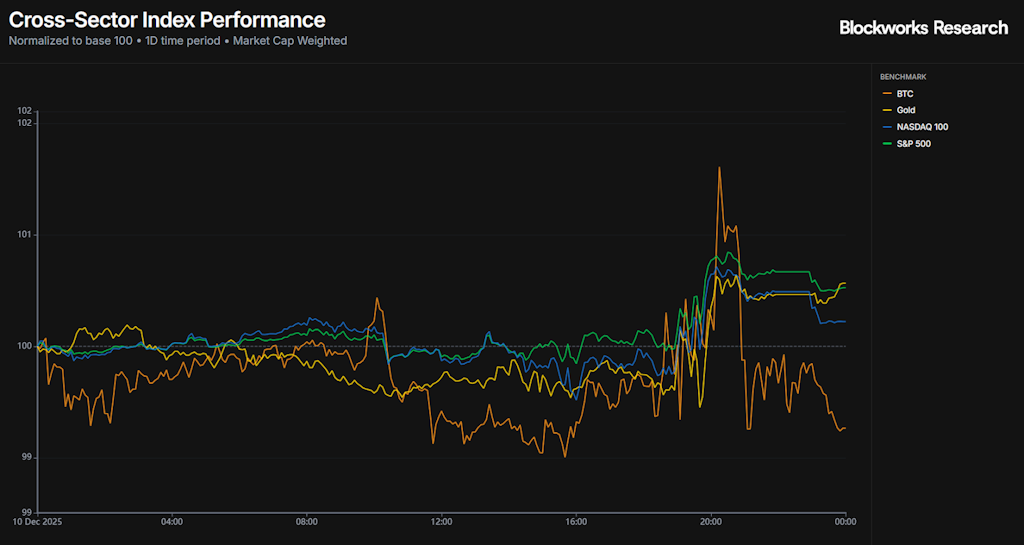
This market reaction followed the Federal Reserve’s widely anticipated 25-basis-point interest rate cut. However, it was not the rate cut itself that caught investors off guard, but rather the forward guidance delivered alongside it. Federal Reserve officials signaled that monetary policy will likely remain restrictive for an extended period, projecting only a single rate cut for the entirety of the coming year. Policymakers pointed to a labor market that is cooling in an orderly fashion, inflation that continues to hover stubbornly above the central bank’s target, and an overarching economic growth rate that remains surprisingly firm.
The message to risk-asset markets was unmistakable. Central bank liquidity will not flood back into the financial system at the aggressive pace previously priced in by optimistic traders. This sobering reality check explains why Bitcoin surrendered its early gains and why the broader crypto market feels largely stuck in neutral. Until macroeconomic indicators point decisively toward a new direction, digital assets appear destined to drift in tandem with broader global liquidity trends.
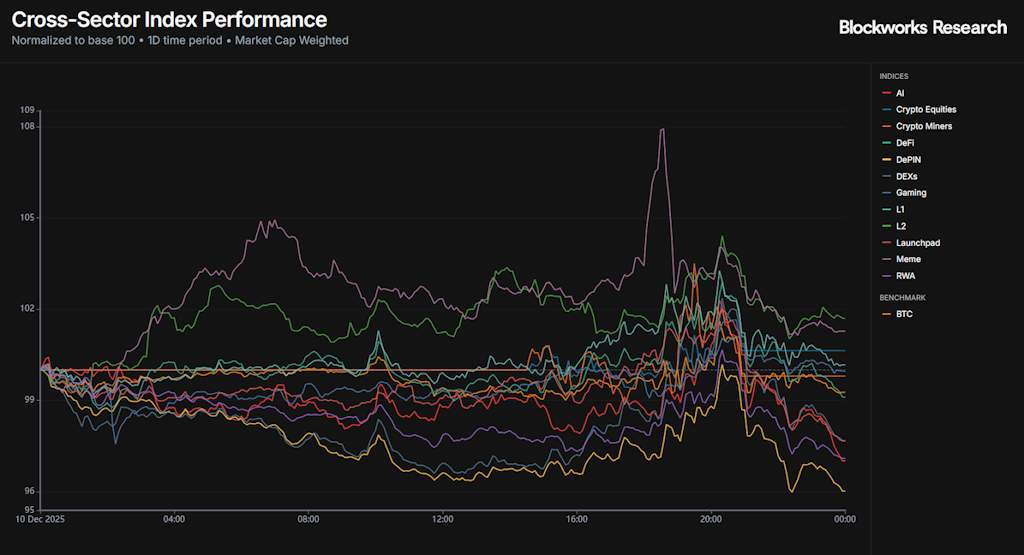
Across different crypto sectors, performance remained notably mixed. Layer-2 scaling solutions and meme-themed tokens managed to eke out gains of 1.70% and 1.27% respectively. The strength in the Layer-2 index was driven almost entirely by MNT, which jumped 4.5% and now commands nearly one-third of the index’s weighting. The meme sector displayed a similar concentration of performance, led by M (MemeCore), which surged 6.2% even as the majority of other prominent meme tokens traded lower on the day.
On the other end of the spectrum, artificial intelligence and decentralized physical infrastructure network tokens lagged significantly, posting losses of 3% and 4% respectively. The AI sector was dragged down by weak performances in IP and ICP, which fell 6% and 7.9%. Meanwhile, DePIN weakness was led by FIL and HNT, registering declines of 4.9% and 5.6%. With the market caught in a macro-induced holding pattern, participants are closely watching for any fundamental catalysts capable of breaking the current trading range.
The Evolution of the Perp Wars and the HYPE Token
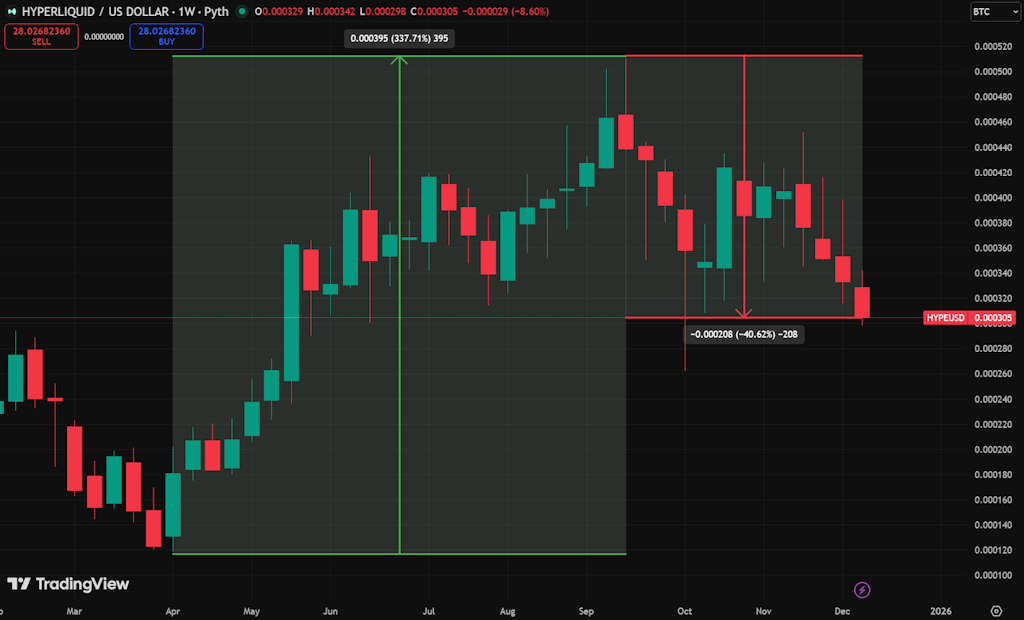
One of the most intensely debated narratives across the digital asset ecosystem centers on the native token of Hyperliquid and whether its market momentum is beginning to fade. In recent weeks, HYPE has struggled to keep pace with the broader market recovery, sliding roughly 20% over a seven-day window while Bitcoin dropped only 3%. Zooming out to examine weekly HYPE relative to Bitcoin returns reveals that the token has surrendered nearly half of its outperformance since hitting its April lows and peaking in mid-September.
The primary catalyst behind this shift is intensifying competition within the decentralized perpetual futures market. Hyperliquid’s performance peak coincided almost perfectly with the market debut of Aster, which swiftly captured significant market share and trader attention. Since mid-September, Hyperliquid’s share of total perpetual exchange volume has contracted from 49% down to roughly 19%. The vast majority of that lost market share has migrated toward competing venues such as Aster and Lighter, with Lighter even managing to edge out Hyperliquid in weekly trading volume since mid-October.
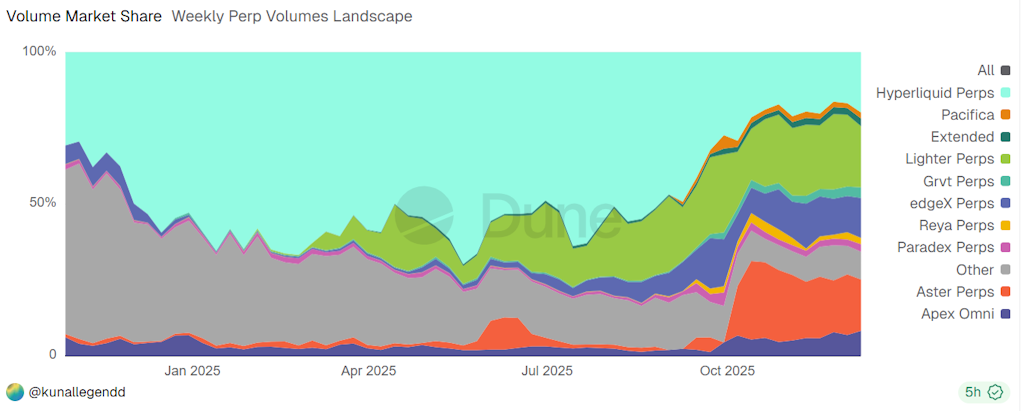
However, raw volume figures alone do not paint a complete picture of market dynamics. When analysts compare weekly volume relative to outstanding open interest, both Lighter and Aster display much higher turnover ratios than Hyperliquid. High turnover ratios typically suggest rapid churn of open positions and can often signal inorganic activity driven heavily by point-farming campaigns. Because both Aster and Lighter have been actively running points programs, a substantial portion of their current activity could theoretically evaporate once those promotional incentives cool down. Lighter’s upcoming token generation event will serve as a crucial real-world test, offering the first clear indication of how much of its platform activity represents sticky, organic usage versus temporary farm-and-flee behavior.
For quite some time, a prevailing assumption across the industry was that Hyperliquid would ultimately run away with the perpetual exchange market in a winner-take-all scenario. Today, the competitive landscape looks considerably more balanced. Industry observers note that the market is unlikely to be monopolized by a single player; instead, the dominant perpetual exchange will ultimately be determined by whichever platform consistently offers the lowest fees, the deepest liquidity books, the widest selection of tradable markets, and the most seamless overall execution experience.
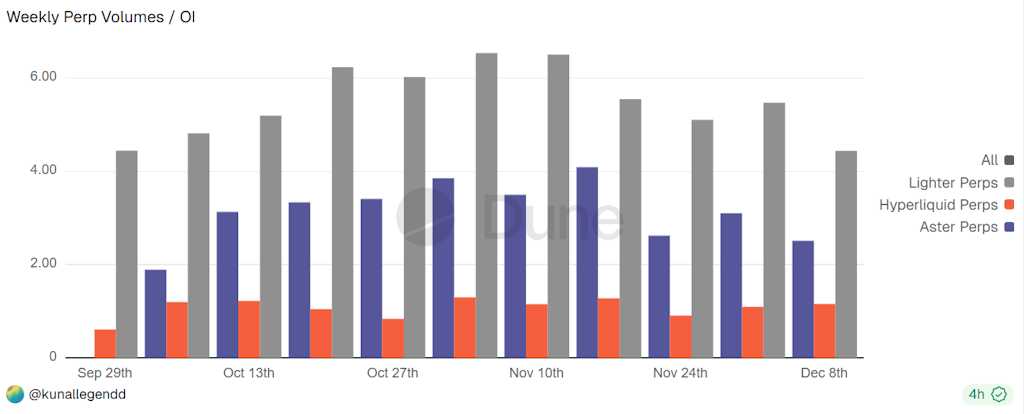
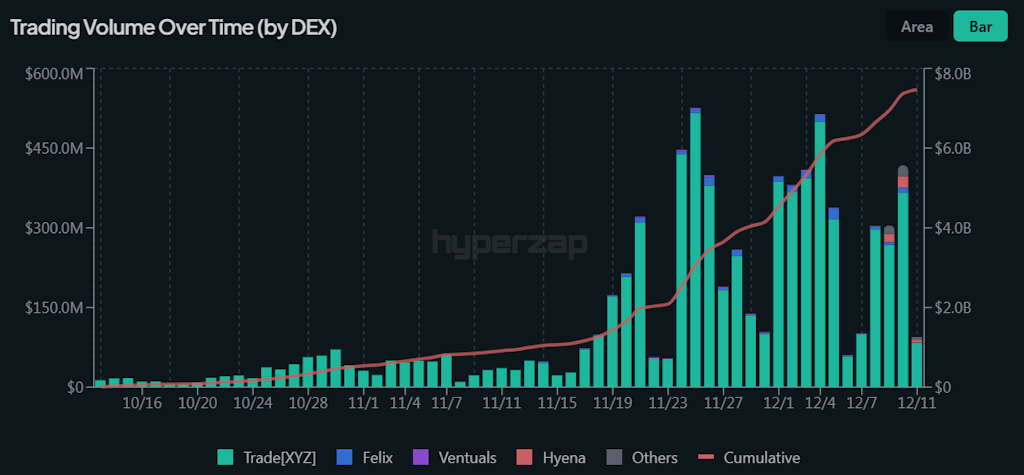
Lighter currently holds an advantage in the fee battle by offering zero maker and taker fees, a structural edge that could be further amplified by the ongoing proliferation of perpetual aggregators directing order flow to the lowest-cost venues. Nevertheless, market depth and asset selection remain equally critical factors. Hyperliquid continues to maintain a commanding lead in both categories, particularly following the introduction of HIP-3, which rolled out equity perpetual markets that have attracted strong early user traction.
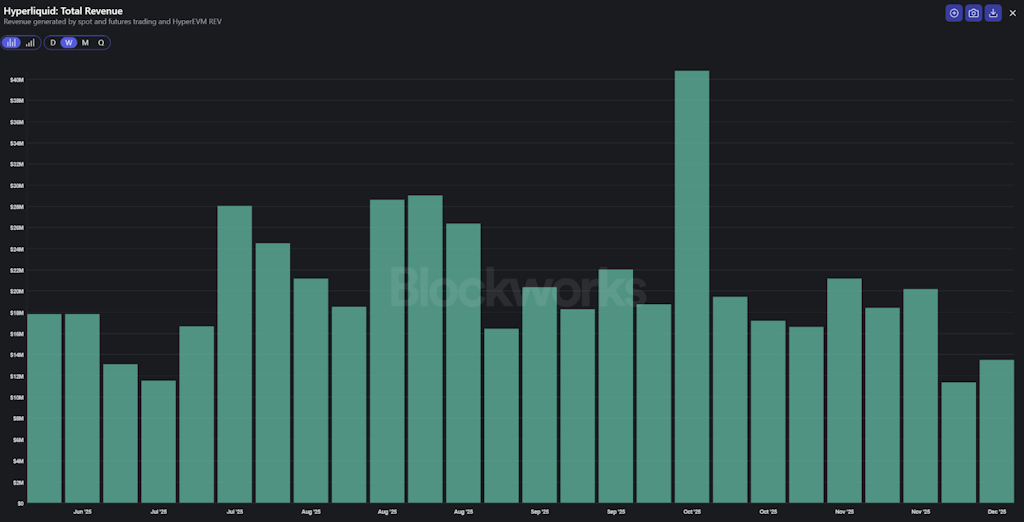
Short-term sentiment toward Hyperliquid has undoubtedly faced headwinds, including significant team token unlocks in November and emerging concerns regarding the protocol’s specific auto-deleveraging design. Despite these temporary hurdles, the protocol’s underlying economic fundamentals remain exceptionally robust. Hyperliquid consistently generates between $10 million and $20 million in weekly protocol revenue, cash flow that is directly utilized to execute buybacks of the HYPE token. Very few decentralized applications possess a comparable economic engine. While market dominance is never guaranteed, writing off Hyperliquid prematurely underestimates the durability of its core infrastructure as the battle for perpetual exchange supremacy heats up.
Addressing the Industry’s Investor Relations Gap
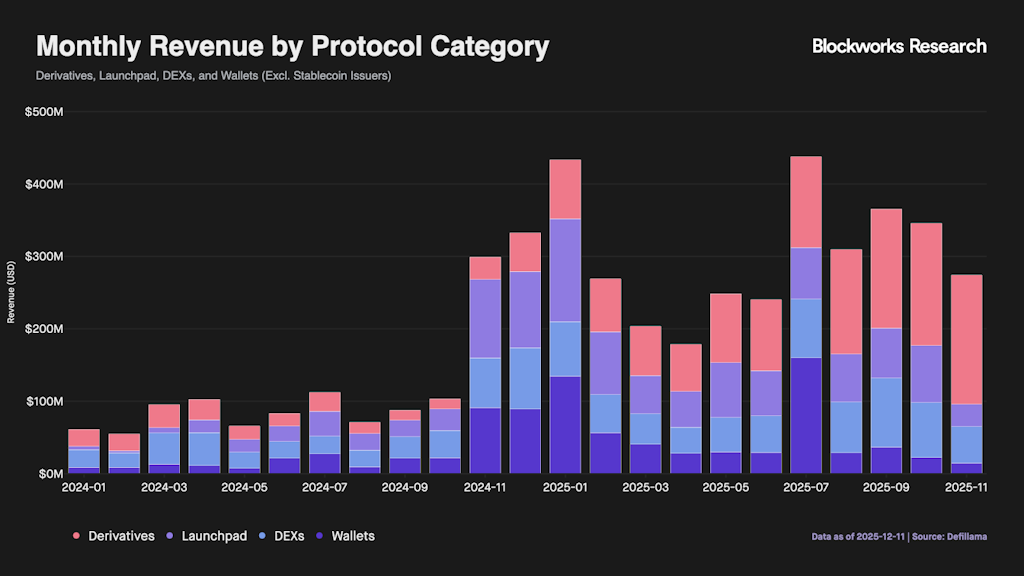
The broader cryptocurrency industry has matured at a staggering pace over recent years. What began as a speculative playground for experimental infrastructure plays has systematically evolved into a diversified ecosystem of robust, revenue-generating financial applications. Monthly protocol revenue, excluding stablecoins, averaged $175 million throughout 2025, representing a 133% increase year-over-year compared to the $75 million average recorded in 2024.
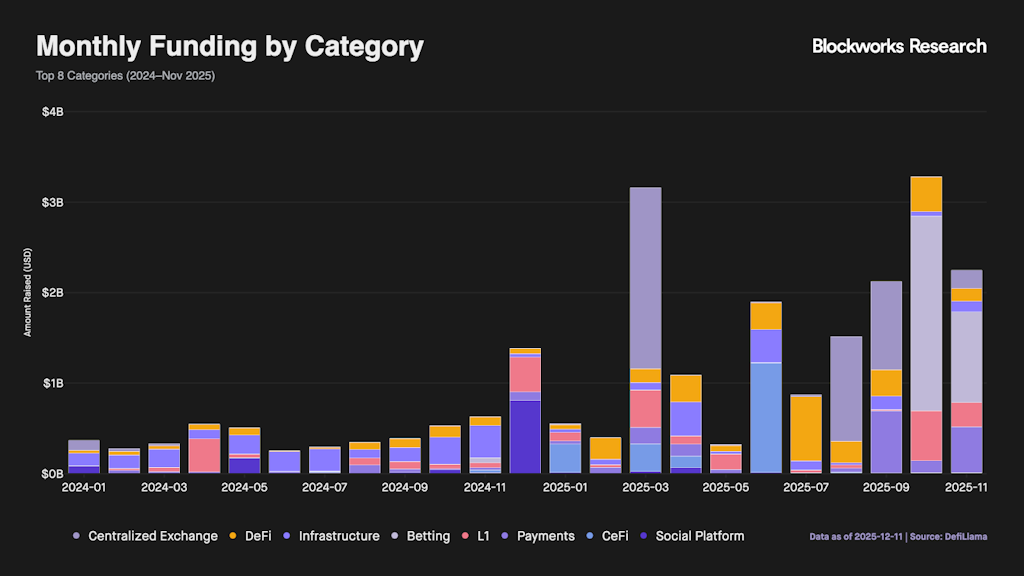
The unprecedented capacity for global coordination across decentralized networks has catalyzed commercial growth on a scale rarely witnessed in traditional industries. Hyperliquid established itself as the fastest team in history to reach $1 billion in annualized recurring revenue. Tether secured funding at a staggering $500 billion valuation, while emerging protocols like Axiom climbed to $63 million in monthly revenue less than half a year after their official launch. Supported by monthly venture fundraising totals regularly ranging between $500 million and $2 billion, the industry continues to expand aggressively.
Yet, despite this phenomenal financial maturation, navigating the crypto asset class has arguably become more complex than ever, particularly for traditional finance investors seeking portfolio diversification. Although digital assets increasingly function as ownership-based, cash-flow-generating businesses, their native technological characteristics render standard due diligence exceptionally difficult for outsiders.
Consider, for example, Pendle Finance, a prominent yield-optimizing platform operating within the decentralized finance space. The traditional interest-rate derivative industry routinely trades $7.9 trillion per day, prompting traditional investors to explore how these massive financial mechanics translate into the crypto sphere. However, the underlying nuances are intensely dense, involving complex interactions between principal tokens, yield tokens, maturity dates, and variable-rate mechanics.
This analytical complexity permeates nearly every corner of the contemporary crypto ecosystem. Professional capital allocators frequently grapple with fundamental architectural questions: how to weigh the distinct advantages of centralized limit order book models against automated market maker liquidity pools; how to evaluate the complex trade-offs between modular and monolithic lending architectures; and how to accurately measure the sustainability and stickiness of various user acquisition strategies. These persistent operational and informational barriers may well explain why many high-performing crypto protocols continue to trade at steep discounts relative to their traditional finance equivalents.
For institutional allocators and professional portfolio managers, the standard workflow for conducting research remains fundamentally broken. Critical operational data, financial metrics, and governance updates are frequently locked behind a fragmented maze of multiple dashboards, decentralized governance forums, GitHub repositories, and private messaging channels. This structural friction creates formidable barriers to entry that discourage traditional capital deployment.
To bridge this widening chasm between crypto-native innovation and institutional capital, industry participants are beginning to build dedicated infrastructure designed to professionalize issuer-to-investor communications. Initiatives such as the launch of Lightspeed IR by Blockworks, developed in partnership with the Solana Foundation, aim to replace fragmented, open-data aggregators with gated, standardized environments. By centralizing high-fidelity onchain metrics, converting raw governance activity into investment-committee-ready research, and streamlining roadmap updates, these platforms seek to establish a reliable bridge for projects to effectively communicate with institutional allocators as the digital asset economy continues its relentless evolution.





Comments (0)