



Global financial markets continued their steady climb yesterday, clawing back the remaining ground lost during Monday’s sharp selloff. Investor appetite for risk improved across major asset classes, buoyed by macroeconomic indicators that heightened expectations for an upcoming monetary policy shift from the Federal Reserve. Benchmark indices across traditional equities and digital assets alike responded positively, though underlying caution remained visible within institutional capital flows and specific sector performances.
In traditional markets, the S&P 500 and the Nasdaq posted modest gains of 0.22% and 0.05%, respectively. Meanwhile, the cryptocurrency market mirrored this resilient recovery, with bitcoin (BTC) leading the charge among major digital assets by advancing 2.52% on the day. Even traditional safe-haven assets felt the shift in momentum; gold gave back a portion of its recent gains, retreating 0.12% as broader risk sentiment improved across global trading desks.

The primary catalyst for the renewed optimism came from the United States labor market, where private sector employment data surprised economists with a notable contraction. Private employers shed 32,000 jobs in November, a stark contrast to prevailing market expectations that had anticipated steady job growth. This unexpected slowdown in labor market activity immediately influenced interest rate futures and central bank watchers. According to data from the Fed Rate Monitor, the implied probability of a Federal Reserve rate cut at the upcoming policy meeting next week climbed to 85%, up from 80% just a week prior.
Not all equities shared in the broader market’s upward momentum, however. The technology-heavy Nasdaq faced specific headwinds from heavyweight constituents like Microsoft. Shares of the tech giant fell more than 2% following reports that the corporation had lowered its sales quotas for artificial intelligence software. The adjustment came on the heels of softer-than-expected corporate adoption and demand for AI-driven enterprise solutions, reminding investors that the commercialization timeline for emerging technologies can face near-term friction.
Within the digital asset ecosystem, performance varied widely across specialized sectors. Most crypto indices finished the trading day in positive territory, with the notable exception of the Gaming sector. Gaming tokens fell 1.65%, extending a dismal yearly performance that has left the sector down roughly 77% year-to-date, making it one of the most challenged segments of the broader crypto market. Memes, a category that typically displays the highest degree of reflexivity and sharpest price action during market rebounds, also lagged behind the broader recovery. The meme token index posted a modest 1.24% gain, weighed down by downward pressure on prominent assets such as PUMP and PENGU, which declined 2.54% and 1.80%, respectively.

Conversely, the artificial intelligence sector surged to lead the market with an impressive 7.46% single-day gain. Token TAO continued to act as the primary engine for the AI index, climbing 7.6% as market participants positioned themselves ahead of its highly anticipated network halving scheduled for the following week. Layer-1 blockchain tokens followed closely behind with a robust 6.45% move. This rally was largely powered by ether (ETH) and Binance Coin (BNB), which together account for 63% of the sector index and posted gains of 6.6% and 5.2%, respectively.
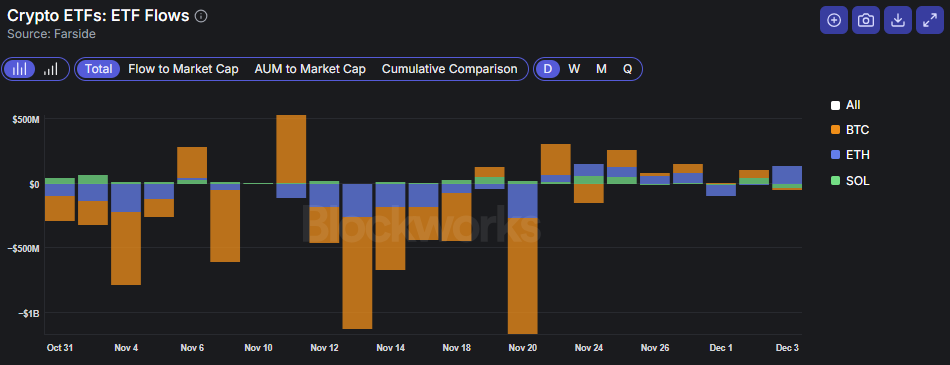
Despite the positive price action across many digital assets, institutional capital flows told a more cautious and nuanced story. After experiencing five consecutive days of net inflows, spot bitcoin exchange-traded funds (ETFs) reversed course, registering modest net outflows of $14.9 million. In contrast, spot ether ETFs experienced a strong rebound, pulling in $140.2 million in net inflows following two consecutive days of declines earlier in the week. Despite these daily fluctuations, market analysts noted that current ETF flow volumes have yet to show true institutional conviction, especially when viewed against the broader backdrop of negative four-point-four billion dollars in net outflows recorded across the month of November.
Market Update: Monad

Shifting focus to the broader decentralized finance landscape, approximately one and a half weeks have passed since the Token Generation Event (TGE) for Monad, providing a timely opportunity to evaluate how the newly launched high-performance blockchain is performing post-launch. Following an initial wave of intense speculative hype and a strong price rally immediately after its debut, the native token MON has cooled off considerably. The asset is down 28% on the week, leaving it trading at a modest 16% premium over its initial coin offering (ICO) price.
Despite the cooling token price, activity within the Monad ecosystem tells a different story regarding adoption and infrastructure deployment. Decentralized finance total value locked (TVL) on the chain has continued its upward trajectory, currently sitting at approximately $277.5 million. A closer examination of this liquidity distribution, however, reveals that a substantial portion of the capital is heavily concentrated in specific assets rather than distributed broadly across diverse native applications.
Approximately $144 million of the total $277.5 million TVL resides within Agora’s stablecoin, AUSD. This stablecoin capital is actively being farmed across various protocols within the network to capitalize on lucrative ecosystem incentive programs. For instance, Upshift holds roughly $73 million and is deploying AUSD across prominent DeFi protocols such as Morpho, Uniswap, and Euler. Morpho currently advertises attractive yields, offering a 4.5% annual percentage yield on AUSD and nearly 6% on USDC. However, market observers point out that the vast majority of this generated yield stems directly from token incentives paid out in MON rather than organic borrowing demand from end users. While such liquidity mining incentives serve as a standard and effective mechanism to jump-start early liquidity on a nascent blockchain, the ultimate test for Monad will be its ability to foster sustainable, organic yield-generating applications once these temporary incentive programs eventually taper off.
Turning to native consumer applications, Nad.fun has firmly established itself as the breakout leader in terms of user accounts and total transaction volume since its launch day. Functioning as Monad’s native memecoin launchpad, the platform has driven significant initial engagement, though questions regarding its long-term staying power remain. Data indicates that only two tokens launched through the platform have successfully crossed the $1 million market capitalization threshold. Furthermore, Chog, widely recognized as the network’s first prominent community-driven token, has experienced a sharp correction, falling more than 65% from its all-time highs to trade at a market capitalization of $4.5 million. This trajectory highlights the volatile nature and challenges of building a sustained, vibrant meme token economy in the early stages of a network’s lifecycle.
Other homegrown projects across the Monad ecosystem are gradually gaining visible traction. FastLane has emerged as the primary liquid staking token protocol on the network, capturing user interest seeking yield-bearing asset alternatives. Concurrently, Pinot Finance is carving out a niche as an alternative decentralized exchange to Uniswap, while Lumiterra, an MMORPG built on the chain, has quietly amassed strong usage metrics. The gaming title recently ranked third across the network in terms of active user accounts and second in daily transaction volume, demonstrating early cross-sector utility.
From a foundational network activity standpoint, Monad’s core metrics appear exceptionally strong for a blockchain in its infancy. The network successfully generated $100,000 in protocol fees over the trailing seven-day period, putting it ahead of established layer-1 alternatives such as Avalanche and Ton in fee generation. Daily transactions and active addresses have stabilized around 2.2 million and 117,000, respectively, signaling healthy baseline network utilization.

However, a closer inspection of cross-chain bridge data introduces a notable cautionary note for long-term analysts. Statistics from WormholeScan indicate that roughly 75% of the total assets initially bridged into the Monad network have already flowed back out to other competing blockchains. This high outflow rate suggests that a significant portion of early capital may consist of mercenary liquidity—users transiently rotating funds to farm short-term yields and promotional incentives rather than committing long-term capital to the ecosystem.
For Monad, the upcoming phase of its development will center entirely on economic conversion. The central challenge moving forward will be determining whether the network can successfully transform early speculative inflows and incentive-driven participation into sticky, permanent liquidity and genuine economic activity. As the ecosystem matures, market participants and analysts will continue to monitor these core on-chain metrics closely to gauge whether initial hype can translate into enduring, long-term industry traction.





Comments (0)