


WASHINGTON — In late September, Wall Street firm Cantor Fitzgerald hosted Nvidia CEO Jensen Huang and other top executives from the dominant chipmaker for investor meetings in New York, an engagement that underscored the long-standing financial and corporate relationship between the financial institution and the artificial intelligence giant.
The firm clearly liked what it heard behind closed doors. "We continue to view NVDA as the best risk/reward in our coverage," Cantor analyst C.J. Muse and his colleagues wrote in a research report dated Oct. 3, which maintained a $350 price target and an overweight rating on the stock.
Yet even as the firm continued to publicly champion the chipmaker’s prospects, securities filings reveal a stark contrast in its balance sheet. Cantor Fitzgerald—formerly run by Howard Lutnick before he stepped down to become U.S. Commerce Secretary in February 2025, and now led by his sons, Brandon and Kyle—reported a nearly 50% decline in the number of Nvidia shares it held between September 2025 and March 2026, according to a CNBC analysis of regulatory disclosures excluding options. Nvidia had previously stood as one of the single largest stock positions reported in the firm’s portfolio filings.
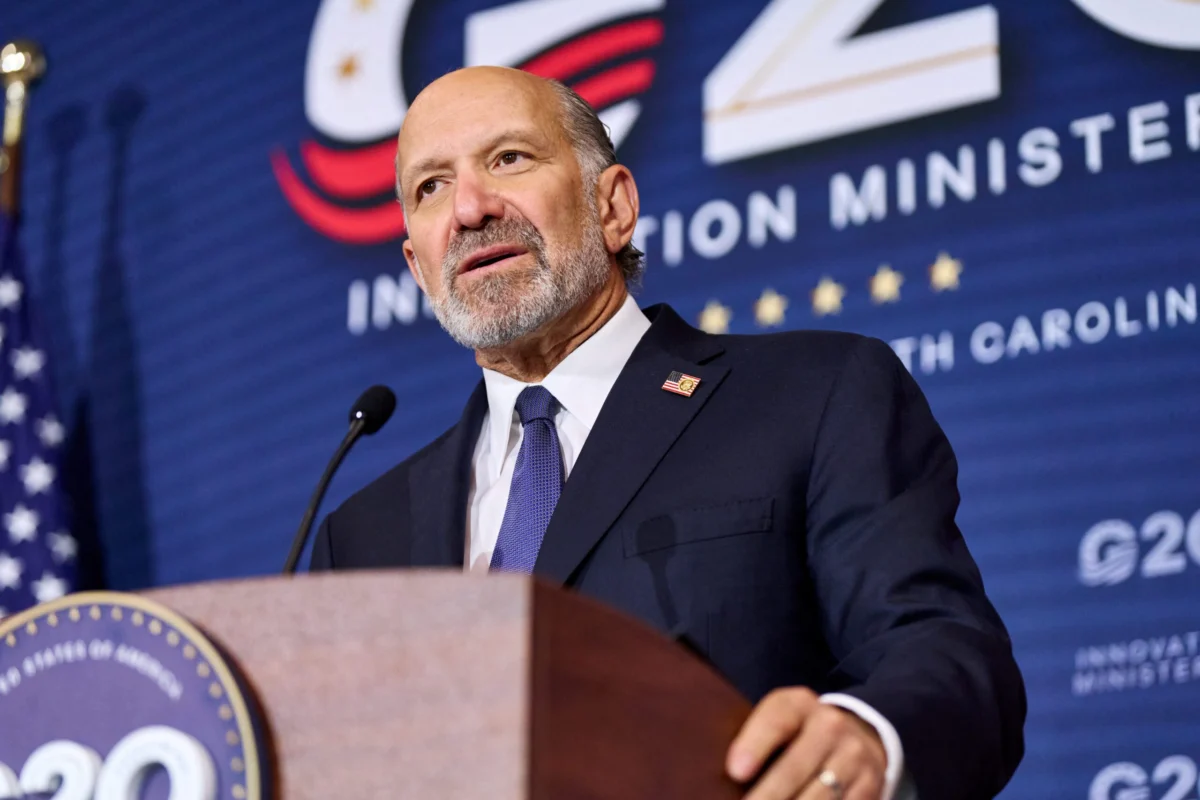
This significant reduction in equity holdings coincided with a turbulent period within the federal government. White House and U.S. intelligence officials were aggressively pressing Lutnick to crack down on Megaspeed, a Singapore-based company suspected of funneling Nvidia’s advanced artificial intelligence chips to China. According to public reports, Lutnick repeatedly resisted those interagency enforcement efforts. By the time Cantor hosted Huang in New York for investor meetings, Lutnick had also received a classified intelligence warning concerning Huang’s ties to a suspected Chinese spy, and he had appeared alongside the tech executive at a G20 technology summit in North Carolina.
Even as Cantor pared back its direct Nvidia stock ownership, the firm remained deeply embedded in the broader ecosystem of the chipmaker’s sprawling AI empire. A comprehensive review of securities filings, corporate announcements, and Wall Street research indicates that the firm has helped arrange billions of dollars in financing for Nvidia’s key business partners while simultaneously maintaining close ties to the chipmaker’s leadership.
Those overlapping relationships have drawn intense fresh scrutiny following Jensen Huang’s resignation and new reports that Lutnick repeatedly resisted regulatory crackdowns on entities suspected of smuggling restricted Nvidia hardware to China. These developments have persisted even though President Donald Trump authorized new export restrictions targeting those illicit supply chains for a third time on Nov. 5.
Ethics experts suggest that the dual reality of Lutnick’s high-ranking government position and his family firm’s ongoing commercial entanglements with Nvidia raise serious questions regarding government transparency and potential conflicts of interest.
Richard Painter, who served as the chief White House ethics lawyer for President George W. Bush and is now a corporate law professor at the University of Minnesota, noted that while no direct proof exists of Lutnick sharing nonpublic government information with Cantor Fitzgerald, "the appearance doesn’t look great."
"His conversations with his sons better be about publicly available information," Painter told CNBC, emphasizing the delicate nature of public service intersecting with private family wealth.
At present, there is no evidence indicating that Lutnick’s sons had advance knowledge of classified intelligence concerns, that shifts in Cantor’s reported portfolio holdings were directly tied to government security warnings, or that the firm’s commercial interests improperly influenced the Commerce Secretary’s official policy decisions.
A spokesperson for Cantor addressed the portfolio fluctuations in a statement to CNBC, explaining that the firm’s proprietary exposure has historically remained minimal. "Cantor has to date from time to time had only immaterial stand-alone proprietary positions in Nvidia, unlike the positions reflected in 13F filings which were entered into in the ordinary course of business in connection with client swap transactions, that are common in institutional markets," the spokesperson said.
Cantor declined to answer subsequent questions from reporters, while the Department of Commerce, the White House, Howard Lutnick, Brandon Lutnick, and Kyle Lutnick did not respond to multiple requests for comment or detailed inquiries regarding the findings.
As public scrutiny over Huang and export policies intensified, Cantor Chairman Brandon Lutnick publicly defended the chipmaker’s corporate leadership. "Nvidia is one of the great companies on the planet, and they have an amazing leadership team," Brandon Lutnick told Fox Business.
Meanwhile, the Trump administration has faced questions regarding internal alignment on trade policy. While a White House official maintained that President Trump preserves "complete confidence" in the Commerce Secretary, cracks in administration unity surfaced when Treasury Secretary Scott Bessent told CNBC’s "Squawk Box" that the departments of Treasury, Defense, and State, alongside the Office of the U.S. Trade Representative, "were in favor of putting Megaspeed on the entity list for months." Pointing out that the Commerce Department holds sole authority over imposing the entity list—which restricts trade with identified entities—Bessent added, "You will have to ask them about their internal processes."
A shrinking Nvidia position
Before Howard Lutnick transitioned from Wall Street to the executive branch, Nvidia represented Cantor’s second-largest reported stock position, trailing only the bitcoin investor MicroStrategy, which has since been renamed Strategy. At the close of 2024, the firm disclosed ownership of more than 3.5 million Nvidia shares valued at $479 million, according to quarterly SEC disclosures.
That share count remained stable through September 2025, though its valuation climbed 36% to reach $652 million as the Trump administration moved over the summer months to ease restrictions on Nvidia’s H20 chip sales into the Chinese market.
Over the subsequent six-month period, however, the volume of Nvidia shares reported by Cantor fell sharply by 49%. Disclosures showed the count dropping to 3 million shares in December and further down to 1.78 million shares by the end of March 2026, with the total reported market value sliding from $652 million to $310 million.
Concurrently, political pressure on Lutnick intensified on Capitol Hill. In March, lawmakers including Sens. Jim Banks and Elizabeth Warren formally urged the Commerce Secretary to suspend or reconsider Nvidia’s export licenses after three individuals linked to Nvidia customer Super Micro Computer were indicted on federal charges of conspiring to smuggle advanced artificial intelligence hardware to China.
"The Trump administration, I think, leaks like a sieve when it comes to nonpublic government information getting to various hedge fund guys," Painter observed regarding the broader environment, though reiterating the lack of direct evidence tying Lutnick to information sharing.
The public filings do not explicitly establish the operational reasons behind Cantor’s falling share count or confirm whether its overarching financial exposure to Nvidia diminished overall. During this window, Nvidia’s stock price experienced substantial volatility, more than doubling from its April 2025 lows by late October before pulling back. Overall, the stock dropped roughly 6.5% between the end of September and the end of March.
Cantor’s reported Nvidia holdings hovered near those reduced levels through June 30, the most recent quarter captured in public disclosures, resting at 1.81 million shares.
The vast majority of those holdings were attributed to CF Secured, a Cantor brokerage subsidiary that utilizes equities and derivatives to hedge institutional customer transactions, as outlined in audited financial statements. Cantor also disclosed substantial options positions in Nvidia throughout the examined timeframe, heavily skewed toward put options, which function to protect portfolios against drops in asset prices.
Classified warnings and a $3 billion deal
As intelligence and administrative concerns regarding Nvidia’s leadership escalated in May, Cantor was simultaneously helping finance the rapid expansion of one of the chipmaker’s emerging corporate partners, regulatory documents show.
On May 7, Nvidia and Australia-based cloud computing provider IREN announced a five-year, $3.4 billion cloud computing contract alongside a strategic partnership granting the chipmaker warrants to invest up to $2.1 billion in IREN.
"That’s not a passive financial investment. Nvidia is a partner who wins as we deliver," IREN co-CEO Daniel Roberts told investors during a quarterly earnings call.
Days later, as President Trump traveled aboard Air Force One, Secretary of State Marco Rubio reportedly warned him about Huang’s connections to a suspected Chinese spy. Huang subsequently joined the presidential delegation during a refueling stop in Alaska. This followed the classified intelligence memo sent directly to Howard Lutnick detailing parallel national security warnings.
On May 12, the day the presidential party departed for Asia, IREN announced the pricing of a convertible bond offering that ultimately raised $3 billion upon its closure. Cantor served as one of seven bookrunners on the transaction, working alongside major Wall Street institutions including JPMorgan Chase and Goldman Sachs.
On May 14—the exact day the bond offering officially closed—Lutnick’s Commerce Department quietly cleared approximately 10 Chinese enterprises, including tech giants Alibaba and ByteDance, to purchase Nvidia’s advanced H200 chips, though some of those administrative approvals predated the intelligence memo.
It remains unclear precisely when IREN retained Cantor for the bond offering or the exact financial compensation the firm extracted from the deal, and Cantor declined to comment on its work with IREN. By the close of June, Cantor reported holding $115 million in IREN shares alongside $362 million in Nvidia shares, combining to represent over 9% of the firm’s total reported $5.2 billion securities portfolio, excluding options.
Beyond the stock
IREN was not an isolated case of a company within Nvidia’s commercial orbit seeking out Cantor Fitzgerald for capital market services.
In October 2025, Cantor advised AI infrastructure developer Lancium on a $600 million debt financing package designed to advance its clean energy data center campus in Abilene, Texas—the inaugural site for Stargate, the massive artificial intelligence infrastructure initiative backed by OpenAI, SoftBank, and Oracle.
Newmark, a commercial real estate services firm controlled by Cantor, also facilitated capital for the Abilene project by arranging a $7.1 billion construction loan in May 2025. Months later, Nvidia agreed to invest $2 billion for a roughly 20% equity stake in Lancium, with an additional $1 billion tied to future developmental milestones. Lancium, which is also backed by Blackstone, confirmed the strategic partnership and investment in August without disclosing specific financial terms.
Cantor’s market footprint extended further into the semiconductor supply chain. In May 2025, shortly after Howard Lutnick transferred his ownership stake in Cantor to family trusts, reports emerged that firm bankers had informally advised executives at Taiwan Semiconductor Manufacturing Co., the primary manufacturer of Nvidia’s most advanced chips, on navigating regulatory landscapes in Washington. Cantor dismissed those reports at the time as baseless. TSMC itself has been the recipient of billions of dollars in federal manufacturing subsidies authorized under legislation administered by the Commerce Department.
These intersecting financial pipelines and policy decisions have fueled sustained political pushback. In December, Democratic senators called for a comprehensive federal ethics investigation into whether the Lutnick family stood to benefit financially from Howard Lutnick’s aggressive push to expand domestic AI data center infrastructure.
More recently, lawmakers including Sens. Warren and Chris Coons formally demanded that Howard Lutnick, Marco Rubio, and White House Chief of Staff Stephen Miller preserve all internal government records concerning Nvidia chip exports to China and the intelligence warnings surrounding Huang.
Appearing publicly to discuss the ongoing inquiries, Senator Coons voiced concern over the administration’s policy trajectory. "The place where I think the Trump administration has most failed here is in being persuaded by Jensen Huang and others to license the export of some advanced chips," Coons said, criticizing officials for allegedly overlooking the thriving black market for high-end semiconductors.


Comments (0)