


For years, the mainstream experience of artificial intelligence has been defined by a conversational loop: humans typing text into a prompt box and waiting for a static response. While generative AI models have grown remarkably sophisticated, their primary operational paradigm has remained largely transactional. The next chapter of technological evolution, however, belongs firmly to autonomous agents. Unlike traditional chatbots, these advanced machines are engineered to chase solutions to complex, multi-layered problems with sustained patience and tenacity, bound solely by the computational resources and contextual boundaries provided to them.
The market demand for such capable agents has arrived at a staggering pace, yet the underlying infrastructure required to run them ambitiously is largely missing from the current technology landscape. Enter Sail, a newly highlighted platform designed specifically to power agents at scale and remove the operational bottlenecks that currently restrict their development. Built by industry veterans with deep roots in high-performance computing, Sail aims to redefine how compute and inference are delivered for long-running artificial intelligence tasks.
A New North Star for AI Infrastructure
Sail is deliberately constructing its architecture for a future in which artificial intelligence agents operate continuously for hours, days, or even months to solve some of the world’s most intricate and data-intensive problems. Traditional inference platforms are typically optimized for quick, low-latency conversational responses rather than the sprawling, open-ended execution loops that define true agency. To bridge this gap, the Sail team has purpose-built their inference platform to operate across a remarkably diverse range of compute hardware, maintaining the flexibility needed to handle long-running, resource-heavy agent tasks without prohibitive costs.
To achieve this ambitious vision, the company is aggressively pushing forward on two foundational technologies. The first is its proprietary inference stack, the complex machinery responsible for actually executing the machine learning models. Operating under the guiding company mantra that "there are no bad chips, only bad prices," the engineering team systematically dismantled the traditional inference stack and rebuilt it from the ground up to squeeze significantly more performance out of every available processor.
Rather than relying exclusively on the newest and most expensive enterprise-grade hardware, Sail’s stack intelligently distributes computational workloads across multiple providers so that processing operations never stall. The platform actively taps into underutilized data center capacity that would otherwise sit idle—particularly hardware clusters that are too small, older, or unconventional for other mainstream providers to bother with. Furthermore, the company positions itself among the early adopters of new hardware accelerators as they hit the commercial market, constantly searching for innovative ways to integrate them productively into its overarching engine.
This reimagined and highly optimized stack fundamentally changes the economics of artificial intelligence operations. It allows agents to think longer, deeper, and more comprehensively, enabling them to expend billions of tokens on a single complex task at a fraction of the cost historically required by legacy infrastructure.

Building Immortality for Autonomous Workloads
The second pillar of Sail’s technological architecture is the "Sailbox," designed specifically as a specialized workspace for agents built to run indefinitely. Sailboxes fluidly scale CPU and memory resources to dynamically match the precise needs of the user at any given moment. This elastic design ensures that an agent idling while waiting for a critical external event, a system response, or a long-running tool execution incurs virtually negligible billing costs during those dormant periods.
Customers can—and routinely do—leave Sailboxes running continuously for months, effectively treating them as immortal computational environments. This persistence underpins a remarkably wide variety of production use cases. These include always-on security verification frameworks, comprehensive systems monitoring every physical product distributed across the web, and even long-running operational testbeds like a corporate chess leaderboard that has been actively computed and contested inside the Sail office for months.
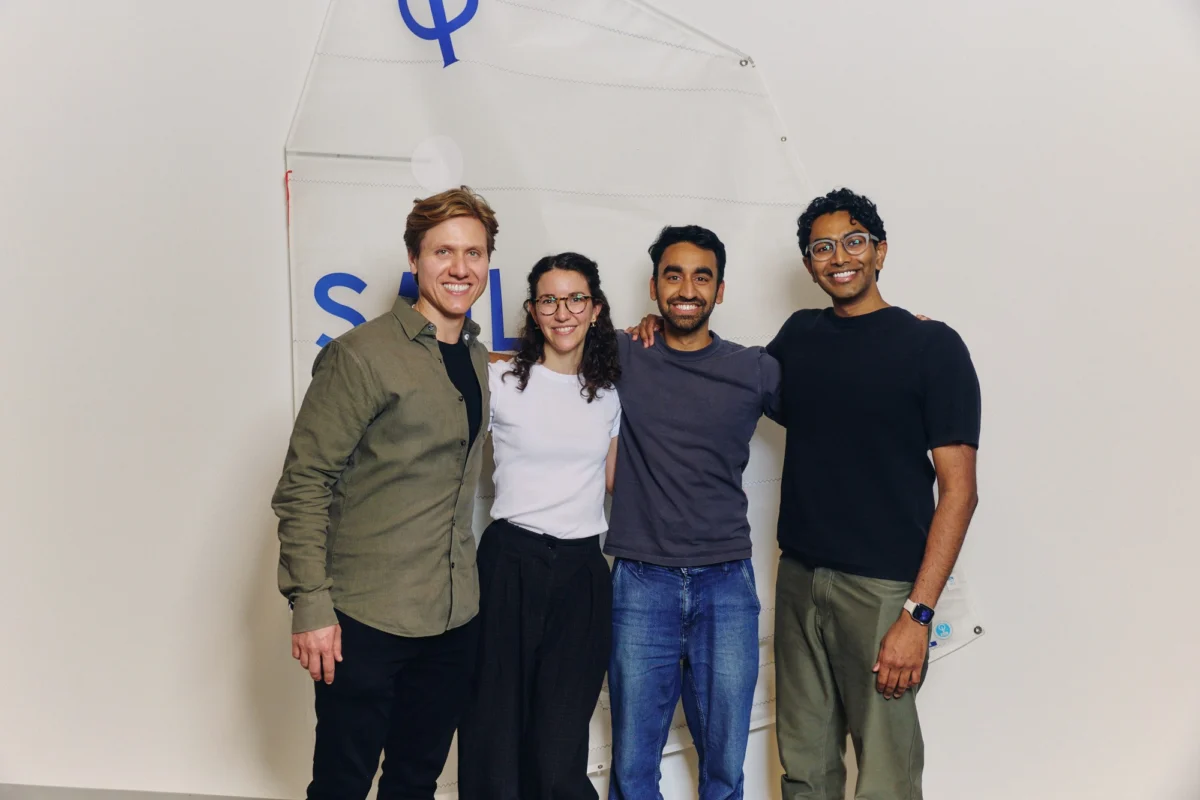
The engineering capability driving these innovations is rooted in extensive industry experience. Co-founder Neil Movva began his career at NVIDIA, where he pushed graphical processing units to their absolute limits, before applying similar optimization principles to new generations of artificial intelligence accelerators at Apple, and eventually returning to GPUs at Together AI. Co-founder Samir Menon brings a critical background from Apple, where he engineered exceptionally reliable systems capable of scaling to support billions of users. Together, they represent a technical leadership team that deeply understands performance engineering and possesses the drive to optimize inference engines down to the absolute boundaries of hardware physics.
Beyond the intensity of high-performance infrastructure development, the company culture blends technical brilliance with a distinctive atmosphere. Office culture features regular unicyclist intermissions, and the top position on the internal chess leaderboard is fiercely contested by every incoming hire, with current champion Nirvik maintaining a notable winning streak. Backed by early partners who have supported the vision from day zero, Sail is rapidly expanding its team and its technological footprint.
Making Intelligence Abundant
The ultimate guiding purpose of Sail is to transform artificial intelligence from a scarce, expensive commodity into abundant, readily accessible intelligence. Every strategic decision made within the organization, ranging from low-level chip optimization choices to high-level application programming interfaces, is intentionally designed to provide engineering teams with the tokens, scale, and operational runtime necessary to build unconstrained autonomous agents. As the artificial intelligence industry shifts its focus from simple conversational interfaces to persistent, problem-solving digital workers, platforms like Sail are poised to provide the essential scaffolding for the next era of computing.




Comments (0)