


Most mornings begin the same way for commuters navigating the San Francisco Bay Area in a Waymo. The vehicle performs physical labor, moving five thousand pounds of metal and glass smoothly across asphalt.
Simultaneously, it executes complex cognitive labor, continuously reading the road, analyzing traffic dynamics, and making split-second predictions that yield a safety record resulting in seventeen times fewer serious-injury crashes than human drivers.
This daily experience demands nothing of human muscles and nothing of the human mind. Both physical and cognitive functions have been externalized.
Such a journey encapsulates two distinct revolutions. The physical revolution is two centuries old, while the cognitive revolution has barely started. Yet, the contemporary mood surrounding this second revolution is an intoxicating cocktail of optimism, skepticism, and anxiety. Public discourse is dominated by talk of a technological singularity, recursive self-improvement, trillion-dollar data clusters, superintelligence, widespread unemployment, societal disruption, and a high-stakes race between global superpowers. It is a dizzying perspective.
However, a broader historical view suggests a calmer lens. Humanity has already undergone a massive transition that rhymes directly with the artificial intelligence revolution unfolding in the coming decades: the Industrial Revolution.
Two Kinds of Work
Human labor can be fundamentally bifurcated into physical work and cognitive work, with most valuable tasks historically necessitating a combination of both. Agriculture serves as one of the oldest examples. Working the land required raw muscle—supplied by humans and domesticated animals—for ten thousand years. Yet, it also required deep insight, including reading shifting seasons, observing crop yields, and understanding soil chemistry.
These two categories of work are inherently different in execution. Physical work is force times distance, involving the movement of mass through space, whereas cognitive work involves processing information and reasoning. Nevertheless, both forms of labor are scarce, carry an economic price, and are applied to tasks society wants completed. In both economic domains, when the price of a resource collapses, a flood of supply follows, and consumer demand inevitably expands to meet that new supply.
What Happened to Physical Work
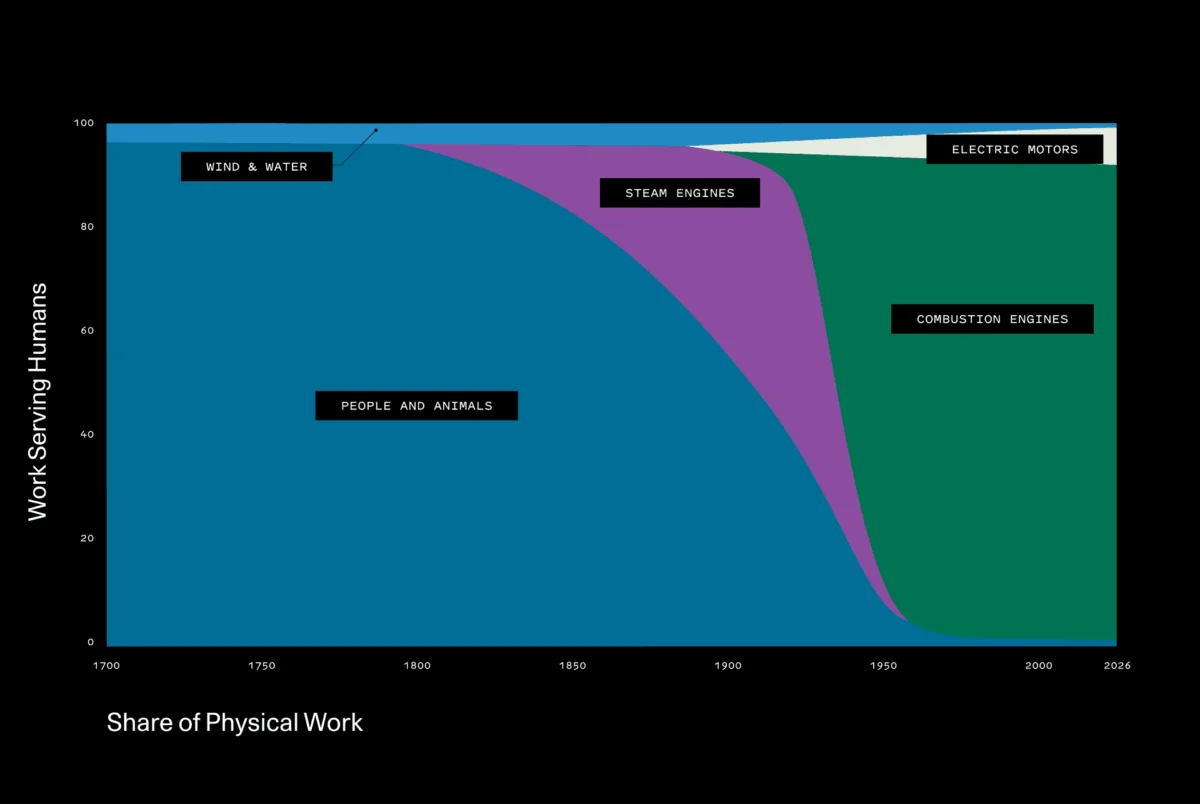
For the vast majority of human history, virtually all physical labor was performed by biological muscle. Historical charts illustrating global energy usage remain remarkably flat across millennia, running backward as far as human records extend.
That baseline began to shift dramatically in the late 1700s and early 1800s. First came steam power, followed quickly by internal combustion and the electric motor. Each successive wave absorbed a progressively larger share of the world’s physical work. Over the course of approximately two centuries, physical work transitioned from being 99 percent biological to 99.9 percent machine-driven.
Today, the tangible results of this shift are ubiquitous. The screen displaying digital text, nearly every article of clothing worn by consumers, the commercial aircraft facilitating global travel, and the complex lattice of cargo ships, freight trains, and long-haul trucks behind every ordinary product in modern life all testify to this reality. Human muscle has become a statistical rounding error in the global energy budget.
History Rhymes: What’s Happening to Cognitive Work
For most of history, essentially all cognitive work was executed by human beings, supplemented by minor biological assists like sheepdogs. This foundation was topped by a thin mechanical sliver of tools capable of rudimentary computation, such as mechanical clocks or Pascal’s calculator.

The advent of electronic computation changed the equation. Within a century, digital processing expanded from simple calculations and spreadsheets to trillions and quadrillions of operations running continuously, twenty-four hours a day. Navigating a daily commute, processing corporate payrolls, and calculating actuarial risk in insurance all represent cognitive work performed entirely by machines.
The current wave of neural networks drastically expands the boundaries of machine cognition. Just as combustion engines magnified the scope and scale of the Industrial Revolution, neural networks are accelerating the Cognitive Revolution. A century ago, 99 percent of cognitive work was executed by humans. In the near future, 99.9 percent will be executed by machines—not because humans will think any less, but because machines will compute on a vastly greater scale.
The parallels between these two historical curves are stark. The Cognitive Revolution will mirror the Industrial Revolution in structure, though it will unfold on a much larger scale and at a significantly faster pace. When dividing the global economy by the nature of work, cognitive and physical labor roughly split a roughly $120 trillion world economy down the middle. The physical half has spent two hundred years mechanizing, while the cognitive half has barely begun.
Inputs Scale Massively and Get Cheap
The industrial age required the massive scaling up of foundational input commodities: first coal and iron, followed by oil and steel. Structural materials like iron relied on processing innovations like puddling, while steel production was revolutionized by the Bessemer process.
A clear parallel exists today in the pairing of electricity and high-performance computing, powered by algorithmic breakthroughs like the Transformer architecture. The providers of these modern components are the industrial titans of the current era, comparable to Andrew Carnegie and U.S. Steel, or John D. Rockefeller and Standard Oil. Modern equivalents include Jensen Huang’s NVIDIA, Morris Chang’s TSMC, the researchers behind foundational AI papers, and the founders of major model laboratories and hyperscalers pouring trillions of dollars into global data center infrastructure. Nations that once measured geopolitical power in oil-refining capacity will increasingly measure it in electrical grid capacity and intelligence output.
A unit of mechanical work in 1900 cost a small fraction of its price in 1800. That dramatic collapse in cost made mass production economically viable, turning an elite novelty into a universal utility. Today, the cost of machine cognition is collapsing even faster. Intelligence per watt has fallen by more than a factor of ten annually. As prices plummet, society will inevitably consume vastly greater quantities of intelligence.
Demand Explodes to Meet Supply
In the year 1800, no one flew commercially to Tokyo, shipped fresh strawberries across an entire hemisphere during the winter months, or utilized air conditioning to inhabit desert cities like Phoenix. All of these physical processes were either technologically impossible or economically prohibitive.
Demand for physical work exploded once new machinery was invented and operational costs collapsed. Economist William Jevons identified this exact phenomenon in 1865, observing that more efficient steam engines did not reduce Britain’s coal consumption, but rather multiplied it.
Cognition is following the exact same trajectory, and the latent demand in this sector is virtually unbounded. Most problems on Earth currently go unexamined simply because deep thinking is an expensive and scarce resource. A medical professional has limited time and cannot review every emerging research paper. A radiologist may study a medical scan for minutes rather than hours due to clinical backlogs. A small business owner operates without a budget for a dedicated financial analyst.
When the marginal cost of cognition approaches zero, every human curiosity can effectively command a dedicated research team. The sheer volume of machine-generated thinking will grow by orders of magnitude, prompting the fundamental question of what all that analytical power will be directed toward.
The Application Era
The primal application of the Industrial Revolution was the mechanization of textile production. Spinning and weaving were skilled, highly respected trades requiring years of apprenticeship, guild membership, and generational family expertise. In 1764, James Hargreaves invented the Spinning Jenny, allowing a single operator to spin multiple threads simultaneously. Clothing prices dropped precipitously, and global consumption exploded.

The defining shift of that era was the human transition from performing the labor to supervising it. One worker tending a mechanical frame could produce what an entire room of hand-spinners previously managed.
The primary skilled application of the current era is AI-assisted software engineering. Writing code has long served as a modern elite craft—requiring extensive skill, high compensation, and a decade of mastery. Software engineering represents the first cognitive domain where the operational pattern has fully flipped, with machines completing the bulk of initial work while human engineers direct, review, and correct the output. It is no coincidence that this is where the Cognitive Revolution found its earliest commercial traction.
While textiles kicked off the industrial era, they did not define its ultimate destination. The defining innovation of industrialization was the automobile, around which modern civilization reorganized via suburbs, highways, complex supply chains, and transformed geographic landscapes.
Coding agents currently function as the Spinning Jennies of the cognitive age, automating an initial skilled task. The ultimate automobile of this revolution has likely not been invented yet; it will represent a capability that remains impossible while advanced thinking is still a scarce commodity. Potential candidates include scientific discovery conducted at machine speeds, deeply personalized AI agents operating like a chief of staff for everyday life, or entirely new paradigms of human connection and coordination. In 1800, predicting the automobile was nearly impossible.
Employment and Economic Anxiety
In 1800, more than 75 percent of the American workforce labored in agriculture. When machines displaced that manual labor, pessimists might have projected catastrophic, permanent unemployment. Instead, society generated entirely new industries that a 1800s farmer could not have named, ranging from radiology and software engineering to podcast production and commercial aviation.
Machines did not eliminate human labor; rather, they erased specific categories of work while radically expanding the total volume of employment. More people are employed today than at any point in human history, and global living standards have risen exponentially.
A parallel dynamic is emerging within the Cognitive Revolution. Despite early automation in software coding, economic data demonstrates that human demand for software engineers and other highly exposed roles has continued to expand. Machines performing cognitive tasks will not stop humans from thinking, just as tractors did not stop humans from engaging in physical movement. Specific tasks evolve, and entirely new categories of work emerge to fill the vacuum.
Nevertheless, while the aggregate historical narrative is one of triumph, individual transitions are often deeply challenging. The handloom weavers of Lancashire were not smoothly retrained into locomotive engineers; many simply lost their livelihoods, enduring hardships that spanned a generation. Economic historian Robert Allen famously termed this turbulent window "Engels’ pause," noting that between 1780 and 1840, British output per worker rose significantly while real wages lagged behind.
Historical Luddites were not fundamentally wrong about the immediate disruptions to their own lives, but they were incorrect about the long-term prospects for their children and grandchildren. By the late nineteenth century, wages caught up to productivity gains and ultimately outpaced them.
The primary difference in the current cycle is sheer velocity. The Industrial Revolution afforded a farmhand’s generation decades to adapt into factory workers, whereas the current transition may compress those timelines into years. The central policy question of the coming decades is whether societal support systems, education, and safety nets can help human populations transform as rapidly as the underlying labor market.
Education and Healthcare Transformation
The Industrial Revolution fundamentally shaped modern education by making mass schooling possible once children were freed from agricultural labor. However, it also influenced the structure of public education to supply factories with literate workers capable of following standardized instructions, maintaining punctuality, and performing synchronized tasks in batch-processed age groups.

The Cognitive Revolution upends both dynamics. If machines handle baseline cognition, factory-model schooling becomes obsolete. Furthermore, the historic binding constraint on education—the ratio of teachers to students—is dissolving as the marginal cost of an infinitely patient AI tutor approaches zero. Hybrid human-AI tutoring models demonstrate enhanced educational outcomes at significantly lower costs, offering a pathway to expand learning access globally.
Similarly, modern medicine was forged by industrial mass production, which delivered penicillin, temperature-controlled vaccine distribution, and the pharmaceutical industry. The Cognitive Revolution accelerates this evolution. Drug discovery historically relied on manual trials across vast molecular spaces; platforms like AlphaFold demonstrate how automated machine learning can solve complex structural challenges that previously consumed entire human careers.
Furthermore, global healthcare systems face severe physician shortages. Accessible cognitive tools will not replace clinical care, but will instead enable medical professionals to manage larger patient loads with higher accuracy, shifting the global medical model from reactive treatment toward proactive preventative care.
The Shape of Daily Life
Beyond labor and education, the Industrial Revolution fundamentally altered the texture of ordinary life, establishing clock time, standardized workweeks, and urban commutes that separated the home from the workplace. The Cognitive Revolution is poised to loosen these industrial structures. As machine collaborators operate continuously and asynchronously, rigid nine-to-five schedules may dissolve back into task-oriented rhythms, while mobile AI tools reintegrate professional tasks directly into domestic spaces.
On a geopolitical scale, industrial nations previously imported raw materials and exported manufactured goods, driving imperial expansion. The modern raw materials are energy, compute, and foundational algorithms, with intelligence serving as the primary output. Just as industrial bases built railways and steel mills while eventually developing atomic weapons, intelligence is inherently dual-use, demanding early and intentional safeguards.
What Remains Human
The underlying anxiety surrounding artificial intelligence ultimately centers on a philosophical question: If machines handle the thinking, what remains for humans to do?
History provides a precedent. At the conclusion of the Industrial Revolution, humans did not stop moving their bodies; instead, physical movement shifted from forced agricultural labor to chosen activities like athletics, marathons, and fitness training.
Cognition is undergoing a similar migration. When Deep Blue defeated Garry Kasparov in chess in 1997, or when AlphaGo defeated Lee Sedol, competitive play did not disappear. Instead, human creativity expanded as players utilized superhuman machines to discover novel strategies, fostering collaborative "centaur" eras.
What remains economically and uniquely human are functions that were never strictly mechanical cognition: desiring outcomes, making conscious choices, bearing accountability for those decisions, and maintaining trust among peers. As the ancient Greek philosopher Protagoras observed, human value resides in what individuals offer to one another.
Conclusion
Viewed from a distance, human history reveals a continuous thread of externalizing physical and cognitive exertion onto constructed machines. While initial transitions spark widespread economic anxiety, history demonstrates that societies emerge into greater abundance, health, and societal capability.
The Cognitive Revolution presents a similar trade at an unprecedented scale and speed. Navigating this turbulent transition will require deliberate adaptation, transparent sharing of prosperity, and a persistent recognition that the ultimate goal of externalizing cognitive labor is to elevate human potential.





Comments (0)