


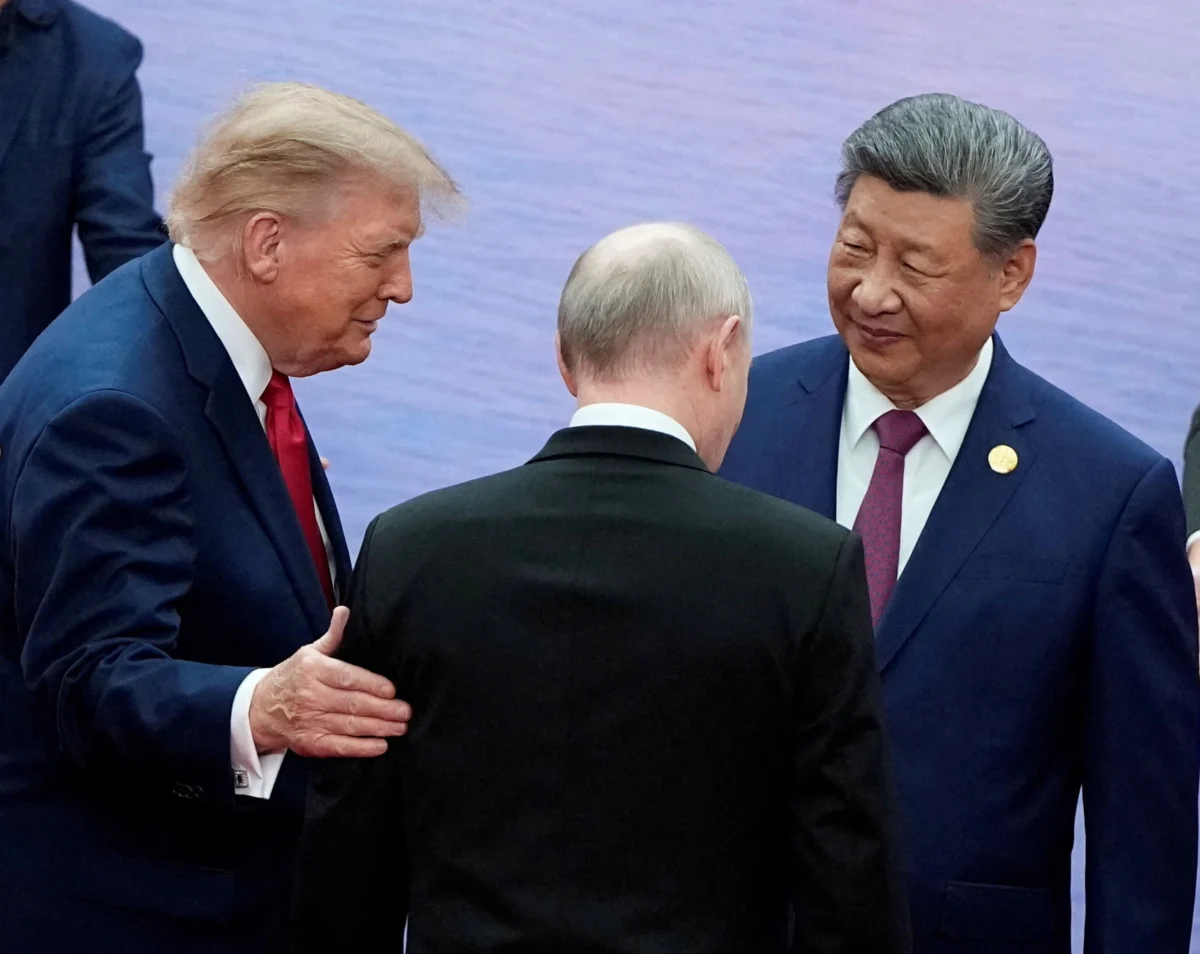
SHENZHEN, China — It took a journey to southern China for an American reporter to witness U.S. President Donald Trump in person for the very first time. Trump emerged from a dense cluster of black-clad photographers and security personnel surrounding him at a high-profile welcome banquet in Shenzhen, the bustling innovation hub in Guangdong province, ahead of the Asia-Pacific Economic Leaders’ Meeting held from November 17 to 19, 2026.
Seated just a few spots to Trump’s left was Russian President Vladimir Putin, who picked up a glass of red wine to join a formal toast led by Chinese President Xi Jinping. The setting was emblematic of the complex geopolitical chessboard unfolding at the summit, where world leaders gathered to negotiate trade, technology, and regional cooperation under the spotlight of international media.
"At tomorrow’s Leaders’ Meeting, we will discuss measures to expand mutual opening up, explore pathways to innovation-driven growth, and identify opportunities to expand practical cooperation across various fields, so as to translate more initiatives into tangible results," Xi said in Mandarin, according to a CNBC translation.
Xi’s remarks during the banquet were broad and diplomatic, but the official agenda carried significant weight. Thursday’s schedule featured a crucial bilateral meeting between Xi and Trump, alongside a highly anticipated trilateral meeting involving Putin. Yet, observing the relaxed yet calculated mood inside the banquet hall, it quickly became apparent that informal trilateral conversations had already commenced Wednesday night across the length of the long banquet table. Much of what happens during APEC summits—including critical bilateral exchanges and backchannel diplomacy—frequently takes place entirely away from the prying eyes of the press.
What struck observers most, however, was the notable absence of tension surrounding a controversy that had gripped global markets and technology circles for the preceding ten days: the sudden resignation of Nvidia CEO Jensen Huang. Ahead of Trump’s entrance into the grand banquet hall, Chinese Commerce Minister Wang Wentao shared a notably friendly moment with U.S. Treasury Secretary Scott Bessent and other key members of the American delegation, signaling a degree of diplomatic insulation from corporate scandals.
Only a week prior, U.S. officials indicated that President Trump did not plan to raise allegations regarding Huang’s personal conduct or his purported affair with an alleged Chinese spy during his scheduled discussions with President Xi. This serene atmosphere stood in stark contrast to the dynamic just two months prior, when photographs circulated widely of Huang and Tesla CEO Elon Musk sharing a table with both Trump and Xi in Washington, D.C.
Furthermore, when Trump visited Beijing earlier in May, Huang had taken a few minutes to speak with reporters inside the hallowed halls of the Great Hall of the People, where Musk was also in attendance, accompanied by one of his sons.
This time around, neither tech titan was visible in a room closely monitored by intelligence agencies, journalists, and financial markets worldwide. Musk had initially been widely expected to join Trump’s official delegation in Shenzhen, but he was conspicuously absent on Wednesday evening. Their absence from the government-heavy banquet was striking. While the world’s most powerful leaders grapple daily with the profound economic, national security, and societal implications of artificial intelligence, they apparently did not require the tech industry’s biggest figureheads sitting at the physical table to do so.
Over the months spent following APEC’s designated "China Year," one overarching theme has become unmistakably clear: the forum has provided Beijing with a strategic opportunity to host the United States, Japan, and other member economies during a historical window when unresolved geopolitical tensions might otherwise have rendered such high-level multilateral gatherings exceedingly difficult to organize.
Even so, throughout a diplomatic calendar heavily defined by official rhetoric concerning U.S.-China "strategic stability," the APEC events have continually exposed deep-seated rifts and shifting dynamics in global power. Those evolving dynamics were fully on display during the opening sessions of the APEC CEO Summit. Several hundred attendees—ranging from Xiaomi CEO Lei Jun to U.S. Ambassador to China David Perdue—arrived early to secure seats for the summit’s opening proceedings.
After waiting in palpable silence for at least ten minutes, the audience finally welcomed President Xi in a distinctly modern fashion: by collectively raising their smartphones in the air to capture the moment on video, while the subsequent applause remained rather muted. A similar scene played out at the government-heavy welcome banquet that same evening, where a multitude of attendees rushed forward to take personal photographs of Xi and other visiting heads of state entering the room, largely blocking the view of accredited journalists trying to document the historic arrival.
Following Xi’s comprehensive opening address in the morning, a lengthy intermission preceded an address by Malaysian Prime Minister Anwar Ibrahim.
"The entire multilateral framework needs to change," Anwar asserted from the stage, while publicly praising China for its rare and consistent recognition of smaller developing nations.
During the subsequent tea break, attendees quickly resumed active networking and mingling. Some participants even carried coffee and snacks back into the main auditorium as Russian President Putin prepared to take the podium. The audience listened as Putin expounded on Russia’s ongoing economic resilience and argued that European economies were steadily losing their competitive footing on the global stage. As attendees eventually drifted away toward the lunch reception, another notable detail stood out: neither Donald Trump nor any other G7 leader had taken the stage during the morning opening event, though Canadian Prime Minister Mark Carney delivered remarks later in the afternoon.
The most visible American presence during the morning session came primarily from U.S. business leaders featured in a promotional video played ahead of Xi’s speech. The absence of a prominent American political voice was arguably even more palpable at Wednesday evening’s banquet.
Trump notably did not follow Xi with a reciprocal public toast of his own. This was the same famously outspoken American president who, during a characteristically winding and combative speech in Davos earlier in the year, had abruptly declared that the United States must actively pursue the acquisition of Greenland.
Yet on Wednesday night in southern China, Trump was not the one holding the microphone, marking a subdued and calculated performance on the international stage as global powers maneuvered for advantage in the changing economic landscape.


Comments (0)