


Operating continuously since September 2022, the Russia-based syndicate has established itself as the most industrious ransomware-as-a-service operation in the current threat landscape. According to a comprehensive threat intelligence report published by cybersecurity firm NCC Group, Qilin’s relentless pace has set it apart from dozens of competing illicit enterprises. For perspective on the broader underground economy, cybersecurity reporting has similarly tracked other major extortion syndicates, such as the group known as The Gentlemen.
Qilin operates on an affiliate model designed to maximize structural reach. It recruits external hackers to breach targeted corporate networks and deploy its custom encryption payloads, incentivizing them by offering at least 80 percent of any extortion payout extracted from victims. Mirroring the modern playbook of major cybercrime cartels, its members practice a "double extortion" strategy. This involves exfiltrating sensitive corporate and personal data before locking down victim infrastructure, subsequently threatening to leak the stolen files publicly on leak sites if demands are not met.
Unlike many Russian ransomware ecosystems that historically restricted their partnerships to Russian speakers to minimize law enforcement exposure, Qilin has adopted a more cosmopolitan approach. Its leadership has openly boasted on Telegram about collaborating with diverse, globally distributed English-speaking cybercrime cells, including prominent names like Scattered Spider and RansomHub.
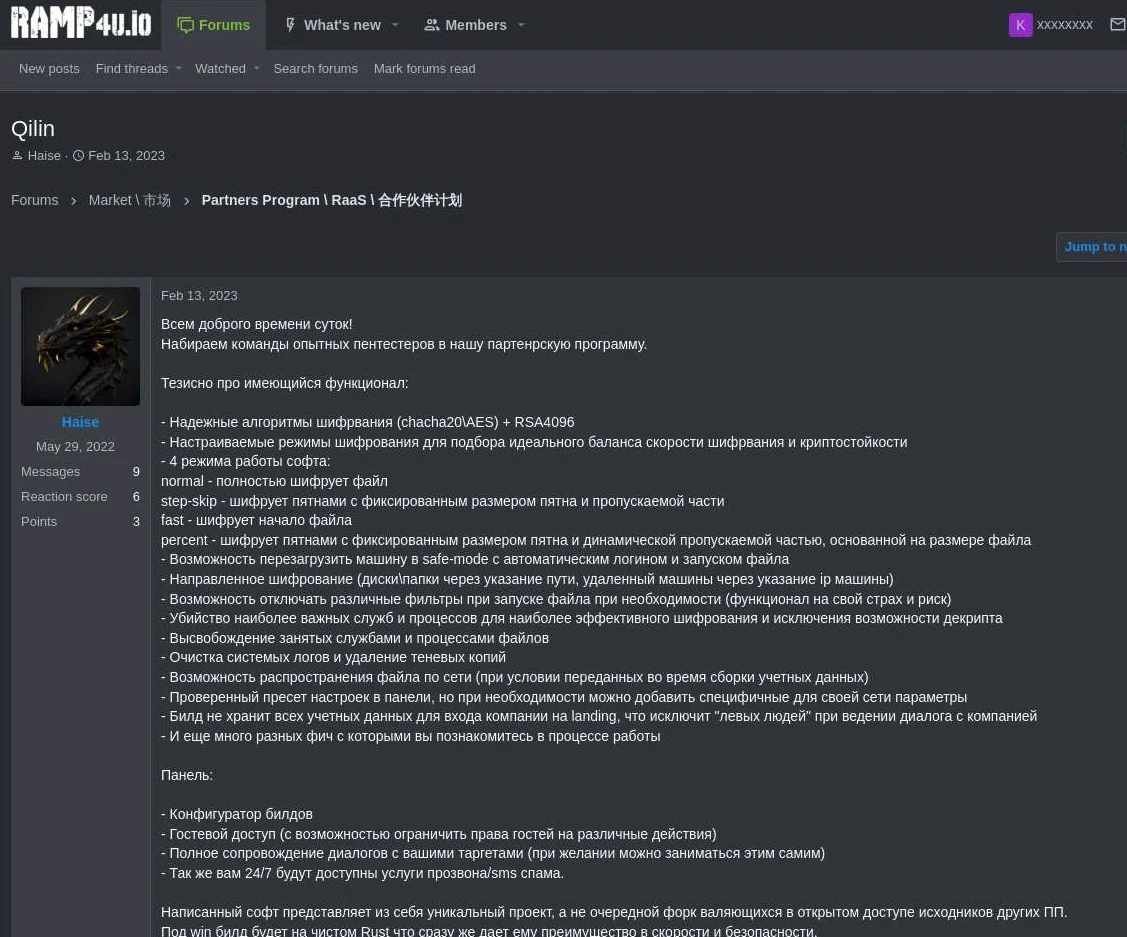
At the helm of this sprawling criminal enterprise is an administrator who goes by the hacker handle "Haise." However, experienced threat actors rarely maintain a single identity indefinitely, as changing aliases is a foundational tenet of operational security designed to distance current criminal enterprises from past mistakes. Nevertheless, even cautious operators inevitably slip up when they must reference legacy handles during applications to trusted underground forums—platforms that inevitably face infiltration, data seizures, or law enforcement takedowns.
That exact vulnerability proved to be the undoing of Qilin’s leadership. According to records compiled by the cyber intelligence platform Intel 471, an operator using the moniker Haise applied for membership in June 2022 to RAMP, a heavily guarded Russian cybercrime forum originally established as a collaborative safe haven for ransomware affiliate networks. Following the FBI’s seizure of the RAMP infrastructure in January 2026, intelligence researchers gained access to archived direct messages. Those records revealed that the forum’s administrator approved Haise’s application while explicitly cross-referencing him with a specific Telegram username: Alexbigboss44.
Pivoting on that Telegram handle within Intel 471’s historical databases uncovers a direct lineage to older personas. Searches demonstrate that the exact same Alexbigboss44 Telegram account was actively utilized around 2020 by a forum user named "Rjun" across prominent Russian cybercrime boards such as Exploit and XSS. According to threat intelligence provider Flashpoint, the account holder behind Alexbigboss44 was a prolific and active participant in multiple illicit channels, heavily engaged in the underground trade of web traffic, stolen logs, and compromised corporate access accounts.

Flashpoint’s analyses indicate that this individual was deeply involved in high-volume acquisitions of Facebook credentials and Google Ads accounts, utilizing them to orchestrate fraudulent advertising campaigns and illicit gambling schemes. In this capacity, the operator functioned simultaneously as a broker and a manager, directing networks of traffic brokers and purchasing compromised data assets to fuel profit-generation schemes before transitioning fully into enterprise-level ransomware operations.
The critical connection bridging Qilin administrator Haise to the older Rjun and Alexbigboss44 profiles was surfaced by IntelHawk, an artificial intelligence platform specializing in the de-anonymization of threat actors through historical username correlation, stylometric analysis, and other digital behavioral signals.
According to IntelHawk Founder and Chief Technology Officer Leo Bogod, a longitudinal analysis of these digital identities reveals a clear developmental progression. The individual evolved from a relatively novice traffic arbitrageur and credit card fraudster during 2018 and 2019 into a sophisticated organizer of complex, high-stakes cybercrime operations between 2020 and 2023, progressively shifting core focus areas toward malware distribution, botnet infrastructure, and illicit payment systems.
Tracing these overlapping identities further back reveals how operational security discipline degraded across platforms. Intel 471 noted that by the time the Alexbigboss44 persona was applying for access to RAMP, the Rjun handle was already a long-standing, established member of several older Russian criminal forums, including Darkmarket, Verified, and Zloy. Records from these legacy sites show that Rjun consistently registered using a specific email address: [email protected].
Identity threat protection firm Spycloud identified that this exact email address had historically utilized the password "Rjun132." Expanding the search via Constella Intelligence, a breach-tracking service, showed that the same email address appeared inside records tied to gosuslugi.ru, the official digital portal for government and municipal services across the Russian Federation.
The Gosuslugi portal suffered a massive data breach, exposing more than 20 million citizen records containing full legal names, dates of birth, and registered mobile numbers. According to those leaked municipal files, the email address [email protected] officially belongs to a 36-year-old resident of St. Petersburg named Aleksey Mikhailovich Yakovtsev.
Further corroborating the digital trail, Flashpoint records show that the Haise persona operated a specific Telegram account tied to user ID 118329521, logging over 5,000 individual messages originating from that identifier since 2018. Educational records maintained by Russia’s federal education oversight agency, Rosobrnadzor, indicate that Mr. Yakovtsev spent his formative school years in Murmansk and later earned a master’s degree specializing in computing and information systems.

Cross-referencing the same Telegram ID within Constella Intelligence links it directly to a Russian cellular telephone number: +79602347275. Pivoting on that specific phone number uncovers associated email addresses, including [email protected] and [email protected]. According to IntelHawk’s findings, the phone number officially belongs to Yakovtsev’s biological sister, and Aleksey frequently leveraged his sister’s contact information and email addresses when registering user accounts across various web services.
That identical phone number also surfaces within historical airline reservation databases managed by Russian travel agencies that suffered cybersecurity incidents in recent years. Those flight manifests confirm that Aleksey Yakovtsev, born on August 18, 1990, traveled by commercial aircraft between St. Petersburg and Murmansk on multiple occasions between 2013 and 2014.
More recent travel logs indicate that while Mr. Yakovtsev has not boarded international flights outside of Russia, he maintains a frequent travel pattern between St. Petersburg and Sochi. Often described colloquially as the "Russian Riviera," Sochi is Russia’s premier resort city situated on the Black Sea coast, located roughly 1,200 miles south of St. Petersburg.
Attempts by researchers and journalists to contact Mr. Yakovtsev for comment via his known email addresses and telephone numbers have been unsuccessful.
Independent investigative efforts by GangExposed, an anonymous security research account on social media with a track record of de-anonymizing high-profile ransomware operators, arrived at identical conclusions regarding Haise’s true identity, publicly crediting IntelHawk’s analytics platform for establishing the definitive links across a decade of digital footprints.





Comments (0)