


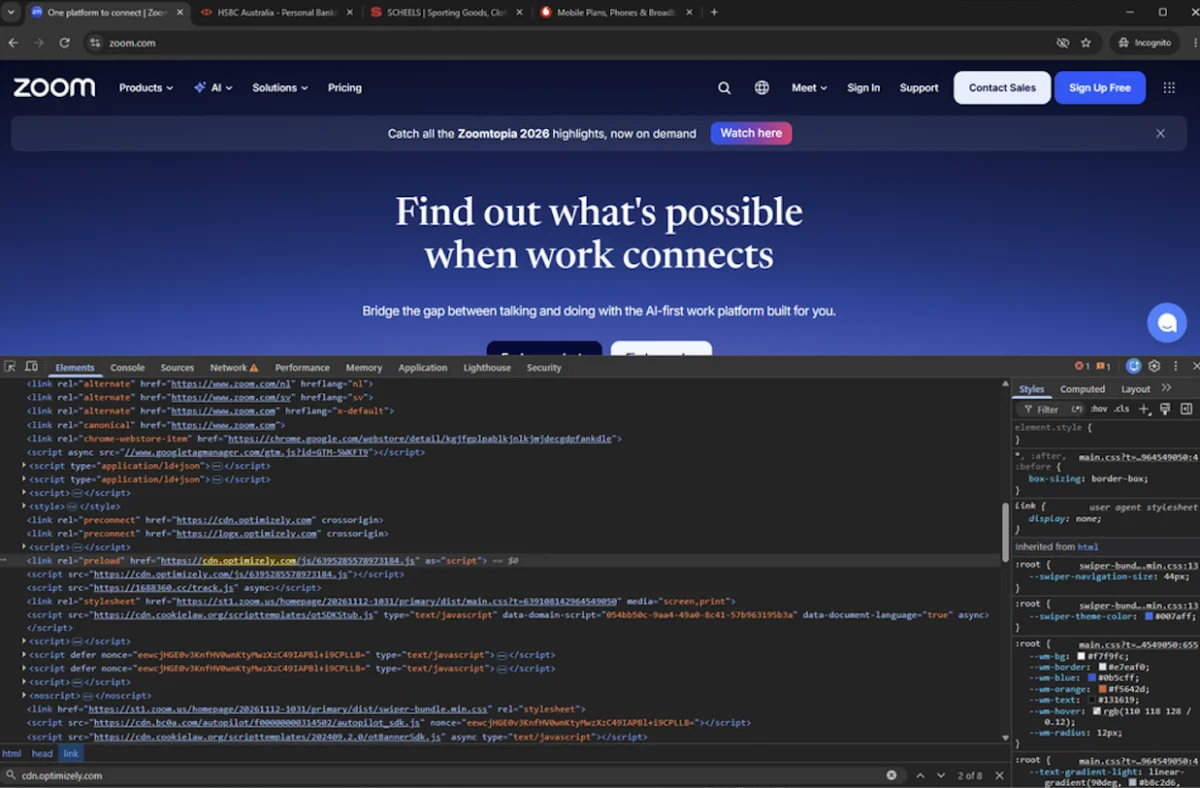
At least 178 prominent web destinations inadvertently served a diverse array of malware exploits to their visitors over a 24-hour period, stemming from a security vulnerability within Optimizely, a widely used digital experience platform that helps websites customize user experiences and conduct A/B testing.
Security experts report that the incident—which resulted in data-stealing malicious software being silently injected into high-traffic domains such as the BBC, CNN, Equifax, Ledger, and Zoom—was severely exacerbated by a systemic industry issue: very few popular websites enforce rigorous controls or strict rules governing the sources of third-party content loaded onto their pages.
According to an incident analysis published by the security firm Report URI, malicious JavaScript code was served to visitors across 178 distinct organizations via Optimizely’s experimentation platform on November 16. Report URI researcher Scott Helme detailed that the payload delivered by the compromised JavaScript was rebuilt 26 separate times throughout the day. The rapid iteration dropped a multi-purpose malware kit capable of harvesting sensitive user data, including payment card information, browser cookies, and screenshots, while dynamically intercepting and swapping cryptocurrency payment addresses to divert funds directly to the attackers.
Helme further noted that the affected websites concurrently served custom-tailored exploit code engineered to target known security vulnerabilities in older Apple iPhone and iPad models. Frequently referred to by designations such as "DarkSword" and "Coruna," these are advanced zero-click exploit kits designed to chain together multiple distinct security flaws. When successful, the exploit sequence can seize complete administrative control over outdated mobile devices and siphon private data without requiring any user interaction.
"The important lesson here is that trusted JavaScript doesn’t always remain trustworthy," Helme wrote in his analysis of the breach. "A website can be compromised through a third-party dependency without its own code or infrastructure ever being breached."
When contacted for comment regarding the security breach, Optimizely stated that it identified a security incident on November 16, 2026, wherein an unauthorized party exploited a vulnerability within the Optimizely Experimentation infrastructure to inject malicious JavaScript into a subset of customer projects.
"We acted swiftly to contain the incident and have fully remediated the identified vulnerability," Optimizely said in a written statement. The company outlined its immediate containment measures, which included blocking access to the vulnerable code path, deploying an emergency software fix, removing the unauthorized injected code from all affected customer projects, terminating active user sessions, revoking security tokens, and forcing a reset of access credentials for impacted user accounts.
Additionally, Optimizely implemented supplemental defensive protections within Cloudflare to block the delivery of any unauthorized or malicious code. The company confirmed that while the active incident has been fully remediated, it continues to collaborate with third-party forensic experts to conduct a comprehensive investigation into the root cause and full scope of the breach.
The incident highlights deep-seated architectural dependencies across the modern web ecosystem. Many high-traffic web properties no longer fully render content unless visitors consent to permitting dozens of third-party vendors to execute JavaScript, a powerful web scripting language that enables dynamic and interactive user experiences. Because JavaScript executes directly on the end user’s device, scripts possess the capability to read information displayed within the browser, record user activity, and even modify the visual appearance or underlying content of a visited website.
The heavy reliance on JavaScript is largely driven by the demand for precise browser fingerprinting, user analytics, and conversion tracking. According to the 2025 Web Almanac compiled by the HTTP Archive, the median homepage loads a minimum of 22 distinct JavaScript files. However, as the Optimizely incident demonstrates, a security compromise at a single third-party vendor can rapidly cascade into a widespread supply chain attack, forcing downstream websites to unwittingly serve altered and malicious JavaScript payloads directly to their unsuspecting audiences.
Zach Edwards, a security researcher at Infoblox and co-founder of the ad-tracking service DecryptAds, explained that Optimizely functions as a vendor that routinely collects telemetry and operational data outside of traditional user consent flows. Because the product is fundamentally designed to support real-time A/B testing and user experience optimization, its JavaScript snippets are typically embedded as high up in the HTML document’s header as technically feasible. This ensures the script is among the very first elements to render upon page load.

"So to make the product work as expected, this code is setup to fire immediately on-page load, and not restrict rendering behind a consent dialog box," Edwards said. "This means that this supply chain attack didn’t require any clicking or consent to trigger — most of the impacted clients would immediately serve up the payload as soon as someone loaded the page, further increasing risks from this type of JavaScript snippet being compromised."
Websites can significantly minimize the probability that a security breach at a third-party content provider spirals into an unmitigated supply chain attack by fully utilizing Content Security Policies, commonly known as CSPs. These security headers explicitly define and restrict the specific domain names and resource origins that are authorized to serve third-party content to a browser.
Despite their proven defensive value, Edwards observed that the vast majority of websites—with the notable exception of the largest e-commerce platforms, major social media networks, and prominent financial institutions—either fail to deploy CSPs entirely or configure them with overly permissive rules to satisfy marketing and tracking requirements.
"With literally all websites which embed 3rd party JavaScript resources, if you don’t have a content security policy then if any of those partners get compromised, new domains can be injected into your website via JavaScript which won’t be stopped," Edwards warned. "We’re in the age of JavaScript supply chain attacks and yet almost no one is talking about why content security policies were invented and how this is largely the solution for operators, even though it’s not always simple to get it initially deployed."
An analysis by Report URI sought to quantify the deployment of CSPs across the specific websites caught up in the Optimizely attack. The findings revealed that 68 of the impacted sites had no Content Security Policy implemented at all. Furthermore, 50 of the sites maintained a CSP configuration that was permissive enough to permit both the execution of the malicious malware payload and the subsequent exfiltration of stolen data. Only 24 of the affected sites—representing a mere 15 percent of the total—utilized CSP configurations that were robust enough to fully block the malicious payload from executing.
Data gathered by Helme’s security scanning platform, crawler.ninja, which continuously monitors the top one million websites daily for security configurations, indicates that overall CSP deployment across the busiest sites on the internet hovers around a low 10 percent. Helme expressed hope that the high-profile Optimizely incident will serve as a catalyst, encouraging more web operators to adopt effective CSP protocols. He noted that the fallout could have been substantially worse: based on Report URI’s current estimates, the perpetrators of the campaign managed to steal approximately $7,500 worth of virtual currency from affected users, alongside an undetermined volume of payment card records.
Reflecting on the broader state of web application security, Helme likened the prevailing lack of strict controls to the unregulated environment of the American frontier.
"Organizations are running all this code, but they don’t know what it’s doing," Helme said in an interview with KrebsOnSecurity. "This is why we keep seeing such large scale breaches in places [where] there are no checks and rules in place on the code we’re running, so this was kind of inevitable. Once an attacker gets to the point of running code on your site, the question is what do they want to do with that and can they write the script to do it. Now with AI that’s not a problem anymore."
While internet users have historically relied on granular script-blocking browser extensions like NoScript to control which JavaScript elements are permitted to execute on a given webpage, such tools have traditionally appealed primarily to advanced security enthusiasts willing to manually vet dozens of distinct JavaScript requests on every newly visited domain.
In practice, modern ad-blocking software and privacy extensions frequently provide an accessible alternative by automatically intercepting and neutralizing a significant proportion of third-party JavaScript requests. While foundational security advice a decade ago emphasized local antivirus installation and network firewalls, security analysts increasingly view comprehensive ad and script-blocking tools as an essential layer of modern browser defense.



Comments (0)