


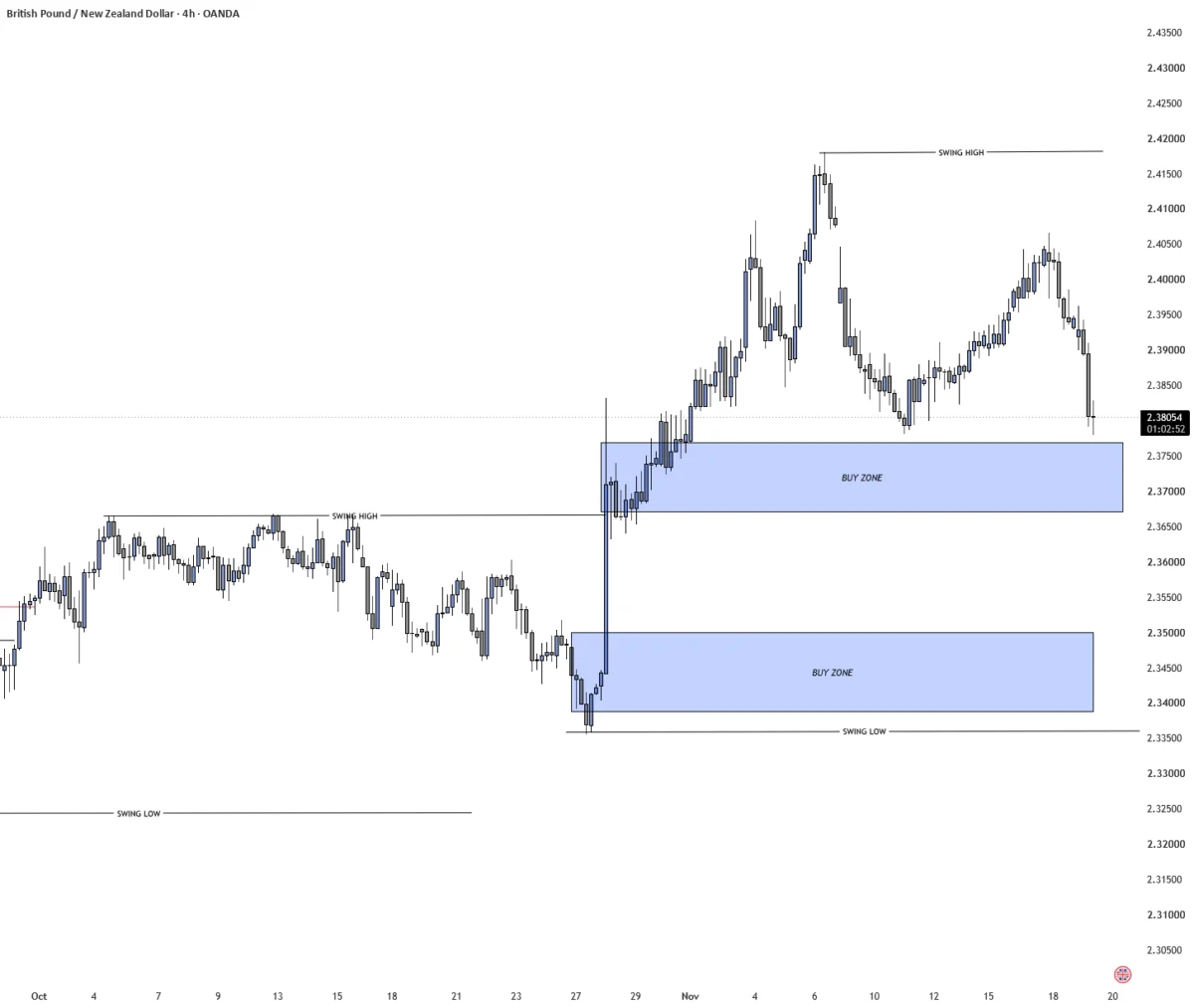
The foreign exchange market is witnessing sustained momentum in the British Pound against the New Zealand Dollar, as technical indicators on multiple timeframes point to continued upside potential for the currency pair. According to market analysis published by trading strategist Sarah Kim on TradingView, the broader market structure for the British Pound and New Zealand Dollar pair remains firmly bullish on the daily timeframe, supported by recent price action breaking higher across shorter durations.
The observation highlights a significant technical development for the cross-rate, which tracks the relative strength of sterling against the Antipodean currency. Foreign exchange participants monitoring the pair have noted that the daily chart continues to respect an upward trajectory, reflecting underlying economic divergence and shifting market sentiment between the United Kingdom and New Zealand.

Technical analysts evaluating the pair emphasize the importance of multi-timeframe alignment in modern currency trading. While the daily chart establishes the primary direction of the trend, intraday developments provide crucial context for ongoing price behavior. In this instance, the formation of a fresh swing high on the four-hour timeframe reinforces the dominant bullish narrative observed on the higher chart. A swing high typically indicates that buyers have successfully pushed prices above previous resistance levels before encountering temporary profit-taking, leaving behind a new local peak that serves as a key reference point for market participants.
The British Pound has experienced varied fortunes across global markets as traders weigh the monetary policy outlook of the Bank of England against persistent domestic inflation data and broader macroeconomic indicators. Sterling has occasionally faced headwinds stemming from fiscal uncertainties and evolving expectations regarding interest rate adjustments. However, relative performance against specific peers like the New Zealand Dollar often depends heavily on the distinct economic pressures facing the domestic economy in Wellington.
The New Zealand Dollar, commonly referred to as the Kiwi, remains highly sensitive to global commodity prices, dairy sector performance, and economic developments within major trading partners such as China. The Reserve Bank of New Zealand has navigated its own complex economic landscape, balancing efforts to manage domestic inflationary pressures with the necessity of supporting sustainable economic growth. Shifts in market expectations regarding interest rate differentials between the United Kingdom and New Zealand frequently translate into notable directional moves in the currency pair.

Market structure analysis, such as that highlighted in the recent technical assessment, relies heavily on identifying sequences of higher highs and higher lows in a bullish trend. When a currency pair prints a new swing high on an intermediate timeframe like the four-hour chart while the daily timeframe maintains its upward structure, it often signals that the path of least resistance remains directed toward higher levels. Traders utilizing these methods watch closely for pullbacks or consolidation phases that may offer opportunities within the context of the prevailing trend.
The analysis shared by market participants on professional charting platforms serves as a focal point for discussion among retail and institutional traders alike. Currency pairs such as the British Pound and New Zealand Dollar often exhibit distinctive volatility patterns, making technical configurations critical for participants managing risk and identifying potential market turning points or continuation zones.
As trading sessions progress, market observers will continue to track whether the newly established swing high on the four-hour timeframe acts as a springboard for further gains or precedes a period of consolidation. The overarching daily bullish structure provides a supportive backdrop for sterling bulls, though ongoing economic data releases from both London and Wellington are expected to heavily influence the near-term trajectory of the exchange rate.

Comments (0)