



A wrapped version of Monero (XMR) suffered a catastrophic collapse on Friday, plunging by more than 99% on the Hyperliquid platform. According to findings from blockchain analytics firm Bitquery, the steep decline was triggered after a suspicious wallet—which had received a massive influx of tokens directly from the project’s deployer account—dumped approximately $13.5 million worth of the digital asset onto the open market in a matter of minutes.
The token, widely traded under the ticker XMR1, plummeted from an approximate valuation of $500 down to a mere $1 in roughly 30 minutes, marking a staggering 99.8% value destruction. Wrapped tokens are designed to mirror the value of other cryptocurrencies across different blockchain architectures, thereby enabling users to trade assets outside of their native network environments. Analysts have emphasized that this dramatic market collapse was strictly confined to XMR1 and did not impact the native Monero (XMR) cryptocurrency itself, which operates independently on its own privacy-centric network.
Detailed onchain data published by Bitquery revealed that the rogue wallet had initially acquired 5.2 million XMR1 tokens straight from the official deployer account. On Friday, the holder of this wallet began systematically liquidating the supply, successfully offloading approximately $13.5 million worth of the asset on Hyperliquid and driving the order book into a complete freefall.

Following the initial token dump, Bitquery’s forensic trackers followed the trail of capital as the proceeds moved swiftly across multiple blockchain networks. The analytics firm traced $13.28 million in USD Coin (USDC) that had been bridged over to the Arbitrum network. From there, $13.22 million of that stablecoin pool was swapped for 7,467 Ether (ETH) utilizing the decentralized exchange aggregator CoW Protocol. The vast majority of the newly acquired Ether was subsequently bridged across to the main Ethereum network, further obfuscating the trail of funds.
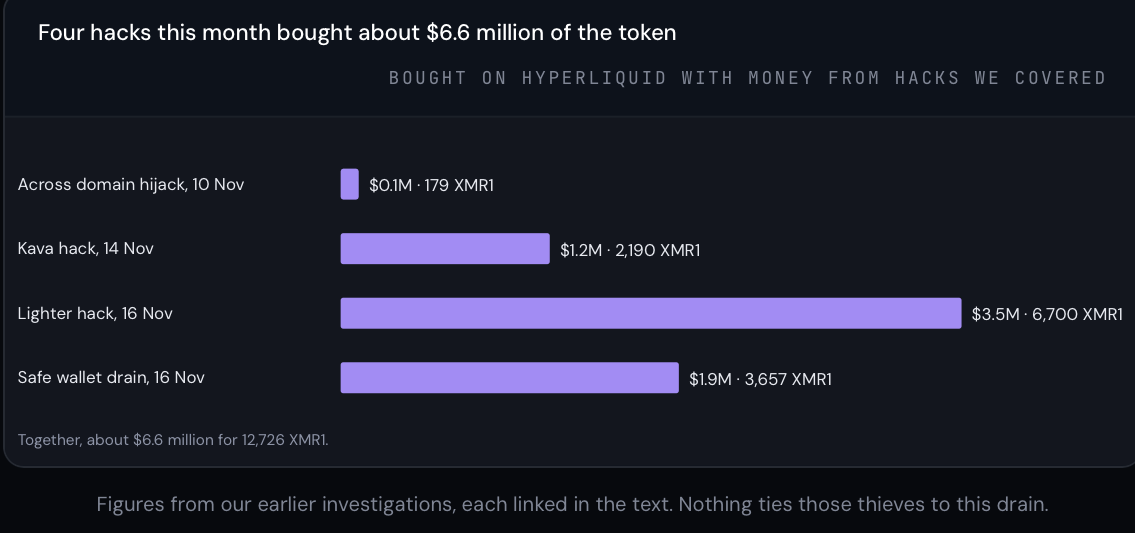
In the course of their broader investigation, Bitquery analysts also uncovered an interesting historical link involving prior market activity. The firm discovered that the proceeds originating from four separate cryptocurrency hacks that took place earlier in November—involving exploits on Across Protocol, Kava, Lighter, and Safe—had previously been used to purchase approximately $6.6 million worth of XMR1 tokens. According to Bitquery’s assessment, those stolen funds appeared to have been funneled into XMR1 as a stepping stone or a layering route to acquire native Monero. However, the analytics firm explicitly noted that it found no onchain evidence directly connecting those four distinct November security incidents to Friday’s sudden and dramatic exploit on Hyperliquid.
Despite the comprehensive tracking of funds across various decentralized protocols and bridge contracts, Bitquery acknowledged that its onchain investigation hit a roadblock regarding the initial vector of the attack. The firm stated that it was unable to establish definitively how the deployer account’s private key was originally obtained, nor could it identify who precisely controlled the account during the execution of the unauthorized transfers. Consequently, the exact operational circumstances surrounding the suspected system compromise remain unconfirmed by independent blockchain auditors.
Wagyu Operator Blames Suspected Infrastructure Breach
As the crypto community rushed to understand the mechanics behind the sudden crash, PerpetualCow, the pseudonymous operator of Wagyu—the underlying service responsible for issuing and managing XMR1—stepped forward to offer an explanation. PerpetualCow publicly attributed the catastrophic collapse to an alleged security breach affecting 1984, the third-party hosting provider utilized by the project. The operator claimed that the infrastructure breach had resulted in the severe exposure of sensitive customer data as well as internal server files.
According to the account provided by PerpetualCow, the private key associated with the XMR1 deployer account had historically been stored on a specific server hosted by the provider. Although that particular server had subsequently been deleted, the operator alleged that the hosting provider retained internal logs, backups, and residual files associated with it, which allegedly created an avenue for unauthorized access by malicious actors.
In the wake of the incident, the pseudonymous operator moved quickly to address community concerns and restore a degree of confidence among impacted users. PerpetualCow pledged to personally reimburse all traders who suffered losses as a direct result of the XMR1 price collapse. Furthermore, the operator indicated that the Wagyu project intends to execute a formal relaunch at a later, unspecified date, though no concrete timeline or roadmap for the restoration of services has been provided to the public thus far.
Representatives from Cointelegraph reached out to the Wagyu operator seeking further technical details regarding the nature of the alleged infrastructure breach, as well as clarification on the mechanics and schedule for the promised user reimbursements, but had not received a response by the time of publication.




Comments (0)