



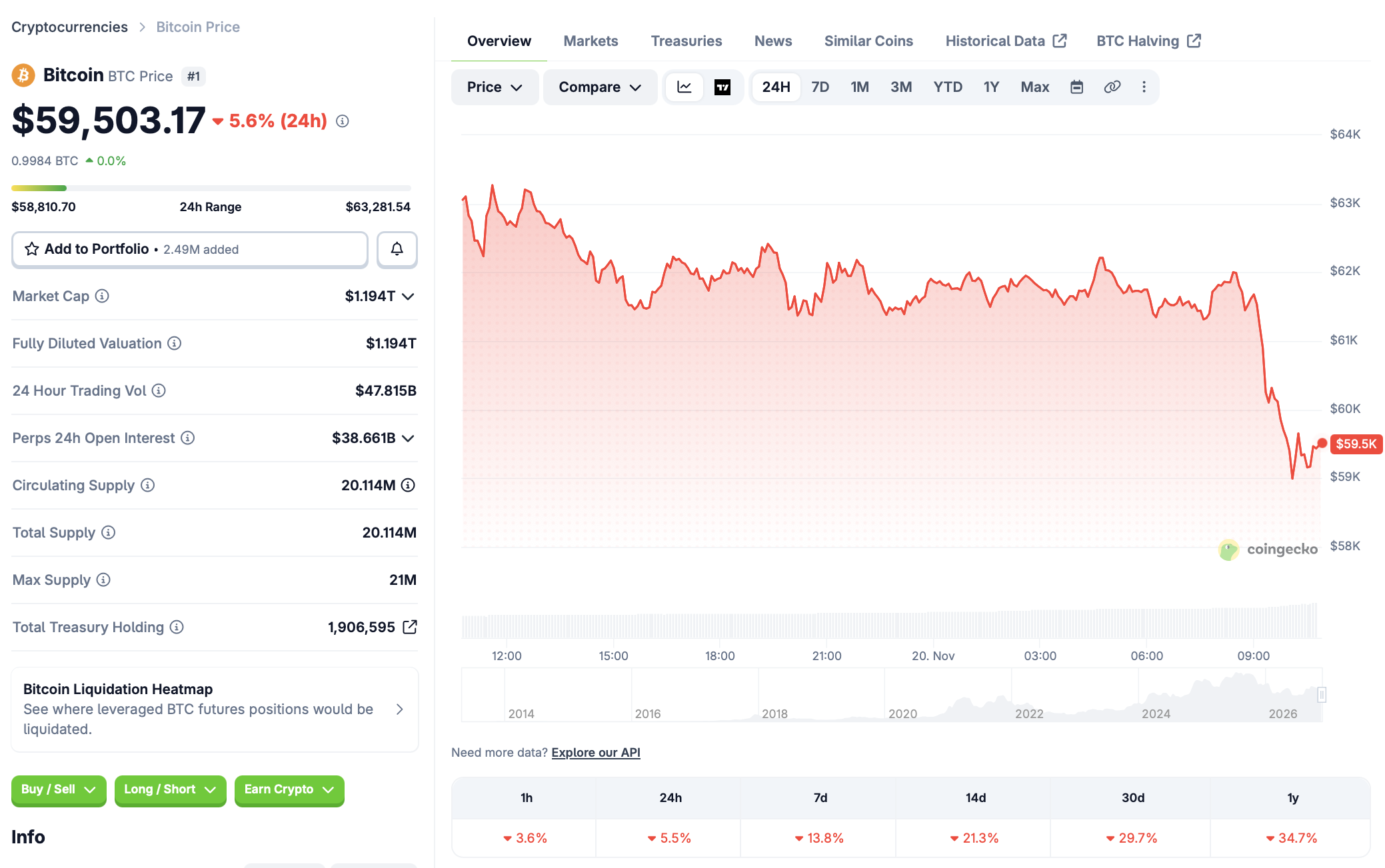
Bitcoin fell below the psychological threshold of $60,000 on Friday, marking its lowest price point since July and extending a brutal streak of recent losses. The flagship cryptocurrency’s decline unfolded alongside a punishing, broader market selloff that heavily impacted technology stocks and other risk-sensitive assets across the global financial landscape.
According to data from CoinGecko, Bitcoin (BTC) dropped as low as $58,811 during the session before mounting a modest recovery. By 16:52 UTC on Friday, the digital asset was trading at approximately $59,503, registering a 5.6% decline over the preceding 24 hours. The downward momentum has severely impacted holders over a broader timeframe, with the cryptocurrency plunging 13.8% over the past week and sliding nearly 30% over the course of the past month.
The bleeding in the crypto market did not occur in a vacuum, mirroring a stark downturn across traditional United States equity markets. On Friday, the tech-heavy Nasdaq Composite closed down 5.28% at 22,617.73, while the broader S&P 500 index retreated 3.69% to finish the session at 6,910.77, according to figures from Yahoo Finance.
Investor anxiety was further amplified by heavy downward pressure on high-profile equities, including shares of Anthropic (ANT). The company, which made its highly anticipated Nasdaq debut just a day prior, saw its stock close down 8.50% at $88.91. Market analysts attributed the slump to mounting concerns over stretched valuations and escalating capital expenditures within the artificial intelligence sector, a trend that quickly leaked into the sentiment surrounding risk assets of all kinds.
Institutional investment products also felt the immediate pinch of the market shift. United States spot Bitcoin exchange-traded funds recorded a massive $582.3 million in net outflows on Thursday, worsening significantly from the $306.5 million in withdrawals registered the previous day, according to tracking data from Farside Investors. BlackRock’s iShares Bitcoin Trust (IBIT) bore the brunt of the institutional capital flight, accounting for $541.1 million of Thursday’s total withdrawals.

AI Selloff Drives Bitcoin Weakness, CoinShares Says
Despite the sharp downward movement in cryptocurrency prices, industry experts suggest that the roots of the current correction lie outside the digital asset ecosystem itself. James Butterfill, head of research at digital asset manager CoinShares, pointed out that Bitcoin’s recent slide is primarily being driven by the broader market selloff in artificial intelligence stocks rather than internal structural flaws within the cryptocurrency market.
In an interview with Cointelegraph, Butterfill explained that Bitcoin has increasingly correlated with liquidity-sensitive growth assets. As investor sentiment toward high-flying AI stocks has soured, the risk-off mentality has naturally spilled over into the crypto space as market participants seek to de-risk their portfolios. Butterfill added that the macroeconomic backdrop, specifically the persistent prospect of interest rates remaining elevated, has significantly exacerbated the severity of the broader equities selloff.
The macroeconomic environment continues to weigh heavily on investor calculations. The United States Federal Reserve opted to hold its benchmark interest rate steady at a range of 3.75% to 4.00% during its October meeting, following a quarter-point rate increase in September. However, persistent inflation concerns and resilient economic indicators have led market participants to re-evaluate the trajectory of monetary policy. As of 17:19 UTC on Friday, traders wagering on prediction platform Polymarket were pricing in a 94% probability of another interest rate hike by the central bank at its upcoming policy decision scheduled for December 9.
Even with Bitcoin breaching the key $60,000 support level, Butterfill noted that the downward price action has not fundamentally altered his medium-term macroeconomic outlook for the cryptocurrency.
"We have been expecting Bitcoin to trade broadly between $60,000 and $90,000 until there is a meaningful change in liquidity or monetary policy, so a temporary move below the bottom of that range is uncomfortable rather than thesis-changing," Butterfill stated. He cautioned that Bitcoin could endure further short-term volatility and additional losses if the ongoing selloff in artificial intelligence and technology stocks deepens further, though he emphasized that the asset should recover relatively quickly once technology equities manage to stabilize.
Alexander Blume, the founder and CEO of digital asset investment firm Two Prime, offered a similarly measured perspective on the current market downturn. Speaking to Cointelegraph, Blume noted that a combination of macroeconomic instability, persistent interest rate pressures, sticky inflation figures, and a temporary absence of Bitcoin-specific bullish catalysts have all contributed to the asset’s recent slide.
However, Blume also highlighted potential silver linings within the market’s internal mechanics, suggesting that the worst of the liquidation cascade might already be in the rearview mirror.
"That being said, I think sellers and leverage liquidations are largely exhausted and would not be surprised for BTC to find a bottom soon," Blume concluded.





Comments (0)