


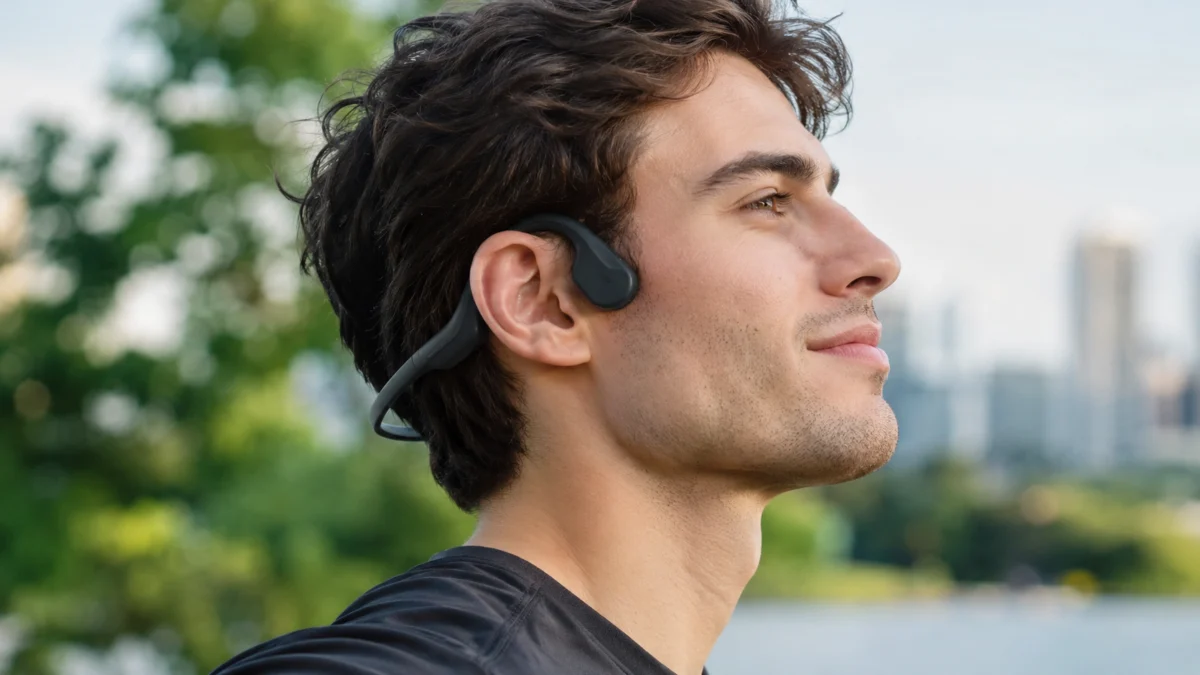
Most headphones function in a remarkably simple manner: sound waves created by internal drivers propagate outward through the surrounding air, traveling directly into the ear canal and striking the inner ear. However, a growing segment of the audio market relies on a fundamentally non-traditional approach to delivering sound. These alternative devices bypass the outer ear entirely, delivering music and spoken word through direct mechanical vibrations sent straight to the head bones and tissues. This enables users to enjoy media without inserting silicone earbuds into their ear canals or wearing bulky over-ear cups that completely isolate them from their surroundings.
Known as bone-conduction headphones, these devices generate distinct physical vibrations that work in tandem with, or entirely replace, conventional airborne speakers. While the concept might initially sound like science fiction, the physiological science behind it is surprisingly straightforward and deeply rooted in everyday human biology. In fact, a form of bone conduction occurs naturally every time a person speaks. The vibrations generated by the vocal cords travel not only through the air as acoustic waves, but also directly through the skeletal and soft tissues of the body. This internal transmission explains why a person’s recorded voice sounds so remarkably different from the voice they perceive while speaking in real time.
The transmission of acoustic signals via the human head fundamentally alters how music and spoken audio are experienced. To fully understand why these sonic differences occur, it is necessary to examine the foundational mechanics of human hearing, the transition of sound vibrations into neurological signals, and the engineering principles that make modern bone-conduction wearables possible.
Understanding How Traditional Headphones Deliver Sound
Before diving deep into the intricate mechanics of bone conduction, it helps to establish a clear baseline of how conventional headphones operate. Understanding this traditional pathway of air conduction makes the technical leap to bone-conduction mechanics much easier to follow.
Traditional headphones are designed around the principle of air conduction, transmitting acoustic information into the inner ear through a well-established biological chain reaction. First, sound waves are produced by the headphones as a direct result of a speaker diaphragm’s rapid vibration. These generated waves move through the air trapped inside the ear canal until they finally encounter the tympanic membrane, more commonly known as the eardrum, causing it to vibrate in synchronization with the audio signal.
From there, three remarkably small bones located in the middle ear—the malleus, the incus, and the stapes—amplify these mechanical vibrations and pass them onward to the cochlea. Located deep within the inner ear, the cochlea is an incredibly small, snail-shaped organ filled with fluid and partitioned by a sensitive structure called the basilar membrane. As the acoustic waves ripple through the internal fluid, specialized sensory hair cells convert this mechanical energy into electrical impulses. Finally, these electrical signals travel via the auditory nerve directly to the brain, which interprets them as recognizable sound. However, the eardrum is not the only pathway by which vibrations can successfully reach the cochlea.
How Bone-Conduction Headphones Actually Work
Whereas miniature dynamic speakers have traditionally dominated the audio landscape, modern consumer bone-conduction headphones utilize specialized electromechanical transducers. The primary function of these transducers is to convert incoming electrical audio signals directly into mechanical vibrations. Unlike conventional headphones, these transducers do not rest inside or directly over the ear canals. Instead, they are engineered to maintain firm contact with the skin and underlying soft tissues surrounding the temporal region of the head.
The hearing experience delivered by a bone-conduction device is distinct from standard earbuds or headphones. Once the audio signal is transmitted from a connected device, it is immediately converted into mechanical waves by the internal transducer. The transducer vibrates in precise synchronization with the audio track, passing those physical motions directly into the skin of the face and the underlying body tissues.
These mechanical vibrations travel through the biological framework of the head without interacting with the outer and middle ear structures at all. Once the mechanical energy reaches the cochlear region, it transforms into internal fluid motion. From this point forward, the hearing process mirrors conventional perception: sensory hair cells detect the movement within the fluid and dispatch electrical signals to the brain via the auditory nerve.
Despite the intuitive assumption that sound simply travels in a straight line through the skull bones, the reality of bone-conduction physics is remarkably complex. The transmission of sound through the head actually involves multiple physiological pathways operating simultaneously. Research into the physiology of bone-conducted sounds highlights several distinct mechanisms at play. Vibrations trigger the movement of fluid directly within the cochlea, a phenomenon known as cochlear fluid inertia, which serves as a primary driver of bone-conducted hearing. Additionally, the tiny ossicle bones of the middle ear react dynamically to the vibration of the skull itself. Furthermore, these vibrations cause minute micro-movements along the walls of the cochlea, and skull vibrations can even generate secondary sound pressure waves directly within the ear canal.
Why Bone-Conduction Headphones Sound Different From Regular Headphones
Anyone who has tested a pair of bone-conduction headphones quickly notices that they do not reproduce audio in the exact same manner as conventional earbuds or over-ear monitors. The resulting sound often carries a distinct texture and weight. This variance stems directly from the unique nature of the transducers, the complex physical vibration pathways through human anatomy, and the way human tissue naturally filters different audio frequencies.
Low-frequency bass sounds play a critical role in the modern music listening experience. In regular earphones, fluctuations in air pressure are used highly effectively to stimulate the eardrum across the entire audible spectrum. In contrast, with consumer bone-conduction headphones, the sound waves must force their way to the cochlea through a dense combination of skin, cartilage, and bone tissues.
Because human tissue has a natural physiological tendency to dampen certain mechanical frequencies, the production of deep bass tones is noticeably less intense. To compensate for this dampening effect, the transducers must vibrate with greater intensity to produce comparable bass levels, which frequently results in a noticeable buzzing or tickling sensation against the listener’s cheekbones.
Furthermore, because the transducers are positioned entirely outside the ear canal and operate via external skull vibrations, a portion of the acoustic energy inevitably leaks out into the surrounding air. This results in sound leakage, meaning individuals sitting in close proximity may overhear the audio playing from the device. Additionally, the open-ear nature of the technology allows ambient background noises to enter the ear canal unimpeded, altering the perceived clarity of the music.
The Engineering Behind Bone-Conduction Headphones
Designing consumer bone-conduction wearables requires engineers to navigate a highly specific set of physical limitations. While building a traditional speaker is primarily an exercise in moving air through an enclosure, building a bone-conduction transducer centers on the efficient transfer of mechanical energy directly into human biological tissue.
The precise positioning of the transducer is significantly more complicated than merely finding a comfortable spot where it can vibrate. The exact placement location, the physical force of pressure exerted against the skin, and the efficiency of the coupling with underlying tissue directly dictate how effectively the vibrations reach the inner ear.
Recent scientific experiments focusing on bone-conduction headsets have illuminated these variables. Studies have demonstrated that positioning transducers near the opening of the ear canal can significantly increase bone-conduction sensitivity by approximately 20 decibels compared to the traditional placement position behind the ear over the mastoid bone. In certain specific frequency ranges, sensitivity increases of up to 40 decibels have been documented.
Engineers are perpetually caught in a design tug-of-war when balancing these variables. Increasing the vibration output of the transducer can improve perceived bass response and volume, but doing so frequently leads to skin fatigue and discomfort for the user. Conversely, applying a tighter headband to ensure superior mechanical coupling and sound transmission can quickly result in headaches caused by continuous pressure on the skull.
Why Do Bone-Conduction Headphones Leave Your Ears Open?
The most defining visual and functional characteristic of bone-conduction headphones is that they leave the ear canal entirely unobstructed. By resting securely on the temporal bone or cheekbone, they avoid physically blocking the ear canal in any way.
This open-ear technology allows the normal transfer of environmental sound waves through the air directly to the eardrum, even while the user is listening to music, podcasts, or phone calls. This addresses a critical need for situational awareness among specific user segments. Bicyclists can hear approaching traffic, office workers can enjoy a private soundtrack while remaining aware of colleagues approaching their desks, and outdoor runners can maintain full spatial awareness of their environment.
However, industry experts emphasize that an open-ear design does not automatically guarantee safety. Listening to audio playback at high volumes via bone-conduction technology can still mentally distract listeners, and loud ambient environmental noises can easily mask the audio being transmitted through the skull. Furthermore, consumer bone-conduction headsets do not offer passive noise cancellation, leaving the user completely exposed to external acoustic distractions.
Are Bone-Conduction Headphones Better for Everyone?
It is a mistake to view consumer bone-conduction technology as a direct technological upgrade or a universal replacement for conventional headphones. Instead, both audio delivery methods solve fundamentally different listening challenges.
Bone-conduction devices are ideally suited for individuals who experience physical discomfort from traditional earbuds, or for those whose ear canal shapes cause standard earbuds to frequently fall out. They represent an exceptional option for outdoor athletes, urban commuters, and anyone who wishes to maintain an independent personal soundtrack without disconnecting from the reality of their physical surroundings.
Conversely, listeners who prioritize absolute high-fidelity sound quality will find that the physical limitations of bone conduction fall short of their expectations. Traditional over-the-ear and in-ear monitors offer superior performance when it comes to deep bass response, a wide soundstage, and a fully immersive listening experience. Furthermore, bone-conduction headphones cannot effectively mitigate the ambient roar of an airplane cabin or a crowded café.
The Bigger Picture: Bone Conduction is More Than Just Another Headphone Technology
Beyond alternative music listening, bone-conduction technology is actively pioneering entirely new categories of consumer wearable devices. Because bone-conduction systems leave the ear canal completely open, they are increasingly becoming an integral component of augmented reality smart glasses and spatial computing visors.
When utilizing augmented reality glasses, users require digital data and visual interfaces to be overlaid seamlessly onto the real world. Bone-conduction transducers integrated directly into the arms of smart glasses can deliver turn-by-turn navigation directions, virtual assistant responses, and audio notifications without isolating the wearer from their physical surroundings. In tactical, industrial, and outdoor sports communications, this capability allows team members to coordinate effectively via voice channels while remaining fully acoustically aware of environmental hazards.
Ultimately, the commercial emergence and evolution of bone-conduction technology highlight a fascinating biological reality: sound does not strictly have to pass through the ear canal to be perceived as audible. These specialized headphones demonstrate the remarkable versatility of the human auditory system and its unique ability to convert mechanical vibrations traveling through alternative physical pathways into music and speech.
While their distinctive transfer method introduces inherent limitations regarding bass reproduction and noise isolation, bone conduction delivers a compelling fusion of digital audio and physical perception. As engineering techniques continue to advance, the success of bone-conduction wearables raises broader questions about how future digital devices might leverage the human body’s anatomy to redefine sensory experiences.





Comments (0)