


For modern e-commerce operators, direct-to-consumer brands, and digital marketers, the primary bottleneck in digital advertising is rarely a shortage of raw product material. Across major digital storefronts, product catalogs are typically fully optimized with high-resolution imagery, detailed descriptions, core feature lists, and dynamic pricing metrics. The operational friction, instead, lies in translating these existing commercial assets into a high volume of video creatives capable of driving performance across competitive short-form channels. Producing dozens of video variations traditionally demands hours of meticulous manual labor, encompassing scriptwriting, storyboarding, visual selection, editing, and localization.
Addressing this pressing industry challenge, recent operational tests have evaluated the capabilities of Vizard Agent, an emerging autonomous video production platform designed to bypass traditional editing bottlenecks. Focusing on a common e-commerce scenario where an operator possesses rich product documentation but lacks the bandwidth to produce hundreds of promotional iterations, the evaluation centered heavily on the platform’s specialized Amazon Product Link to Promo Video workflow. Furthermore, the testing framework explored its UGC-style formatting and multi-angle advertising generation functions to determine how effectively artificial intelligence can manage end-to-end video production workflows at scale.
What We Tested
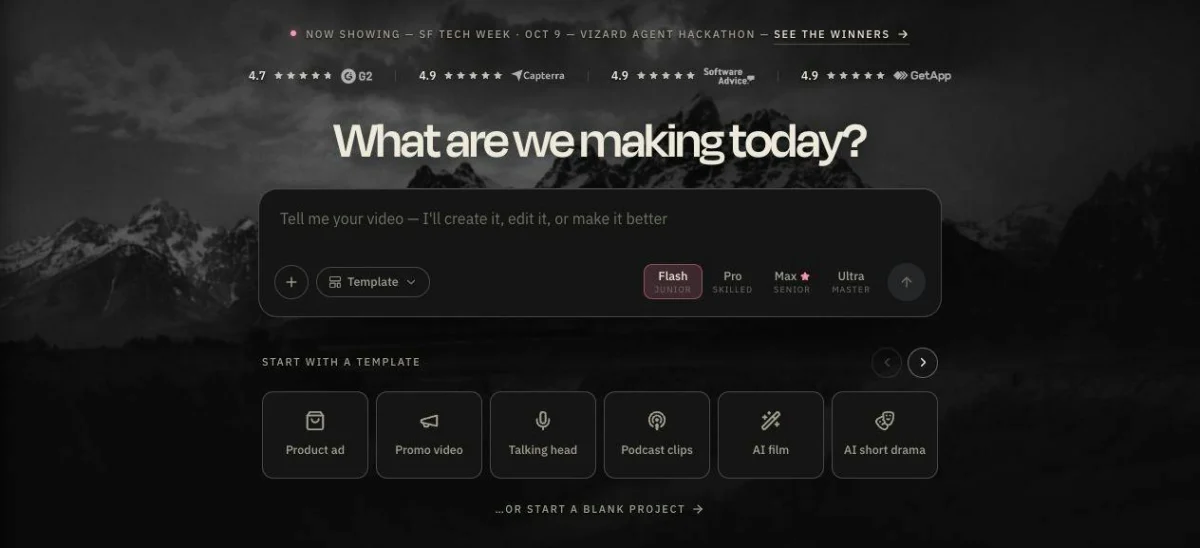
The testing methodology began with a remarkably simple premise. Rather than demanding a comprehensive, pre-packaged video production brief, the operational workflow originates from a single source: an active Amazon product listing URL. Through Vizard’s specialized ads mode, marketers can copy and paste a listing link directly into the system, enabling the agent to autonomously parse and extract visual assets and descriptive text to serve as the structural foundation for upcoming video projects. For instances where a live URL is unavailable or unsuited to the campaign, the workflow remains flexible, accommodating direct uploads of raw product imagery, text descriptions, and itemized feature highlights.
This foundational approach reflects the broader architectural design philosophy of Vizard Agent. Engineered to ingest links, existing video footage, isolated files, or hybridized combinations of user-uploaded and system-generated assets, the platform undertakes a comprehensive production cycle. It interprets the foundational request, formulates a cohesive video strategy, selects or synthesizes supplementary assets, executes complex creative decisions, assembles the final cut, and conducts a self-review of the finished media. For e-commerce operators and digital marketing agencies, this fundamentally shifts the starting point of a campaign. The static product listing itself transitions from a passive reference document requiring manual interpretation into an active creative brief that drives automated production.
From Amazon Listing to Promo Video
The practical utility of this workflow stems from its ability to bridge the traditional gap between static product data and dynamic video execution. Once a listing is ingested into the system, the user provides high-level creative prompts to define the desired video format—ranging from direct product showcases and lifestyle-oriented narratives to high-converting promotional advertisements. Vizard Agent then adapts its visual treatment to match the requested aesthetic. While product imagery and written descriptions anchor the production, the platform automatically incorporates dynamic elements such as stylized subtitles, professional voiceovers, and complementary visual graphics into the final composition.
This capability elevates the technology far beyond simple automated slideshow generators. The primary objective is translating dry product information into a structured, engaging promotional narrative. Instead of forcing a human marketer to manually determine which product feature merits primary placement, draft a compelling hook, write a script, hunt for supporting stock footage, and manually arrange individual scenes on a timeline, the operator simply provides the product link and the overarching advertising objective.
Documentation surrounding Vizard’s product-ad workflow demonstrates that this capability extends far beyond basic conversions. The system covers a diverse array of commercial requirements, including transforming standard product pages into direct video ads, converting static product images into authentic user-generated content styles, generating multiple distinct advertising angles from a single product listing, creating variations derived from historical winning advertisements, and deploying seasonal campaign iterations. For high-volume e-commerce campaigns running continuously across multiple platforms, the ability to rapidly branch out from a single product into numerous creative directions is arguably more valuable than the creation of any single polished video.
UGC Adds Another Layer
Among the various operational modes evaluated during testing, the user-generated content function proved to be one of the most practically significant. By inputting the exact same baseline product materials rather than sourcing an entirely new batch of creator footage, the testing team utilized product images to generate a distinctly creator-focused advertising format. The resulting video diverged sharply from traditional, sterile product showcases, successfully positioning the item within an authentic, community-driven social media aesthetic.
A standout aspect of this workflow was the degree of autonomy demonstrated by Vizard Agent in managing the preparatory phases of production. The testing team was not required to draft a separate UGC script, map out the psychological structure of a creator-style review, or manually assemble product visuals on a scene-by-scene basis. By treating the creative process as a holistic video production task rather than a disjointed sequence of isolated editing operations, the platform successfully transformed static product imagery into a native social media format.
From an analytical perspective, the most compelling finding was the platform’s agility in driving the same foundational product assets in divergent directions without necessitating a restart of the production pipeline. Marketers could leverage product information to generate a conventional, highly polished promotional video, and subsequently pivot toward a UGC-style treatment when targeting specific demographic segments or placement channels where polished corporate ads underperform. For e-commerce operators tasked with scaling creative output across diverse channels, this flexibility offers a substantial operational advantage over traditional editing suites.
Why This Matters for High-Volume Advertising
The primary advantage observed throughout the testing process was not tied to any single, isolated editing feature. Rather, it manifested as a dramatic reduction in the cognitive load and decision-making volume required from the human marketer. In a conventional workflow, producing digital advertising creative is an exhaustive, multi-step marathon. A marketer must carefully read the product listing, identify unique selling propositions, write an attention-grabbing hook, develop a comprehensive script, gather appropriate visual assets, edit the footage, apply captions and voiceovers, and then duplicate a significant portion of that labor for every subsequent advertising concept.
Vizard Agent streamlines these disparate activities by consolidating them into a unified production pipeline. Its documented workflow encompasses understanding the initial request, strategic video planning, asset selection and synthesis, creative decision-making, automated assembly, and final review. This consolidation becomes profoundly valuable when a performance marketing team realizes that a single product requires ten distinct creative variations rather than one finished advertisement. By supporting multiple advertising angles, variations derived from proven winners, and automated seasonal updates, the platform directly addresses the immense volume demands of modern performance marketing.
Who Should Consider It?
The operational capabilities of Vizard Agent are most directly relevant to Amazon marketplace sellers, direct-to-consumer retail brands, e-commerce marketing specialists, digital agencies, and performance marketing teams that already possess rich, detailed product documentation but face continuous pressure to scale their video output. Furthermore, the platform serves as a vital tool when a single product must be adapted into diverse creative formats tailored to the distinct algorithmic and cultural expectations of short-form video channels.
Crucially, Vizard’s automated video workflows are not restricted to the Amazon ecosystem. The promotional assets generated through the platform can be seamlessly deployed across a wide array of social media and paid advertising channels, including Instagram Reels, TikTok, and YouTube Shorts, allowing brands to maintain a consistent yet diversified multi-channel presence without proportionally expanding their creative staff.
What Still Requires Human Review
Despite the significant efficiencies introduced by artificial intelligence, testing made it clear that automated video production does not eliminate the necessity for rigorous human oversight. Critical elements such as factual product claims, accurate pricing structures, internal brand guidelines, campaign objectives, and strict platform advertising policies must be thoroughly verified by a human operator before any media is published.
Furthermore, the quality of the output remains intrinsically linked to the quality of the source material. Because the agent constructs its narratives based on the information and assets available within the listing, any inaccuracies or omissions in the original product page can propagate into the generated video. For Amazon sellers and brand managers, this limitation is critical. Automating the mechanical aspects of video production does not inherently ensure that an advertisement is factually accurate, legally compliant, or commercially appropriate. Human review remains an indispensable safeguard, particularly when video content features specific performance or health claims.
Our Assessment
Within the context of modern e-commerce operations, Vizard Agent functions less like a conventional AI editing tool and more like an autonomous video production assistant. The Amazon Product Link to Promo Video workflow establishes a uniquely frictionless entry point for digital marketers, allowing existing product listings to serve as the raw material for dynamic promotional assets. By integrating UGC-style creation and multi-angle ad generation, the platform enables a single set of product data to support divergent creative strategies across multiple platforms.
For e-commerce teams that maintain abundant product information but consistently struggle against the relentless demand for fresh video creatives, the primary value of this technology lies in workflow compression. The most significant paradigm shift is not simply that artificial intelligence can execute editing tasks at accelerated speeds, but that the entire continuum—from product listing and creative brief to asset selection, scripting, editing, and variation generation—can now be managed as a single, cohesive production task.





Comments (0)