



Cryptocurrency markets have opened the year with subtle yet important structural shifts, led by Bitcoin demonstrating a rare and timely negative correlation with traditional risk and defensive assets. While mainstream equities and gold experienced a pullback, Bitcoin pressed higher in a steady, low-drama rally. At the same time, higher-beta crypto narratives reawakened, and derivatives positioning across major networks pointed to a careful, deliberate rebuild of market exposure rather than an outbreak of speculative excess.
As traders and analysts assess the early landscape of the year, attention is focusing on how digital assets are behaving as portfolio diversifiers, the underlying health of Ethereum derivatives following a quiet December, and the rapidly growing case for equity perpetuals as a crypto-native product nearing a major retail inflection point.

Indices and Market Performance
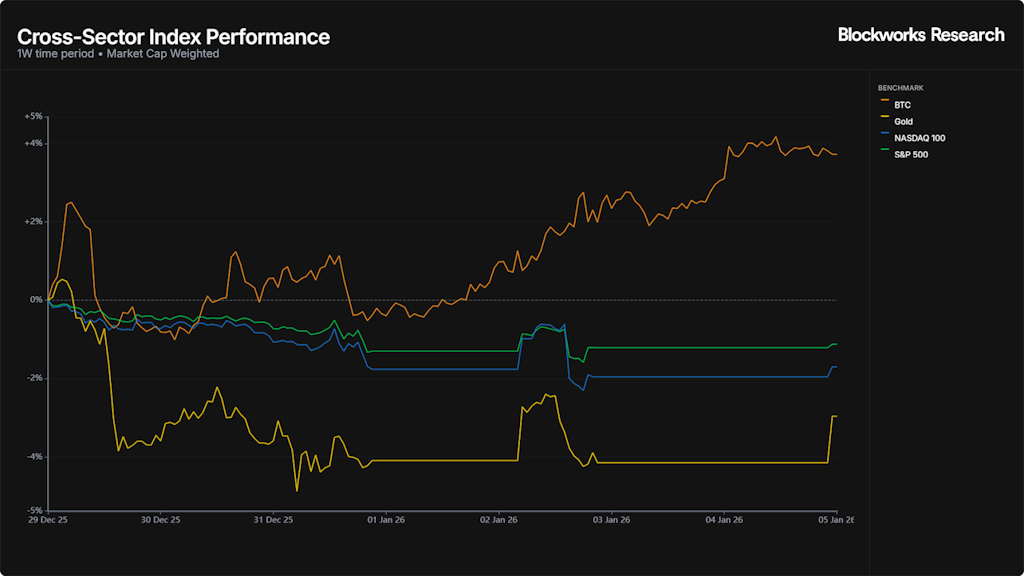
Bitcoin quietly stole the spotlight during the opening week of the year, benefiting from an unaccustomed negative correlation to both equities and gold. While traditional financial markets softened—with the Nasdaq 100 dropping 1.7 percent and the S&P 500 slipping 1.1 percent—and gold suffered a sharp 3 percent sell-off, Bitcoin advanced by 3.7 percent. This steady, low-drama move stood out precisely because of how prolonged the period has been since crypto outperformed both risk-on and defensive asset classes within the same window.
Rather than feeling like an outburst of unbridled speculative exuberance, the price action functioned as a reminder of Bitcoin’s potential role as a portfolio diversifier. Throughout much of the previous year, correlations across asset classes repeatedly snapped back toward parity, making decoupling a rare event. Whether this independence from traditional markets can persist will likely depend on macro-level follow-through, but for now, Bitcoin’s ability to outpace both stocks and gold marks a notable shift in tape behavior.
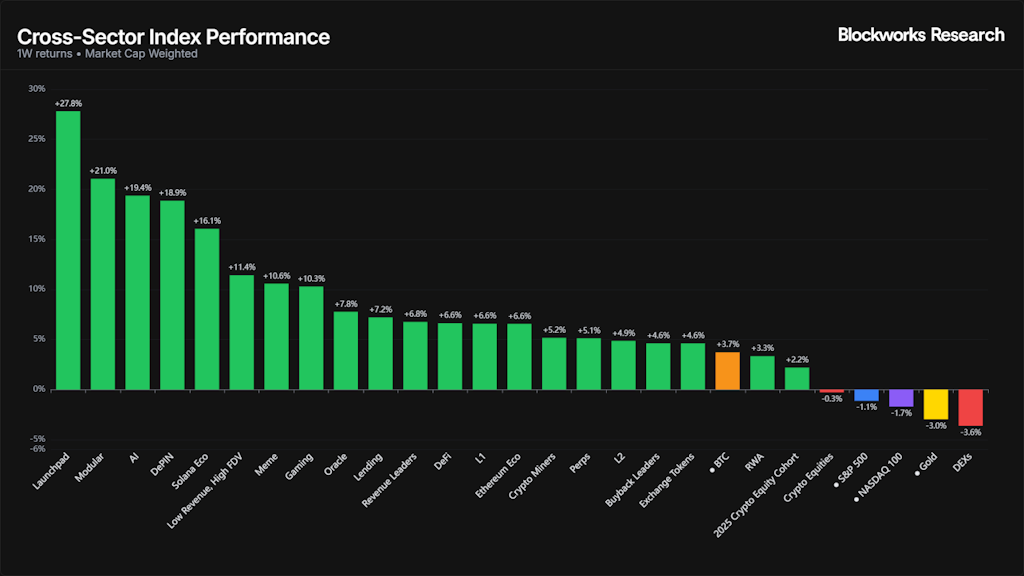
Beneath Bitcoin’s steady climb, the past week’s winners were concentrated almost entirely in the higher-beta, narrative-driven corners of the digital asset ecosystem, signaling a broader appetite for speculative positioning. Launchpad tokens led the field by a wide margin with a 27.8 percent gain, propelled by renewed retail participation and a resurgence in short-duration token launches as traders chased velocity over fundamental metrics. Modular frameworks and artificial intelligence tokens followed closely, posting gains of 21.0 percent and 19.4 percent, respectively, while Decentralized Physical Infrastructure Networks and the Solana ecosystem also recorded strong performances.
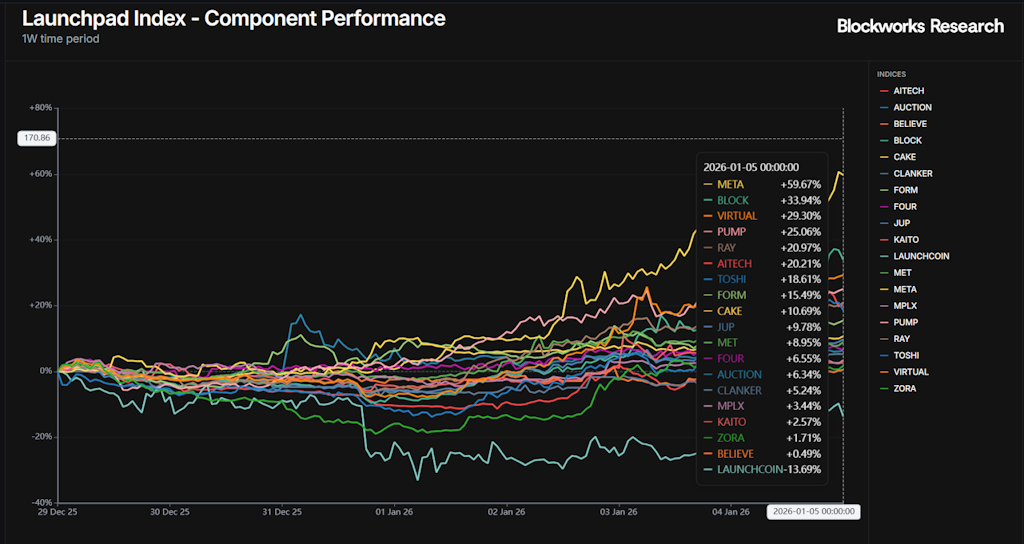
Within the launchpad sector, leadership once again belonged to MetaDAO, which extended its relative outperformance and reinforced its position as the bellwether for the vertical. Sharp gains for the token reflected renewed investor interest in token issuance infrastructure, as market participants gravitated toward platforms closely levered to new issuances and velocity-driven capital flows.
Just as notable as the top performers was the market breadth: nearly every constituent in the launchpad index finished the week in positive territory, highlighting a synchronized sector-wide move rather than isolated token news. The sole exception was Launchcoin, which lagged while the rest of its cohort capitalized on the upside. Such near-universal participation is typically indicative of broader sector-level positioning. Looking ahead, the structural setup remains compelling, with regulatory frameworks expected to crystallize and compliant launch infrastructure steadily transitioning from a speculative niche into a permanent pillar of the crypto stack.
Market Update and Derivatives Behavior
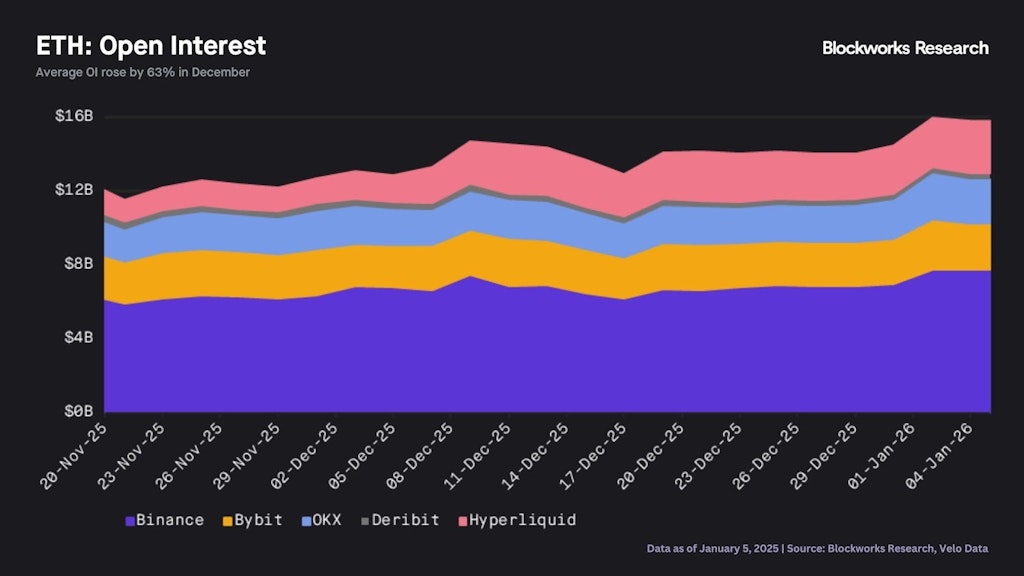
Turning to derivatives, Ethereum markets in December were defined by a clear and revealing divergence between market participation and underlying positioning. Perpetual futures volumes continued to cool significantly, with aggregate Ethereum perpetual volume falling roughly 31 percent month-over-month. This extended a contraction that began in November, reflecting fading speculative intensity amid a broader period of price consolidation and compressed market volatility. Activity declined across major trading venues, signaling a reduced appetite for short-term directional trading, a trend exacerbated by thinner holiday liquidity.
Despite the pullback in turnover, open interest rebounded sharply. Average Ethereum open interest rose approximately 63 percent over the course of the month, reversing the contraction seen in November and climbing steadily as price action stabilized. The combination of falling trading volumes and rising open interest suggests that exposure was rebuilt quietly and deliberately. Rather than aggressive, high-leverage chasing of price movements, the data points to longer-horizon participants or relative-value strategies establishing positions.
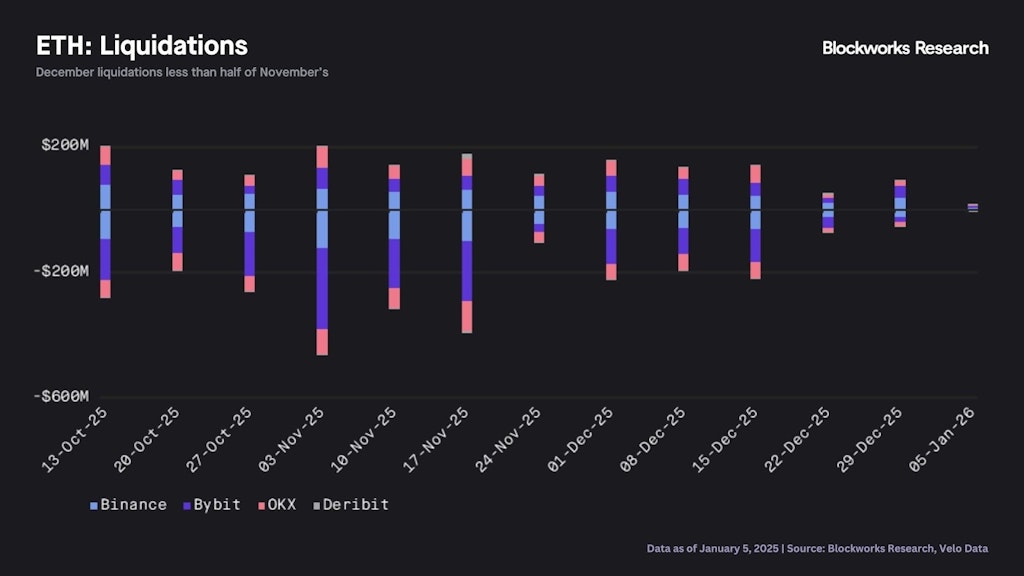
This measured approach to positioning was further reinforced by a continued decline in liquidation activity. Ethereum liquidations remained subdued throughout December, with weekly liquidation volumes dropping 56 percent from November levels and sinking well below the forced deleveraging extremes seen in October. Both sides of the market remained relatively contained as prices consolidated, with short liquidations continuing to modestly exceed long liquidations, albeit at significantly lower absolute values. The total absence of large-scale liquidation cascades, paired with rising open interest, underscores a healthier leverage profile where positions were added gradually and risk was managed with greater discipline.
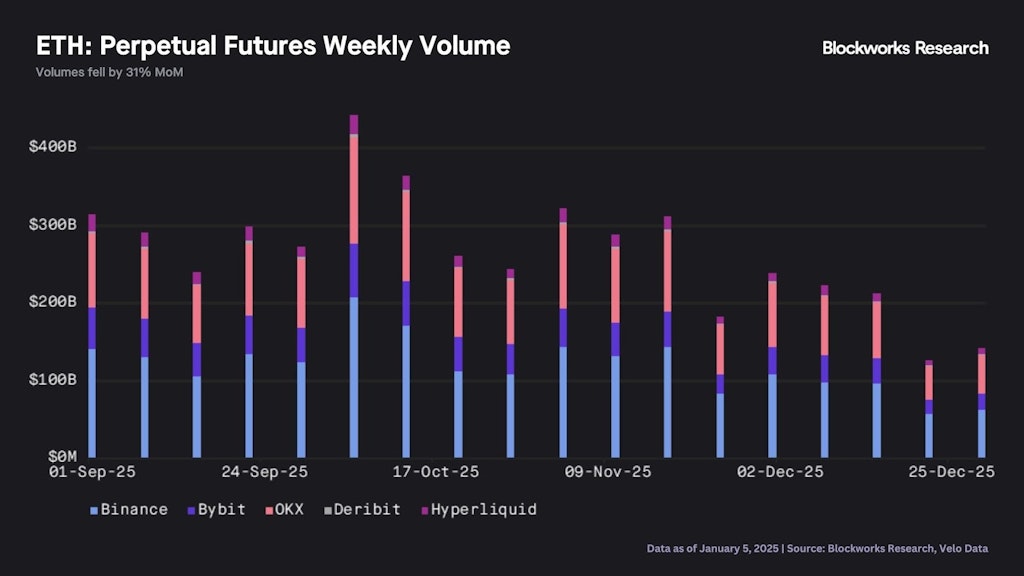
When taken together, declining trading volumes, rising open interest, and falling liquidations characterize the final month of the previous year as a period of risk reduction and positioning reset rather than a resurgence of speculative excess.
The Bull Case for Equity Perpetuals
Beyond traditional crypto assets, market observers are increasingly turning their attention to equity perpetuals, a product class often framed as a crypto-native attempt to bring traditional financial markets onchain. In reality, however, the primary competition for equity perps is not decentralized options, but rather leveraged exchange-traded funds, a product category that has already achieved massive adoption among retail investors. The underlying appeal is straightforward: retail market participants increasingly demand leveraged exposure packaged in a clean, intuitive format.
Recent data highlights the sheer scale of this retail demand. According to estimates from JPMorgan, retail equity flows over the course of the year were more than 50 percent higher than in the previous year, surpassing even the peak meme stock mania of 2021. Leveraged ETFs have absorbed a significant portion of this appetite, with assets under management expanding from $41.6 billion to $250 billion, accompanied by monthly trading volumes regularly exceeding $800 billion.
Despite their popularity, leveraged ETFs suffer from structural design flaws. Because they rely on underlying derivatives to reset their exposure on a daily basis, they introduce volatility drag. Even if an underlying index ends a given period unchanged, leveraged ETFs can steadily lose value over time due to this mechanical decay. Although these products are engineered explicitly for short-term trading, they are frequently misunderstood by retail participants and held for far longer than intended, often resulting in unintended losses.
Equity perpetuals solve this structural issue by providing constant notional exposure without the need for daily resets, meaning leverage does not decay mechanically. Volatility does not compound against the trader in the same way, making equity perps a fundamentally cleaner instrument for anyone seeking leveraged directional exposure.
Early market traction supports this thesis. Since mid-October, equity perpetual volume on Hyperliquid has reached approximately $12.9 billion, with daily volumes consistently registering between $200 million and $300 million. Hyperliquid currently dominates market share in this nascent sector, followed closely by platforms like Lighter. Accessibility remains a critical factor, with equity perp volume emerging naturally on the same onchain venues that already command liquidity for crypto perpetuals.

Nevertheless, structural frictions remain. When traditional equity markets are closed for weekends or holidays, market makers are unable to hedge their positions, liquidity thins out noticeably, and funding rates can experience sharp spikes. Platforms have addressed these challenges through various methods, including restricted trading hours or internal oracle adjustments, which helps explain why adoption has grown at a steady, deliberate pace rather than exploding overnight.
Ultimately, the long-term winners in this space will likely not be determined by venue design alone, but rather by distribution channels. Just as centralized exchanges came to dominate crypto perpetuals, equity perpetuals will likely scale through platforms boasting massive retail reach. Major financial technology and crypto platforms are exceptionally well-positioned to capture this demand. Some industry participants have already taken initial steps toward tokenized equities, raising the prospect that compliant versions of equity perpetuals could emerge broadly. With leveraged ETFs currently trading between $800 billion and $900 billion per month, capturing even a small fraction of those flows would represent a substantial expansion in trading volume for retail-focused platforms. As the market matures, equity perpetuals are increasingly viewed not merely as a speculative crypto experiment, but as a retail product waiting for the right distribution channel to unlock mainstream scale.





Comments (0)