



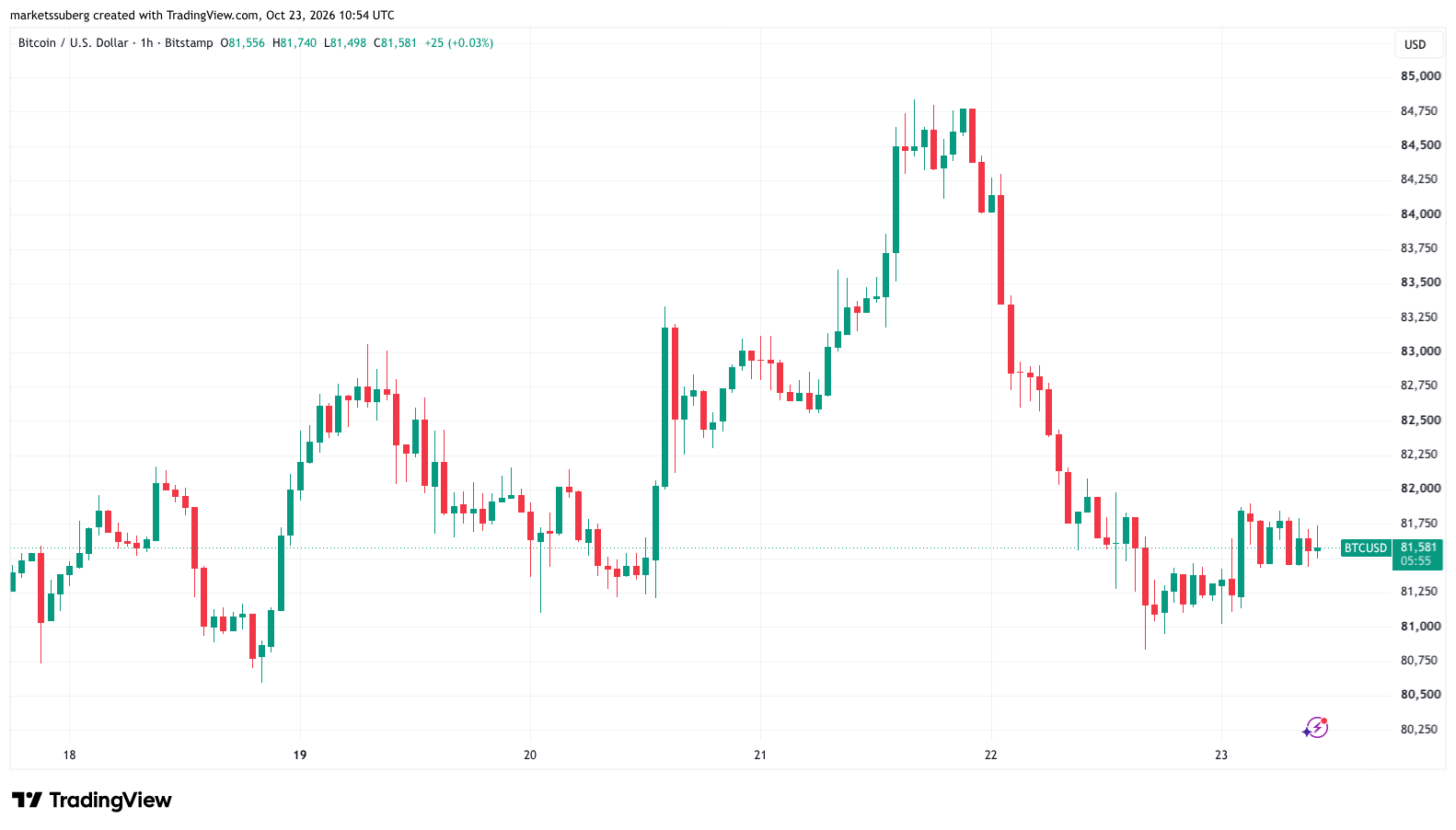
Bitcoin (BTC) traded in a subdued range below the $82,000 threshold leading into Friday’s Wall Street opening bell, as broader stock markets experienced a sustained downward slide driven by growing anxiety surrounding artificial intelligence financing and corporate debt.
Data from TradingView highlighted that BTC/USD attempted to stabilize after enduring a sharp 3.2% drop during Thursday’s trading sessions, a downward movement that dragged the world’s leading cryptocurrency to an intraday low of $80,840 on the Bitstamp exchange. The latest price action underscores a persistent correlation between digital asset valuations and macroeconomic sentiment, particularly as institutional investors reassess risk exposure across high-flying technology sectors.

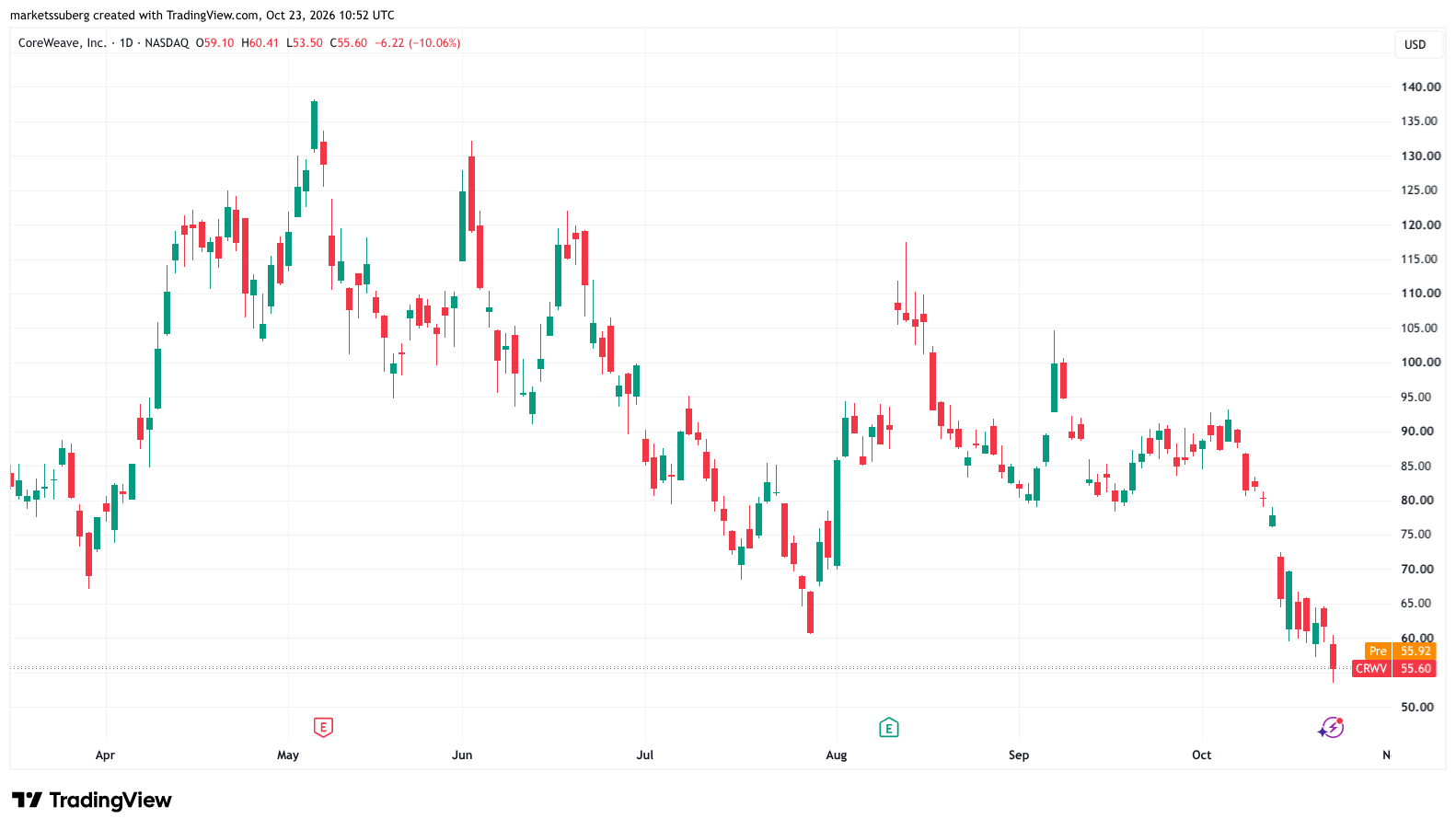
Market nerves regarding AI-sector profitability and the escalating cost of insuring major industry players against potential default have reemerged prominently this week, sending ripples of caution across both traditional equity and digital asset exchanges. Among the hardest hit was CoreWeave, a prominent neocloud infrastructure provider, which recorded a steep 15.5% decline week-to-date by the close of Thursday’s U.S. trading session, touching its lowest valuation levels since May 2025. Adding substantial downward pressure to the company’s valuation was a notable price target downgrade issued by financial services firm Bernstein, which slashed its target for the stock from $74 down to $51.
Industry analysts point out that these equity corrections are symptomatic of a broader anxiety spreading across the technology landscape. Crypto trading firm QCP Capital addressed the phenomenon in a recent market note, writing that the spread of credit stress across the neocloud infrastructure sector has triggered broader equity market weakness as institutional investors evaluate capital expenditure commitments and profitability across technology firms dependent on AI infrastructure expansion.
The cautious sentiment was not confined to Western markets. On Friday, fresh downside pressure impacted Asian equities markets, adding to the global risk-off mood. South Korea’s KOSPI Composite Index experienced notable volatility, opening the trading day at 5,402 points before tumbling as low as 5,305 points—its weakest performance since late July. Despite the steep morning dive, the index managed a modest recovery, ultimately finishing the session up 0.3% for the day.
The underlying structural pressures facing the AI and cloud infrastructure ecosystem were further highlighted by industry leaders. Speaking to CNBC on Thursday, Nvidia CEO Jensen Huang addressed the looming issue, pointing to what he described as a "scarcity of capital" directly impacting neocloud buildouts. Huang noted that the corporate demand for capital to fund massive technological expansion is currently much greater than the availability of liquid capital in the broader financial system.
This capital constraint narrative builds upon earlier market reactions. Cointelegraph previously reported on lower-than-expected capital expenditure figures released by Tesla during its third-quarter earnings report, which, despite broadly conforming to headline market expectations, revealed a more conservative approach to heavy corporate spending. QCP Capital noted that these tempered capital expenditure figures reinforced prevailing concerns that elevated financing costs will constrain the pace of artificial intelligence infrastructure buildouts and potentially reduce expected return profiles for capital-intensive projects moving forward.
Analysis warns of AI “credit stress” contagion
The ripple effects of these macroeconomic pressures were felt acutely within the cryptocurrency derivatives and spot markets, where capital flows reacted sharply to Bitcoin’s local trading range between $80,000 and $87,000.
Institutional products experienced an immediate shock as capital flows into exchange-traded funds reacted to the shifting price landscape. On Thursday, United States spot Bitcoin ETFs registered net outflows totaling $635 million, marking the single-largest daily drawdown for these investment vehicles since late June and signaling a temporary retreat by institutional allocators.
Concurrently, derivatives traders found themselves severely exposed as BTC/USD revisited the lower boundary of its established range. Data compiled by crypto analytics platform CoinGlass revealed that leveraged market participants were caught off guard by the swift downward momentum. Cross-crypto liquidations surged to a total of $336 million over the 24-hour period leading up to noon UTC. The vast majority of these liquidations consisted of bullish bets, with long positions accounting for $281 million of the total flush, underscoring the swift and aggressive nature of the correction as Bitcoin tested support near the $81,000 level.





Comments (0)