



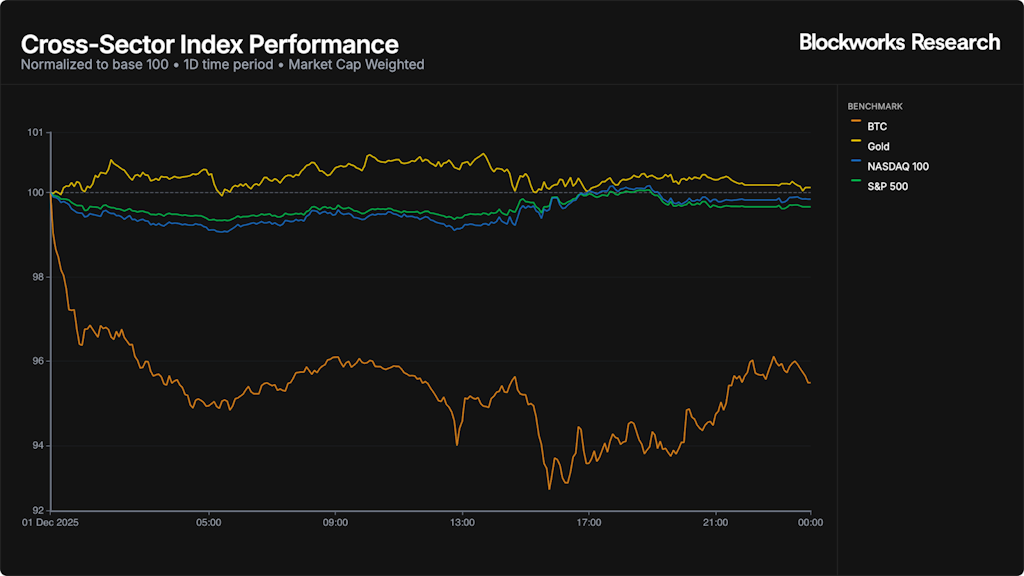
Financial markets experienced widespread downward pressure as cryptocurrencies endured a significant sell-off, pulling prices lower even as broader economic indicators pointed to growing expectations of an upcoming interest rate cut by the United States Federal Reserve. Bitcoin traded lower throughout the session, shedding more than 6% at its lowest point before paring some losses to finish the day down approximately 4.5%. Traditional equity markets showed far more resilience by comparison, with the Nasdaq 100 slipping 0.2% and the S&P 500 declining by a modest 0.3%. Meanwhile, gold continued to demonstrate relative strength, posting a 0.1% gain and holding comfortably near its recent highs, once again outpacing the flagship digital asset during a period of macroeconomic uncertainty.

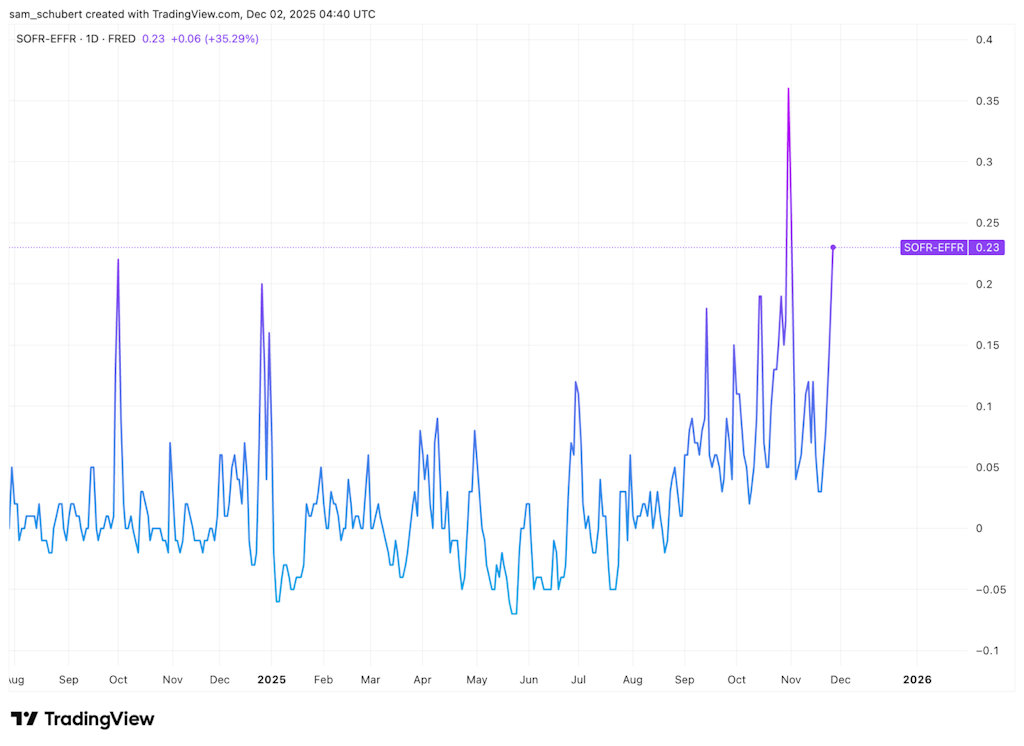
Market participants remain intensely focused on macroeconomic developments within the United States, particularly regarding monetary policy adjustments. Current data from the CME FedWatch Tool indicates an 87% probability that the central bank will implement a 25-basis-point rate cut during its upcoming December meeting. Beneath the surface of these rate cut expectations, analysts have highlighted concerning signals emerging from short-term funding markets. The Secured Overnight Financing Rate (SOFR) has recently moved materially above the upper bound of the Federal Reserve’s target policy corridor, serving as a clear warning sign of emerging liquidity constraints and stress within commercial bank reserves.
When a key overnight secured rate persistently trades above the top of the central bank’s policy corridor, it typically indicates that banking reserves are becoming scarce at the margin and that overall balance sheet capacity is constrained. Consequently, market participants are monitoring the Federal Reserve for its next operational steps. Financial institutions anticipate that some form of adjustment to balance sheet operations or the administered rates toolkit will be required to alleviate this tension and successfully re-anchor money market pricing back inside the targeted policy range.
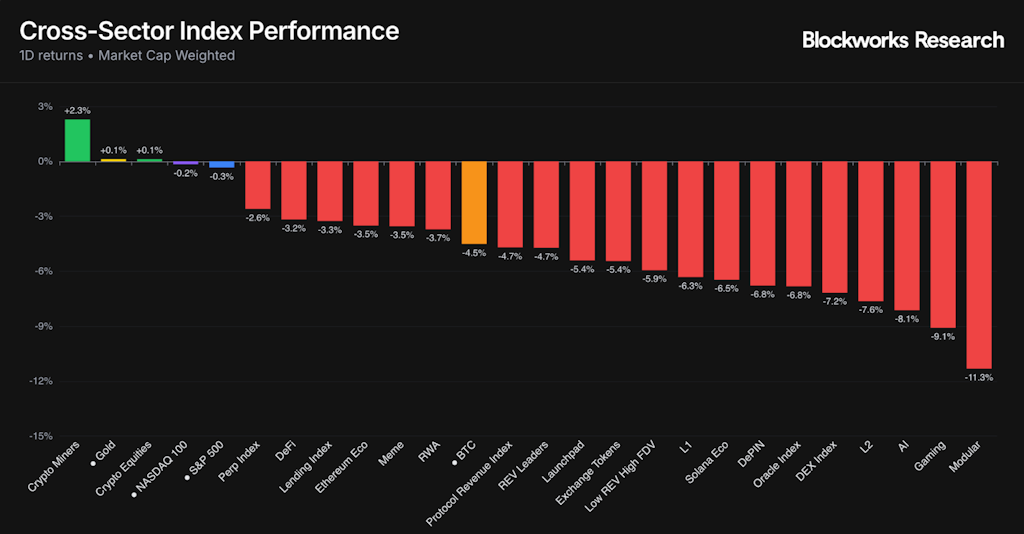
Digital asset performance across various sectors reflected broader weakness, with most crypto-specific indices underperforming Bitcoin following a difficult month for high-risk assets overall. The notable exception to the downtrend was the crypto miners sector, which managed a 2.3% gain and continued to decouple from the rest of the digital asset complex. Crypto equities also finished the session marginally higher, posting a 0.1% increase. At the opposite end of the performance spectrum, modular blockchain tokens suffered the steepest losses with an 11.3% decline, followed by the gaming sector down 9.1% and artificial intelligence-focused token baskets dropping 8.1%. Major foundational sectors also felt the pinch, as indices tracking layer-2 networks, decentralized exchanges (DEXs), and decentralized physical infrastructure networks (DePIN) recorded losses ranging between 6% and 8% on the day. Industry observers view this performance pattern as entirely consistent with ongoing risk reduction across higher-beta tokens while market participants wait for concrete confirmation that monetary authorities will intervene to address prevailing liquidity concerns.
Market Update
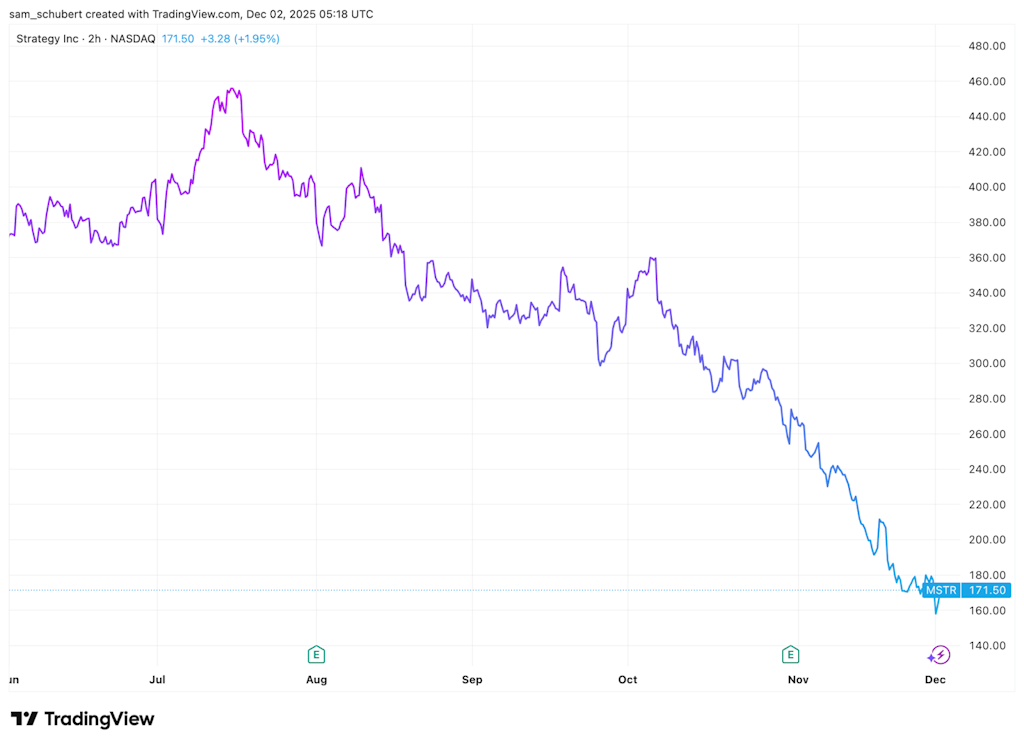
Corporate treasury strategies involving heavy digital asset exposure came under intense scrutiny as shares of Strategy extended their recent drawdown. The company’s stock dropped below $160 during the session before recovering slightly to close near $171. This latest downward movement leaves the equity down roughly 37% over the course of a single month and more than 60% below its highs recorded in July 2025.
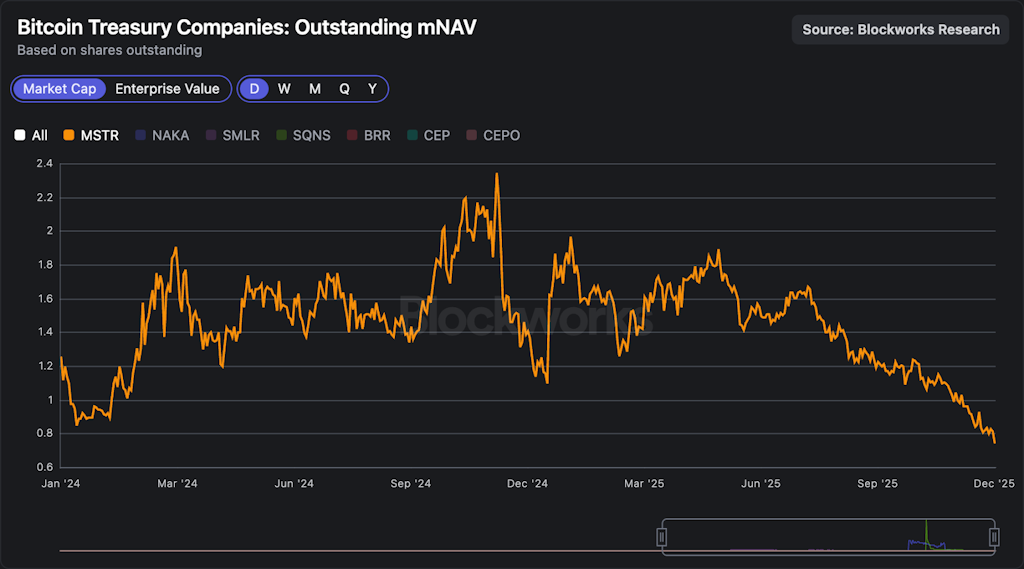
Market analysts point out that the company’s outstanding market-to-net-asset-value (mNAV) ratio dipped below parity in early November and has since slid toward 0.75, illustrating the severe risk-off sentiment currently dominating the sector. This dynamic introduces systemic concerns regarding potential cascading effects, as investment vehicles trading at a persistent discount to their underlying assets can inadvertently amplify drawdowns and trigger forced selling pressures.
When a corporate vehicle trades below its net asset value for an extended period, issuing new equity ceases to be an accretive mechanism and instead becomes value-destructive, effectively removing one of the entity’s primary funding levers. This structural constraint forces management to consider alternative measures—such as liquidating treasury holdings of Bitcoin or executing derivative strategies against those holdings—precisely when both the underlying token and the company equity are already facing severe downward pressure. Financial markets frequently begin pricing in these risks well in advance.
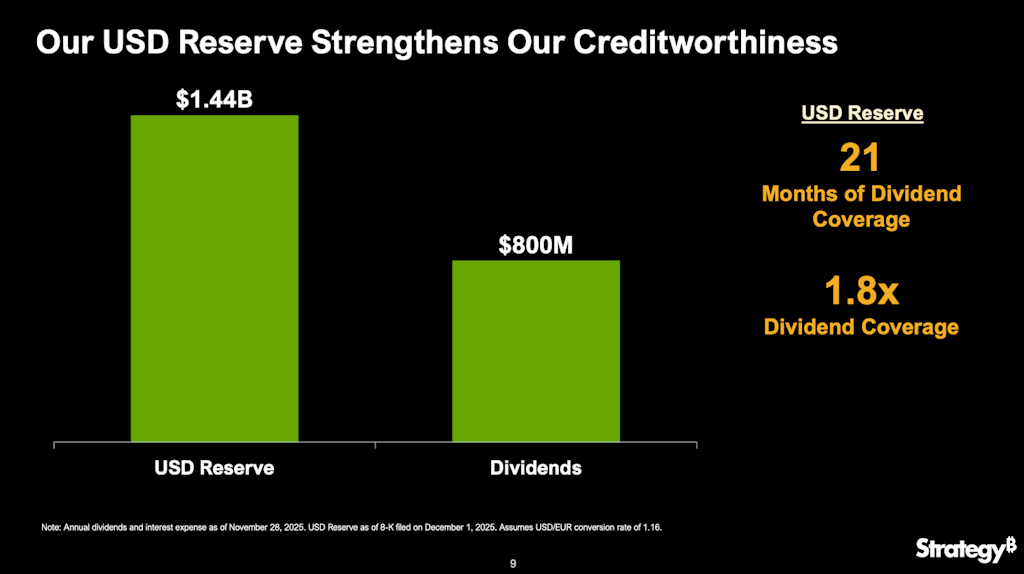
However, recent corporate disclosures provided some relief to investors by revealing that Strategy has successfully accumulated a cash reserve of approximately $1.4 billion, funded through previous equity issuance initiatives. Management has explicitly earmarked this capital to cover at least 12 months of dividend payments, with an ultimate strategic goal of extending that runway to 24 months. This financial cushion is designed to ensure the firm can maintain its dividend obligations without needing to liquidate any portion of its massive treasury holding of roughly 650,000 Bitcoin, even if current market drawdowns prove prolonged. This announcement helped the stock recover a portion of its daily losses by reassuring equity holders regarding the security of their payouts.
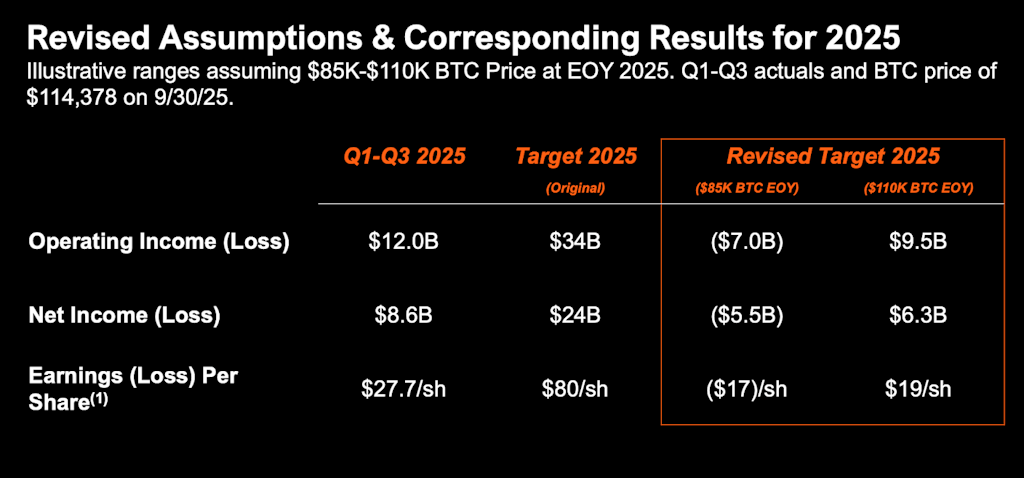
Simultaneously, corporate leadership revised its forward-looking guidance, reducing its year-end Bitcoin price assumption from a previous target of $150,000 down to a range between $85,000 and $110,000. This adjustment lowered the company’s projected full-year dollar-gain targets for its digital asset holdings to between $8.4 billion and $12.8 billion, leaving full-year GAAP earnings highly sensitive to where the cryptocurrency ultimately settles. During the subsequent investor earnings call, management noted that a year-end Bitcoin price falling below approximately $94,000 would result in the company operating at a net loss, whereas a price exceeding that threshold would support positive net income.
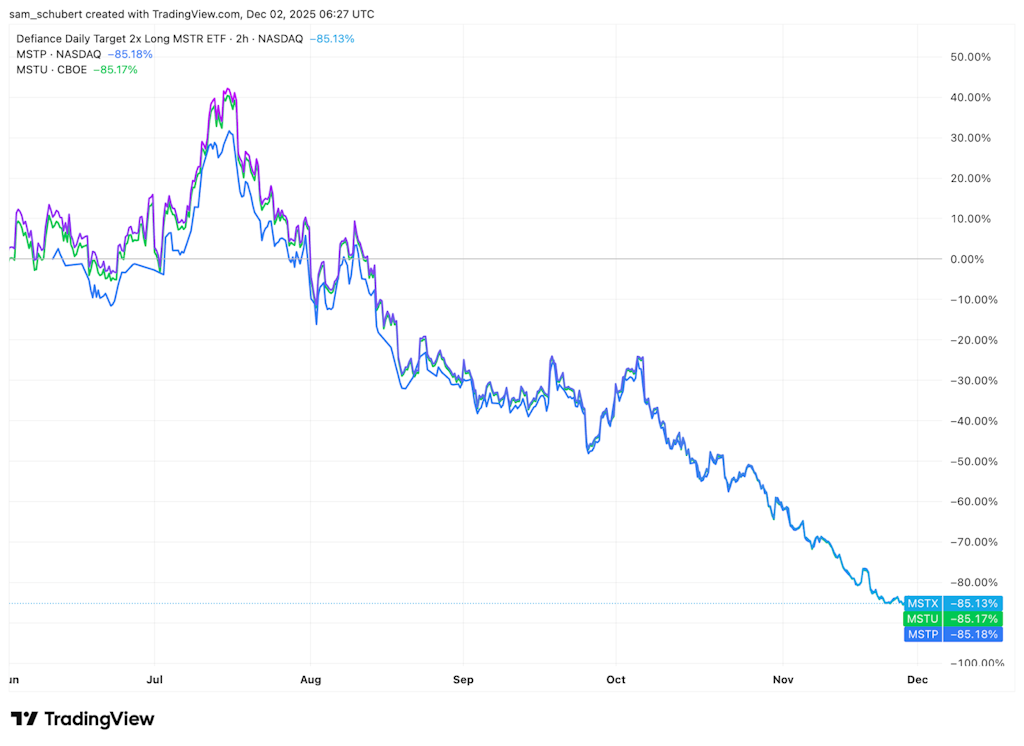
The severe volatility has hit leveraged exchange-traded products tied to the corporate strategy particularly hard. Specialized funds such as MSTX and MSTU, which are designed to deliver twice the daily return of the underlying stock, rank among the ten worst-performing United States-listed exchange-traded funds for the year, having suffered losses exceeding 80%. A newer fund, MSTP, has experienced a similarly steep decline since its inception. Consequently, the combined assets under management for this trio of products have shrunk from more than $2.3 billion in early October to approximately $800 million. These financial instruments vividly demonstrate how compounding volatility can steadily erode investor returns during a steep downturn, even if an asset eventually stabilizes. This dynamic has left late-arriving retail investors holding substantial losses, turning what was once a wildly popular leveraged trade into a classic textbook example of negative reflexivity.
HumidiFi’s ICO: Dark AMM, Darker Disclosures
Attention in the decentralized finance ecosystem also turned toward upcoming token generation events, specifically the scheduled token sale for HumidiFi’s WET asset. The token is slated to debut as the first initial coin offering hosted on Jupiter’s Decentralized Token Formation platform, with subsequent public trading scheduled to open on Meteora and HumidiFi. HumidiFi operates as a proprietary automated market maker developed by Temporal, a research and development firm deeply rooted in the Solana ecosystem. Alongside the market maker, Temporal also operates Nozomi, a high-performance transaction landing service on Solana, and Harmonic, a specialized block-building system designed to compete with industry participants like Jito. Ahead of the scheduled token sale, the development team published detailed documentation outlining the proposed tokenomics for the asset.
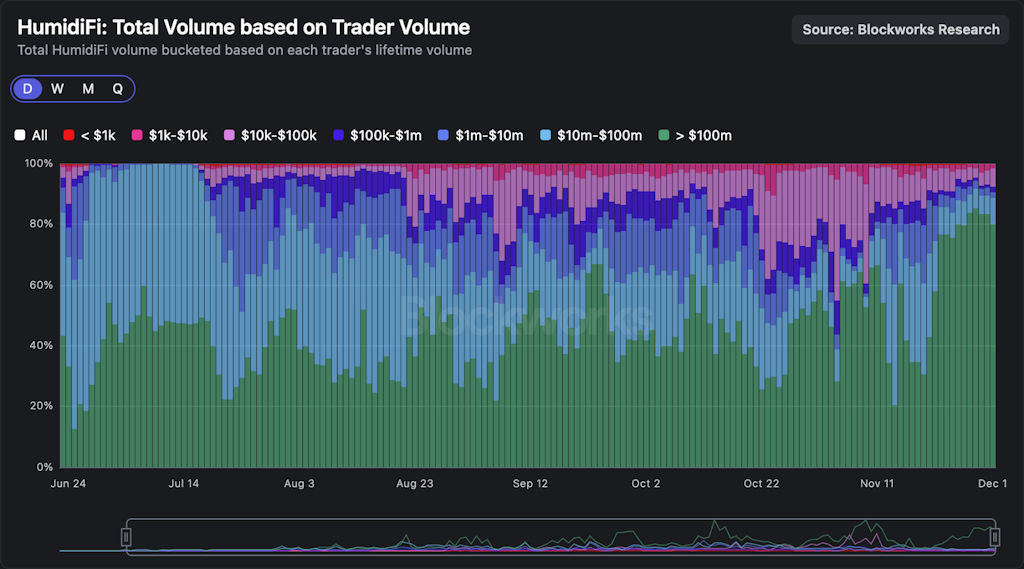
The WET token will feature a maximum total supply of 1 billion tokens, with 10% specifically carved out for initial coin offering participants. Documentation indicates that eligible participants fall into several distinct categories. The protocol previously captured a network snapshot to establish pre-sale allocations reserved explicitly for active platform users, heavily favoring top-tier traders. Historical trading data indicates that wallets with lifetime trading volumes exceeding $100 million have consistently accounted for more than half of the platform’s daily volume. Market observers note that these high-volume wallets likely belong to professional market makers and algorithmic arbitrage bots that secured whitelist status for the offering.
The broader token distribution schedule shows that the remaining 90% of the supply is divided between the Zero Position Foundation, which receives 40%, an ecosystem development fund allocated 25%, and core engineering labs taking the final 25%. While the operational details remain somewhat opaque, industry watchers presume the foundation will be managed by Temporal, although official announcements left the exact operational entity unnamed just prior to the sale. The labs allocation is also widely understood to refer to Temporal given its foundational role in engineering the automated market maker. Furthermore, because HumidiFi has relied on a broad collaborative network including external engineering teams, liquidity providers, and market makers, the ecosystem allocation is expected to serve as a mechanism to incentivize and reward these key contributors.
The token will launch with an initial circulating float of 23%, bearing structural similarities to the low-float, high-fully-diluted-valuation token launches that have historically characterized parts of the Solana decentralized finance landscape. Analysts expressed surprise that the core development team opted for a low initial float given how unfavorably the broader market has treated similar token structures over preceding cycles. Public schedules indicate that 19.25% of the total supply, amounting to 192.5 million tokens, will be unlocked every six months over a two-year period following the token generation event.
From a fundamental adoption perspective, HumidiFi has successfully established itself as a dominant proprietary automated market maker by trading volume over recent months. During November, the platform captured 51% of all Solana-native token pairs traded against stablecoins and accounted for 36% of total decentralized exchange volumes across the entire Solana network, successfully surpassing traditional automated market makers such as Orca, Raydium, and Meteora.
The protocol’s trading dominance extends beyond decentralized venues, regularly eclipsing traditional centralized exchanges in spot volume for major liquid pairs. HumidiFi has averaged more than $1 billion in daily volume for major pairings, occasionally surpassing major centralized platforms like Binance to claim the top spot globally. This rapid ascent since its launch highlights the technical progress achieved by the core engineering team in automated market maker design.
Until recently, market participants lacked a straightforward mechanism to gain direct financial exposure to the growth of proprietary automated market makers. Investors previously had to rely on indirect strategies, such as shorting traditional decentralized exchange tokens, to express a bearish view on legacy Automated Market Maker designs. However, industry analysts suggest the upcoming token utility may not entirely fulfill investor expectations for direct equity-like exposure. WET token utility centers primarily around allowing users to stake tokens in exchange for fee rebates, with the development team explicitly noting in disclosures that the asset is not intended to be viewed as an investment.
As the token generation event approached, several fundamental questions remained unanswered by the core team. Observers questioned why a highly profitable proprietary trading desk needed to conduct an initial coin offering to raise capital, whether the token conferred any formal governance or economic ownership rights over the underlying trading platform, and which specific entity would ultimately govern the foundation controlling the largest share of the token supply. Market participants noted that only time would reveal whether the asset would accrue genuine economic value or simply function as the latest promotional vehicle within the ecosystem.




Comments (0)