



In what has quickly emerged as one of the most alarming security incidents in the history of decentralized finance, a hot wallet belonging to cryptocurrency exchange Binance was entirely emptied in a single, devastating transaction on October 29, 2026. The exploit utilized EIP-7702, a groundbreaking feature that went live on the Ethereum mainnet in May 2025 as part of the Pectra upgrade. As the crypto community scrambled to assess the fallout by October 30, developers and security researchers confirmed a chilling reality: no flaw or vulnerability in EIP-7702 itself had been reported. Instead, the tool executed precisely what a valid cryptographic signature instructed it to do, transforming the conversation surrounding the breach into a critical examination of signing-side security, automated infrastructure vulnerabilities, and the inherent risks of account abstraction.
To understand the mechanics of the attack, industry experts have turned their attention to how EIP-7702 fundamentally changes the interaction between regular Ethereum wallets and smart contracts. Introduced officially on May 7, 2025, EIP-7702 allows a standard externally owned account, commonly referred to as an EOA, to temporarily or permanently borrow smart contract code, enabling it to behave like a programmable smart account without forcing users to migrate their funds to an entirely new address. The specification introduces a novel transaction type that carries signed authorizations. Each authorization explicitly names a target smart contract, specifies the blockchain network, and references the wallet’s current nonce—the running count of transactions originating from that address. Once an account submits this authorization, the network writes a delegation indicator directly onto the account. From that moment forward, calls directed to the address execute the logic of the designated smart contract, while the wallet’s underlying private key retains ultimate authority over the account. To reverse this state, a user simply needs to sign a new authorization pointing the delegation back to the zero address, restoring the account to a plain, traditional wallet.

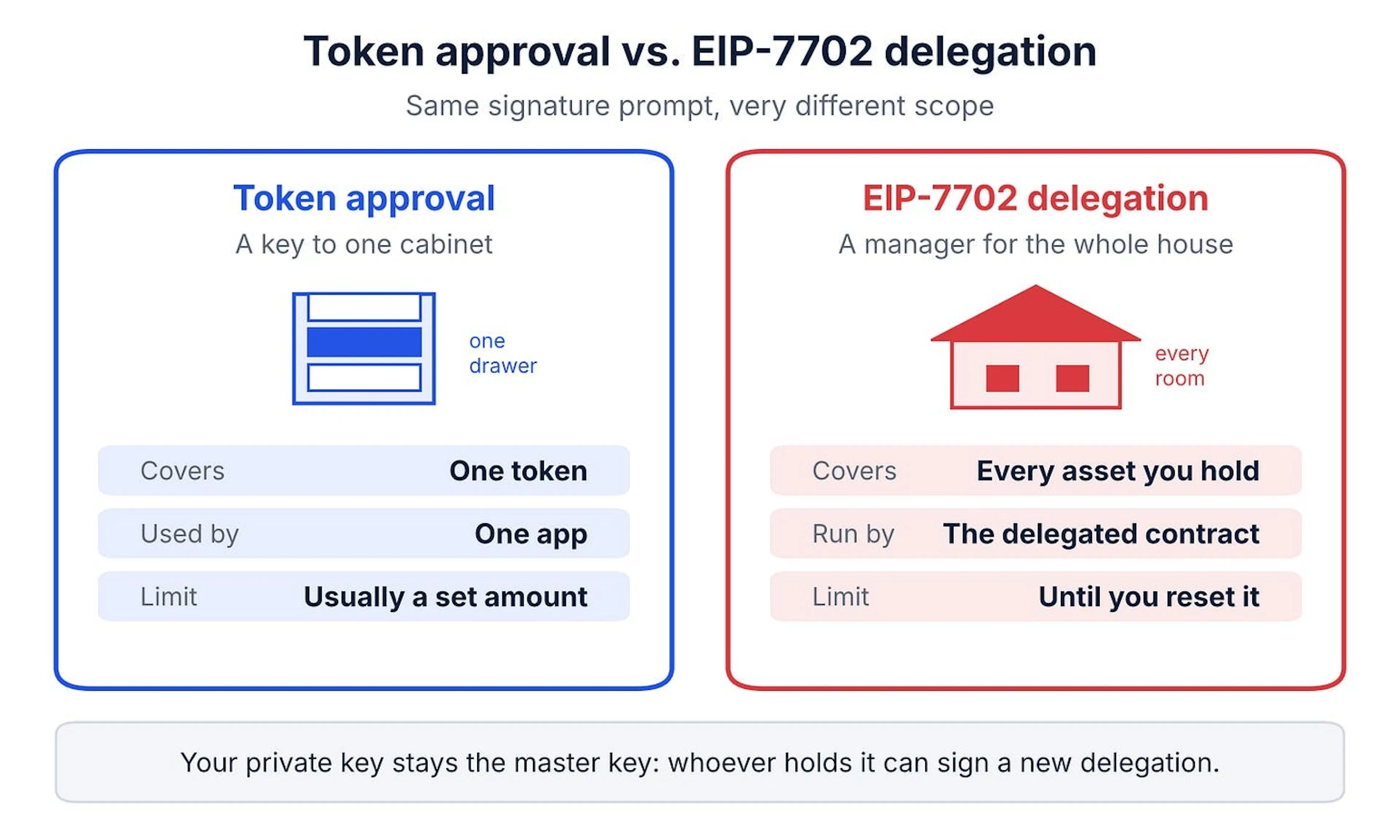
Proponents of account abstraction have long championed EIP-7702 for its ability to bring modern programmability to legacy wallets, introducing features such as batching multiple actions into a single all-or-nothing transaction, fee sponsorship where a third party covers network gas in exchange for alternative tokens, and privilege de-escalation via narrow sub-keys. However, this vast expansion of capability also introduces unprecedented risks. While a traditional token approval limits a malicious application to moving a single specific token up to a predetermined limit, an EIP-7702 delegation hands the operational logic of an entire account over to a contract, covering every asset held within it until explicitly reset. Security analysts often illustrate this disparity using a physical analogy: a token approval is equivalent to handing someone a key to a single cabinet to retrieve one specific item, whereas an EIP-7702 delegation resembles hiring a facility manager who assumes operational control over every room in the building. A benevolent manager follows strict user instructions, but a malicious actor holding that level of access can sweep an entire portfolio in a single motion.
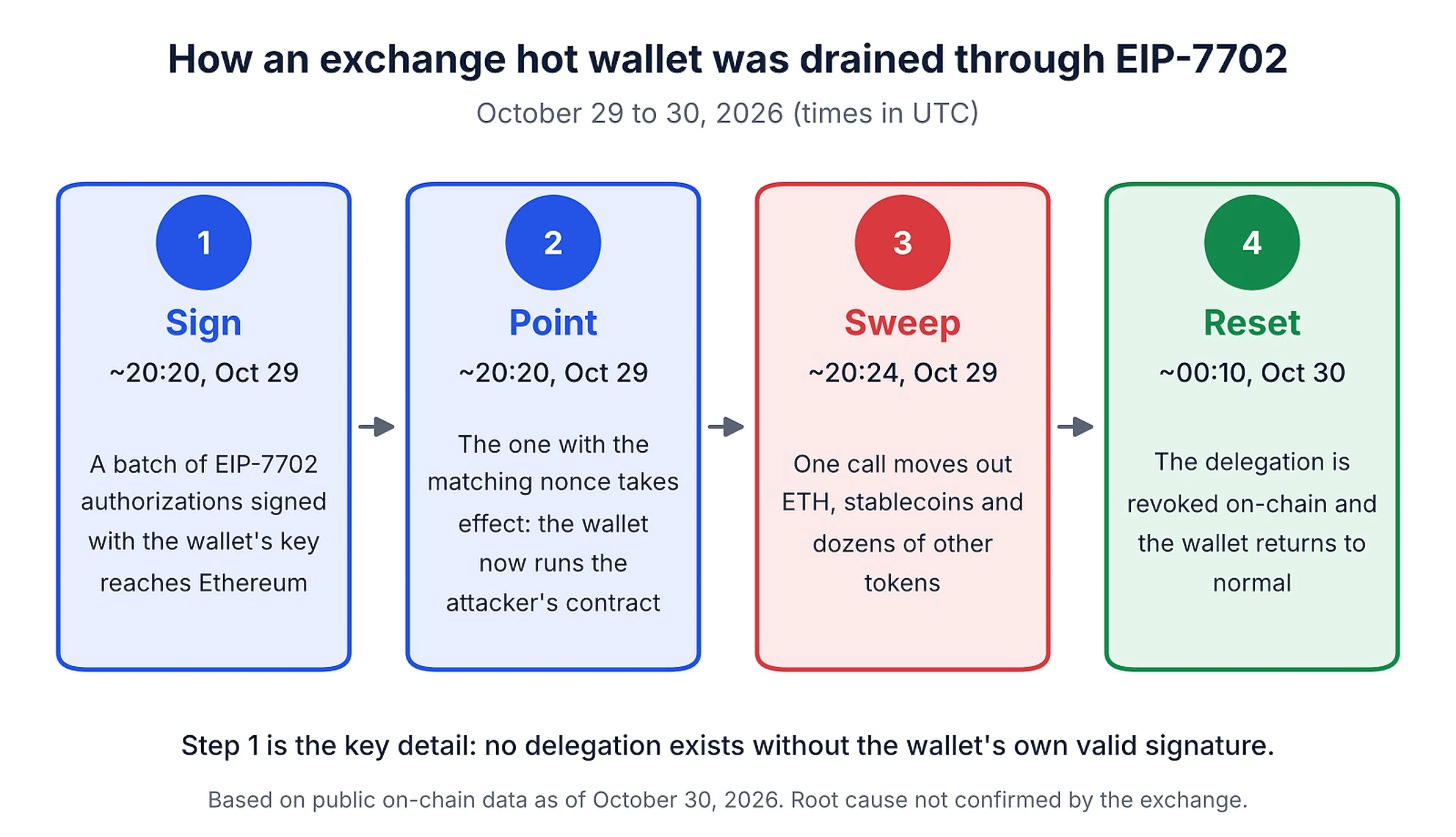
The vulnerability of this mechanism was laid bare during the Binance incident on October 29, 2026. On-chain data indicates that an attacker successfully engineered signed EIP-7702 authorizations to point Binance’s Ethereum hot wallet toward a malicious smart contract deployed by the perpetrator. Mere minutes after the authorizations landed on the network, a single transaction executed, sweeping the wallet clean of Ethereum, stablecoins, and dozens of other digital assets. Early estimates circulating within the blockchain analytics community placed total losses across affected Binance wallets in the billions of dollars by October 30, 2026. Public ledger data outlines a rapid sequence of events: at approximately 20:20 UTC, a batch of authorizations signed using the hot wallet’s key was broadcast to the network. Because the hot wallet’s nonce was continuously fluctuating due to standard operational activity, the submitted batch reportedly covered multiple nonce values, allowing the matching authorization to successfully hand control of the account to the attacker’s contract. Approximately three minutes later, a sweeping transaction occurred, and nearly four hours subsequent to the initial breach, the unauthorized delegation was finally revoked.
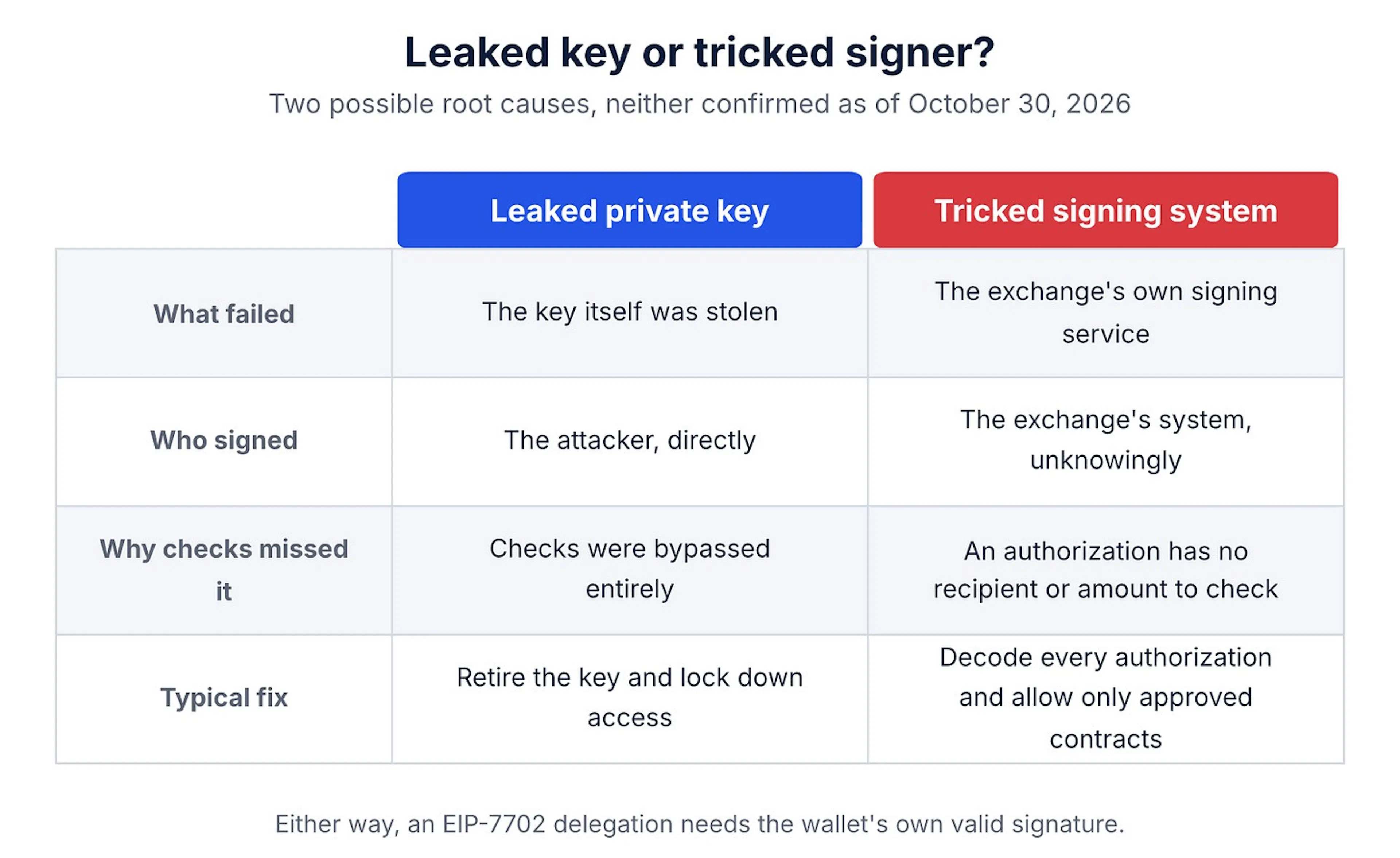
The pivotal question dominating post-incident analysis is whether the disaster stemmed from a leaked private key or a compromised automated signing system. As of October 30, 2026, Binance had not yet published a definitive root cause analysis. A leaked private key represents a conventional security failure with a well-established remediation path involving key retirement and personnel audits. However, industry insiders suggest a more unsettling alternative related to automated infrastructure. Many major exchanges rely on automated signing services to manage hot wallet transactions, utilizing internal compliance rules to vet destination addresses and transfer volumes. Because an EIP-7702 authorization is formatted as a short signed message naming a contract rather than a traditional value transfer, it lacks the explicit recipient fields and monetary amounts required by standard automated risk-assessment filters. If a signing service processed and approved the authorization without correctly decoding its underlying intent, the exchange’s own automated security architecture inadvertently signed away control of its assets. Compounding these concerns, preliminary reports suggested that funds may have also exited through blockchains lacking EIP-7702 support entirely, which, if verified, would further implicate vulnerabilities on the signing infrastructure side.
In the wake of the breach, exchange users and cryptocurrency holders globally have sought to understand the implications for their own funds. Because a hot wallet represents only the fraction of an exchange’s capital maintained online to service immediate customer withdrawals, the long-term impact on everyday users depends heavily on the company’s underlying reserves, risk management funds, and official corporate commitments. Industry observers have repeatedly urged caution, advising market participants to ignore speculative social media commentary and instead monitor official communications channels, individual network deposit and withdrawal statuses, updated proof of reserves reports, and comprehensive post-mortem disclosures. Fraudsters notoriously exploit the chaos following major security breaches, deploying sophisticated phishing campaigns and fraudulent refund portals designed to trap anxious traders.
For self-custody users operating outside of centralized exchanges, the immediate risk posed by EIP-7702 remains nuanced. Simply holding Ethereum in a non-custodial wallet does not activate EIP-7702, and there is no mandatory network upgrade or token transition required for everyday holders. Official Ethereum developer communications have explicitly warned users that any message claiming an urgent need to "upgrade" ETH due to EIP-7702 is a scam. The genuine threat lies in social engineering and malicious phishing attempts, where deceptive web applications or fake airdrop claims trick users into signing authorization prompts disguised as routine cryptographic interactions. Security monitors emphasize that delegations signed with a chain ID of zero can remain valid across multiple EVM-compatible networks supporting the standard, multiplying the potential surface area for exploitation.
To maintain peace of mind, self-custodial users have been advised to inspect their wallet addresses via blockchain explorers such as Etherscan to verify the status of their Delegated Address field. If the field displays a null value, the account remains untouched by delegations. If it points to a recognized wallet provider’s smart account contract, it reflects intentional user configuration. However, if the address points to an unknown or suspicious contract, users face a critical situation. While delegations can theoretically be revoked by signing a new authorization pointing back to the zero address, security experts caution that a revocation is entirely ineffective if the underlying private key or seed phrase has been compromised, as an attacker retaining access can instantly issue a fresh delegation. In such worst-case scenarios, moving all remaining assets to a newly generated wallet remains the only secure course of action.
As the cryptocurrency industry continues to digest the monumental scale of the Binance incident, the ecosystem faces a profound reckoning regarding the implementation and safeguards surrounding account abstraction standards. EIP-7702 remains a permanent, finalized fixture of the Ethereum protocol, meaning the feature itself cannot and will not be excised from the network. Consequently, the burden of defense falls heavily upon wallet software providers, institutional infrastructure developers, and automated signing services to implement rigorous decoding mechanisms that can intercept and reject unauthorized contract delegations before they reach the blockchain.





Comments (0)