


The institutional investors who supply capital to venture firms—often referred to as the "money behind the money"—are experiencing an unprecedented moment. These limited partners (LPs) find themselves operating in uncharted territory that, while accompanied by unique systemic pressures, presents potentially lucrative opportunities for their portfolios.
Traditionally, the playbook for LPs relies heavily on portfolio diversification. Investors spread their commitments across a wide array of venture firms, writing checks to both emerging managers and established institutions, as well as generalists and sector specialists. The overarching goal is twofold: capture strong returns while strictly minimizing overall risk exposure through a broad distribution of capital.
However, that conventional playbook has largely been thrown out the window. The valuations of dominant artificial intelligence leaders like OpenAI and Anthropic have skyrocketed at such a rapid pace that nearly the entire venture ecosystem has piled into the same two companies on their way up. This convergence frequently occurs even within the same venture capital firms, challenging the longstanding industry convention of avoiding direct investment conflicts between competing portfolio companies.
Despite breaking traditional rules, discontent is virtually nonexistent. Institutional investors who speak about the phenomenon appear unbothered by the sheer scale of the gamble, largely driven by the potential for historic returns and expectations of a massive financial bonanza.
At the same time, these stakeholders acknowledge looming market hazards, describing the current landscape as a "yellow light" scenario. Particular unease surrounds the compressed timelines of venture capitalists returning to the market to raise subsequent funds.
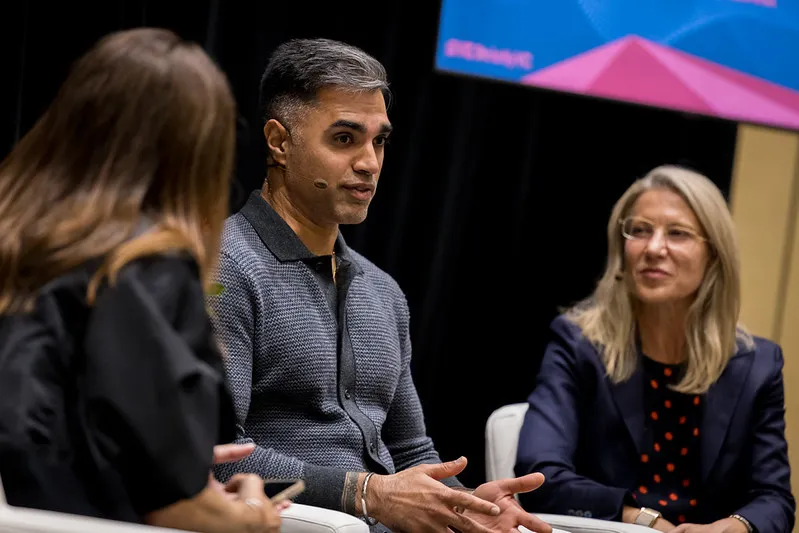
To unpack these dynamics, industry perspectives offer a window into the shifting private equity landscape. Recent discussions with Beezer Clarkson of LGT Capital Partners, a Zurich-based diversified asset manager, and Amit Bhatti of TrueBridge, a Chapel Hill firm dedicated exclusively to venture capital, shed light on how institutional backers are navigating this chaotic cycle.
Navigating Strange Days: Excitement Amidst the Chaos
Navigating the current startup ecosystem requires a steady hand, balancing intense market velocity with historical perspective. For seasoned allocators, the breakneck pace of activity is viewed less as a threat and more as the natural evolution of market cycles.
"It’s very busy, but I wouldn’t say it’s scary," says Beezer Clarkson of LGT Capital Partners. "There’s a lot of change and a lot of variables at play. I love venture, so I find the chaos fun. I’ve been doing this for a couple of decades, so seeing the cycles makes it less scary. You appreciate that these things happen, and that we should enjoy the upside, because sometimes there’s downside, and the up is a lot more fun than the down."
From the perspective of specialized allocators, the intense focus on artificial intelligence has elevated the profile of venture capital from a niche asset class to the center of global attention.
"If anything, it’s exciting," notes Amit Bhatti of TrueBridge. "Venture is sometimes looked at as a niche, and now that AI is all-consuming, all the attention is on venture. This feels like our moment more than it is like, ‘Oh gosh, what’s going to happen?’ The pace of investing and the valuations may be different, but really meaningful stuff is happening, and all the attention is focused on this corner of private equity."
Portfolio Concentration and the Power Law
A defining characteristic of the current funding cycle is the multiplication of identical brand names across multiple portfolios. Funds backed by the same institutional investors frequently hold stakes in both OpenAI and Anthropic, raising questions about traditional diversification mandates.
Venture capital has historically operated as a power law business, where a tiny fraction of portfolio companies generates the vast majority of financial returns. From this analytical framework, industry veterans argue that portfolio concentration is a natural structural feature rather than a critical bug.
"Venture has always been a power law business, so I actually view the concentration as a good thing," Bhatti explains. "If we were getting to the maturity of one of our funds and there were still lots of tiny positions, something’s gone wrong. Our funds that are 10-plus years old are starting to consolidate into a few names. There’s a lot of Databricks, a lot of SpaceX, a lot of Stripe. In this generation of funds, I would hope there’s a lot of Anthropic and a lot of OpenAI. That’s a feature, not a bug. Not every one of these companies is going to work out, but that consolidation is typical. What’s different is how quickly it’s happened. I don’t view it as an immediate panic signal."
At the earliest stages of the startup lifecycle, however, capital deployment looks distinctly different. Smaller check sizes and a wider variety of early-stage opportunities provide a natural cushion against late-stage concentration.
"At the early stage, you still see quite a diversity of opportunity sets, and the dollars are smaller," Clarkson notes. "It aggregates up into the same companies, but early-stage funds obviously aren’t doing the big late-stage stuff, so you have more diversity there, if that’s what you’re looking for."
Accelerating Fund Pacing and Rising Check Sizes
The velocity at which venture capital funds return to the market has accelerated dramatically. Historically structured around four-year investment cycles, deployment schedules have systematically compressed to three years, two years, and in some cases, a mere 18 to 12 months.
This rapid pacing generates mixed reactions among institutional allocators, who monitor fund life cycles closely to ensure sustainable capital deployment.
"We’re seeing funds come back on one-year pacing, which is fast," Clarkson observes. "The norm was probably two to two and a half years. Some funds are deploying much faster because they’re taking concentrated, big-check positions. That could be a worrisome sign. It could work out, we don’t know, but it’s typically harder to do a one-year vintage and get it right."
Bhatti echoes these concerns, noting that mid-cycle fund size increases have become increasingly common as round sizes expand across the board.
"Similar for us. I would have said 24 to 36 months was roughly normal. Now 12 to 18 is not crazy for some of the funds going really quickly," Bhatti says. "A lot of funds are bumping up their fund sizes mid-cycle, which is definitely unusual. That’s partly because rounds have gotten so large. If Anthropic is raising a giant quantum of capital and you put 20% of the fund into it, you’re obviously going to be ahead of pace. Seed round sizes have gone up almost 2x, too, so if you want to lead, you’re writing 2x the check. It’s definitely a yellow light. It gives us a little bit of heartburn."
Despite the accelerated timelines, allocators emphasize a fundamental difference between current deployment patterns and past speculative frenzies, pointing to real revenue generation as a differentiator.
"When we look at what these managers actually bought, the numbers are different," Bhatti adds. "The last time we had accelerated pacing, there was a lot of investing in zero-revenue crypto moonshots. Now we’re seeing a lot of companies go from zero to $100 million in revenue, which was totally unheard of before."
Managing Relationships and Capital Commitments
When a high-performing manager returns to the market ahead of schedule while previous returns remain largely unrealized on paper, LPs face delicate strategic choices. Declining to participate risks losing a valued seat at the table, yet maintaining pace requires careful liquidity management.
"It’s very hard to leave a manager and then come back," Clarkson explains. "It happens, but it’s more typical to downsize your check. In 2021, a lot of LPs said, ‘If I was going to give you $10 million, I’ll do $5 million, because $10 million was for two years.’ In our portfolios, the pacing gets pulled through, so we think about our pacing as well as yours."
Institutional portfolios rely on predictable calendars to manage capital calls and distributions. Disrupting these schedules puts operational pressure not only on asset managers, but also on the ultimate beneficiaries of institutional funds.
"Same here. We’re building out a calendar of when we expect to make commitments, so if someone goes way off that map, we need to make sure the capital is there," Bhatti says. "You see people downsize or communicate it up front. It’s hard to say you’re sitting it out altogether, because then you’re not reliable capital. That’s also why you’re seeing upsizes; managers don’t want to come back and say they’re raising a whole new fund, so they bump up the old one."
For endowments, hospitals, and foundations, prolonged periods of capital calls without corresponding distributions create severe strain on operational budgets.
"People also rotate out of venture sometimes because capital calls keep running with no distributions coming back, and they still have to meet operating commitments, whether it’s the endowment, the hospital, or the foundation," Clarkson points out. "That puts a lot of strain on those situations."
The Evolution of Venture Liquidity and Secondaries
As the venture ecosystem matures, the mechanisms for returning capital to investors have expanded significantly beyond traditional initial public offerings. The secondary market, once viewed with skepticism in venture capital circles, has evolved into a sophisticated and crucial liquidity channel.
"Secondaries have become much more sophisticated in venture over the last, call it, five years," Clarkson notes. "It’s localized in the top handful of companies, but it’s much more prevalent than before, which I think is good, because the ecosystem needs liquidity options. Venture is predicated on that, and if you wait 20 years for an IPO, that is not what structurally we all thought it could be. They’re also happening at multiple levels now. LPs sell stakes of their GPs, a strip of their portfolio, and the taboo around it is less."
This shift represents a fundamental evolution from historical attitudes, where selling private shares was frequently interpreted as a sign of financial distress.
"It’s the third leg of liquidity now: IPOs, M&A, secondaries," Bhatti explains. "Private equity has always had a well-developed secondaries market, and venture didn’t. It was kind of a dirty word. You were only selling if you were distressed. Then people were holding the bag in 2021 and thought, ‘I should have sold.’ Now more managers use it as a tool, and more judiciously. If you still believe it’s the power law company, you’re probably not exiting the whole position. But if you can sell 20% of your position and return your fund, you should probably do it."
Parallel to institutional secondaries, employee tenders and founder liquidity events have introduced complex motivational dynamics within startups. Drawing lessons from past market cycles, investors emphasize the importance of maintaining long-term alignment between employees and company performance.
"We were talking before about the analogy to crypto, where things got very difficult in part because employees were paid in tokens that were liquid immediately. What’s your motivation to stick around when things get hard? So I think it’s great that there are employee tenders, especially for companies that have been around a long time, like Stripe and Databricks, with a very clear financial picture," Bhatti says. "For them to offer partial liquidity to employees is totally reasonable. But a lot of the enforcement falls on the lead investors. Investors we back have told companies, ‘We don’t want you to do an employee tender right now.’ Those conversations are happening behind the scenes, and people have learned some lessons from last time. It’s all based on leverage, though. If the founder has incredible leverage…"
Ecosystem Density and the Rise of Emerging Managers
Despite the concentration of institutional capital among a handful of large venture platforms, emerging managers continue to secure commitments, albeit with adjusted fund sizes tailored to early-stage investing.
"There are still first-time and emerging managers, funds one through three, being raised this year, last year, the year before. You still need a differentiated point of view, a reason for being," Clarkson observes. "Fundraising has gotten harder, but we see them being funded, and the fund sizes are just smaller. Fifty percent of the money might go to the big funds, but if your average first fund is $25 million to $50 million, there can still be enough of those to add up to $1 billion."
For new fund managers, building a verifiable track record with smaller initial pools of capital remains the most viable path to long-term institutional backing.
"There are people raising $5 million or $10 million right here in SF, maybe formalizing their angel investing. A lot of really well-known funds started with a $5 million fund," Bhatti notes. "It’s much better for an emerging manager to build the track record, prove out the thesis, your access and your judgment with whatever capital you have, and then fund two will be easier to raise. If you try to raise $50 million or $100 million on day one, you’re creating a giant hill to climb."





Comments (0)