


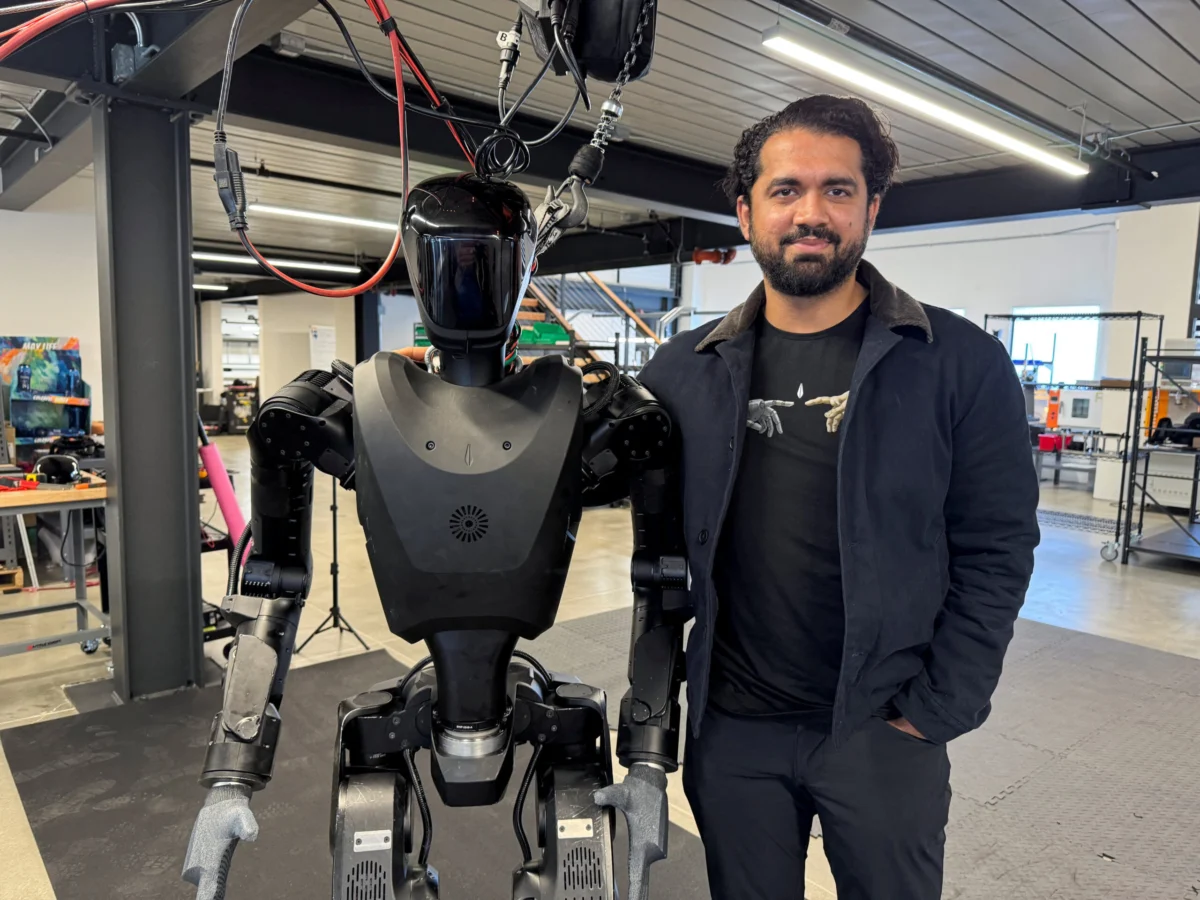
SAN FRANCISCO — Foundation Future Industries, a high-profile military robotics startup backed and advised by Eric Trump, failed to make its payroll last month as its cash reserves rapidly dwindled, according to individuals with direct knowledge of the matter.
Employees at the San Francisco-based company have yet to receive their wages following the missed October 30 payday, according to the sources, who spoke on the condition of anonymity to discuss internal company matters freely. The financial crunch has intensified internal friction and frustration among staff, particularly as details have emerged regarding personal financial transactions made by the company’s chief executive officer and co-founder, Sankaet Pathak.
According to the sources and public records, Pathak borrowed $4.6 million from the company last year to finance the purchase of a luxury home. Property records show that a limited liability company listing Pathak as its sole principal acquired a $4.6 million property in Sausalito, California, in October 2025, featuring expansive views of the San Francisco Bay—funds that insiders note could have been utilized to meet employee payroll obligations.
A spokesperson for Pathak acknowledged receiving a detailed list of inquiries addressing these points on Thursday but did not respond to subsequent requests for comment. Pathak’s leadership history includes the 2024 collapse of his previous startup, a fintech firm named Synapse, which left thousands of everyday Americans locked out of their personal savings accounts.
The current cash shortage arrives at a critical juncture for Foundation. Pathak has publicly stated that the company is on the verge of unveiling a next-generation, weapons-ready humanoid robot designed to help the United States maintain a competitive edge against Chinese technological advancements. Simultaneously, the startup has been actively seeking to raise hundreds of millions of dollars from investors at a target valuation of $3 billion.
Throughout the year, Foundation has generated significant media attention due to ambitious assertions from Pathak that its humanoid robots could soon be deployed for battlefield logistics in Ukraine or tasked with patrolling the southern border of the United States. Media appearances and press coverage have frequently highlighted claims that the enterprise secured $24 million in defense contracts from the Pentagon.
"What we’re about to unveil in the next couple of months [is] going to be the strongest humanoid robot that exists anywhere in the world, including China," Pathak declared during a television interview in April.
‘Plain sight’
The April broadcast also formally introduced Eric Trump—son of the U.S. president—as an investor and chief strategy advisor to Foundation, though the exact size of his financial stake remains undisclosed.
Eric Trump and his brother, Donald Trump Jr., have built a diverse portfolio of defense technology investments, taking stakes in manufacturers of military drones and autonomous systems. An investigative report published in July by The Washington Post revealed that startups backed by investment vehicles connected to the Trump brothers had collectively secured at least $3.2 billion in government business.
"We have to win robotics in the United States of America," Eric Trump said during his April television appearance. "When you go up and interact with these robots … they fist bump you, they high five you, they follow your commands."
The high-profile involvement of the president’s son quickly drew sharp criticism from lawmakers, most notably Senator Elizabeth Warren of Massachusetts, who publicly questioned whether Foundation’s association with the administration influenced its pursuit of defense agreements.
"Eric Trump went on FOX to brag about winning ANOTHER multimillion-dollar contract from the Trump administration," Warren wrote in a social media post on April 23. "This looks like corruption in plain sight."
Eric Trump did not respond to requests for comment regarding the controversy. However, a spokesperson for Eric Trump told the Financial Times that he maintains "no involvement in Foundation’s management, operations, strategic decisions or commercial activities, including the solicitation, negotiation, procurement or execution of any government contracts."
While the public rollout regarding Eric Trump’s advisory role fueled internal speculation that a congressional committee might investigate the startup, industry observers noted a discrepancy regarding the company’s defense credentials. Foundation did not independently win $24 million in direct Pentagon contracts, despite widespread reports to that effect.
Instead, Foundation acquired Florida-based Boardwalk Robotics in late 2024, and government research contracts previously awarded to that firm accounted for the reported figures, according to a person familiar with the corporate structure. Foundation utilized Boardwalk’s robotic platform, known as Alex, as the foundational architecture for its initial model, the Phantom MK-1.
Another source with direct knowledge of the acquisition noted that the transaction included specific performance milestones for the robot that have yet to be officially met.
The situation echoes past marketing controversies involving Pathak. In 2024, reporting revealed that promotional letters sent by Pathak to prospective investors cited an imminent investment and a $300 million purchase order from General Motors—claims that the automaker ultimately rejected. Mike LeBlanc, a co-founder of Foundation, acknowledged at the time that he was embarrassed by the marketing collateral distributed during that fundraising push.
Rescue loan?
Company insiders have expressed growing concern that Foundation could face insolvency if Pathak fails to secure substantial new capital infusions. Pathak has been courting venture capital and institutional investors since January, aiming to finalize a fundraising round at the $3 billion valuation threshold.
Corporate governance structures within the startup have also raised alarms among prospective backers. Pathak serves as Foundation’s sole board member and retains majority ownership of the company’s shares, a concentration of power that critics argue leaves little oversight.
This governance model enabled Pathak to secure the $4.6 million corporate loan last year, which he characterized internally as a short-term financial arrangement, according to sources familiar with the matter. Existing investors were made aware of the transaction through formal company disclosures.
"This is what happens in a company with no governance," one source remarked. "Are you just going to let it ride into the ground, and you ride off into the sunset?"
The recent payroll crisis is not the company’s first cash flow emergency. Foundation also exhausted its operating reserves ahead of an August payday, though employees experienced only a brief two-day delay before receiving their compensation after the firm secured an emergency bridge loan from an existing investor.
In a memo distributed to employees this week, Pathak indicated that he was actively working to secure funds necessary to clear all outstanding back wages.
Foundation was established in April 2024 by Pathak, Tribe Capital CEO Arjun Sethi, and LeBlanc, who previously co-founded Cobalt Robotics, a maker of autonomous security systems. Following its launch, the startup recruited dozens of specialized robotics engineers and artificial intelligence researchers, successfully attracting talent away from established firms such as Tesla and Zoox.
Missing money
Before launching Foundation, Pathak was widely known as the founder of Synapse Financial Technologies, a middleware provider that allowed fintech companies—including Mercury, Dave, and YieldStreet—to offer consumer banking products, such as savings accounts and credit cards, in partnership with small community banks.
Synapse operated largely behind the scenes until its sudden and chaotic bankruptcy filing in 2024. The collapse left more than 100,000 consumers locked out of their FDIC-backed accounts, trapping a combined $265 million in customer deposits.
While some account holders recovered partial balances during ongoing bankruptcy proceedings, thousands of individuals remain unable to access their funds after more than two years. Jelena McWilliams, the former Federal Deposit Insurance Corporation chair who was appointed as the bankruptcy trustee, reported that as much as $96 million in customer funds remained unaccounted for.
The formal bankruptcy proceedings concluded last year without definitively determining the location of the missing money. Pathak attributed the shortfall to a banking partner, Evolve Bank & Trust, while Evolve countered by blaming Synapse for the ledger discrepancies. Federal regulators intervened when the Consumer Financial Protection Bureau filed an enforcement action against Synapse, establishing a $55 million relief fund for affected consumers.
Financial records and independent reporting later revealed that Pathak withdrew $320,000 in loans from Synapse as the company unraveled toward bankruptcy amid growing disputes over unmatched financial ledgers. Furthermore, federal prosecutors convened a grand jury to investigate potential criminal misconduct surrounding the Synapse collapse, according to reports from The Wall Street Journal, though those investigations did not publicly single out Pathak by name.
Despite the controversies trailing his previous venture, Eric Trump proceeded to invest in Foundation and align himself with Pathak, whom he described as a personal friend during their joint April media appearances.
"I walked into his factory, and I couldn’t believe what I saw," Eric Trump said in an interview. "I’m telling you, he’s doing a phenomenal job."




Comments (0)