


Federal Bureau of Investigation agents have arrested a high-ranking executive from a Canadian cybersecurity firm in Pennsylvania, marking a dramatic escalation in the ongoing federal investigation into the notorious "ShinyHunters" hacking syndicate. The syndicate recently managed to infiltrate the FBI’s own digital infrastructure, making off with sensitive records pertaining to thousands of federal agents. Multiple sources familiar with the ongoing probe confirmed the arrest to KrebsOnSecurity, shedding light on a fast-moving international investigation that bridges the worlds of high-level enterprise defense and cybercrime.
The high-profile apprehension was first reported by The New York Times, which noted that federal authorities had taken a Canadian man into custody in Pennsylvania on suspicion of providing illicit assistance to the ShinyHunters threat group. Neither the initial newspaper report nor a brief public statement posted to social media by FBI Director Kash Patel explicitly identified the detained individual. However, subsequent investigative reporting and federal court filings have begun to piece together the identity of the suspect and the broader circumstances surrounding the raid.
According to a source close to the investigation, the Canadian executive had traveled to Pennsylvania to attend a prominent cyber insurance and risk management conference. The suspect’s professional background heavily intertwined with the high-stakes sector of handling ransomware negotiations and extortion advisories on behalf of targeted corporations. A secondary source familiar with the case confirmed that operational control and coordination over the sweeping ShinyHunters investigation have recently been centralized at a primary FBI field office in Texas, signaling a consolidation of federal resources to target the inner workings of the cybercrime operation.
Publicly available records and conference itineraries indicate that the annual Cyber Risk Summit was hosted at the Loews Philadelphia Hotel. While the event featured backing from multiple corporate sponsors, conference documentation highlighted a prominent Canadian cybersecurity firm known as Cypfer as its primary and largest financial sponsor.

Digital footprints on professional networking platforms such as LinkedIn further connected individuals from the regional cyber defense circuit to the event. One profile previously designated a prominent figure named Edward Dubrovsky as an "ex-founder" of Cypfer, though a corporate spokesperson for Cypfer later clarified that Dubrovsky was never a founder or co-founder of the firm. Instead, he had served as a managing director before ultimately tendering his resignation in December 2025. Following his departure from Cypfer, Dubrovsky became closely affiliated with another Canadian security enterprise and event sponsor known as CyberSteward. Roughly a month prior to the summit, Dubrovsky posted publicly on LinkedIn to announce his travel plans, confirming that he intended to attend the Philadelphia risk conference alongside colleagues from the CyberSteward team.
Federal court dockets reveal that on October 8, an individual named Edward Dobrovsky—noting a slight spelling variation in the surname found within early judicial paperwork—was formally arrested within the jurisdiction of Pennsylvania under severe federal charges involving cyber extortion and criminal conspiracy. While several key documents, including the foundational criminal complaint, have been placed under seal by the court, a handful of records and summaries were successfully indexed on public legal documentation platforms such as CourtListener.com. These accessible summaries charge the defendant with criminal conspiracy intended to threaten and impair the confidentiality of proprietary information for the primary purpose of extorting money, alongside charges related to interference with commerce through unlawful threats.
U.S. Bureau of Prisons inmate tracking databases show that a 54-year-old individual matching the name Edward Dubrovsky is presently being detained within a federal detention facility located in Philadelphia. Nevertheless, court dockets reflect a swift judicial maneuver initiated on October 9, filing a notice to transfer the entire legal proceeding to the U.S. District Court for the Eastern District of Texas. Insider sources indicate that this district has officially become the central hub and epicenter for the comprehensive federal crackdown on the ShinyHunters collective. Representatives for the FBI declined to offer official public comments regarding the ongoing proceedings.
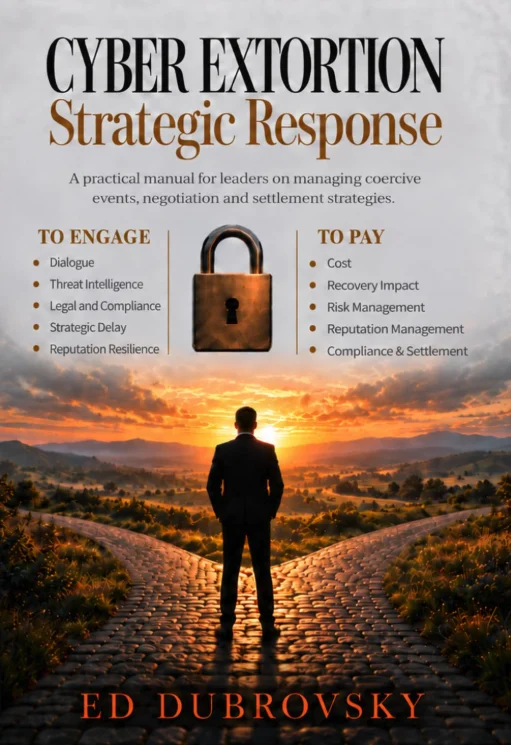
Beyond his executive roles within the Canadian cybersecurity sector, Dubrovsky is recognized within industry circles as the author of a 252-page professional volume titled Cyber Extortion Strategic Response. The publication purports to guide corporate leaders past initial ransom demands and deep into the critical decision-making processes required to effectively manage organizational response, data recovery, and asset protection during a crisis. An excerpt featured on commercial book listings emphasizes a foundational premise taught within the text: that establishing communications with a malicious actor is fundamentally distinct from negotiating a financial payout, and that entering into dialogue does not equate to a binding commitment to capitulate to extortion demands. The passage suggests that active engagement can serve alternative defensive strategies, such as validating threat actor claims, collecting actionable intelligence, buying critical operational time, and safeguarding corporate options while leadership evaluates subsequent moves.
As of press time, Mr. Dubrovsky could not be reached directly for comment regarding the federal allegations. Inquiries directed toward fellow executives at CyberSteward yielded no immediate statements, though updates are expected should corporate representatives respond. Available court documents indicate that the defendant has not yet retained private legal counsel, nor has the court formally appointed a public defender to represent him in the early stages of the federal proceedings.

The ShinyHunters organization has long maintained a reputation in the global cybersecurity landscape for deploying sophisticated phishing campaigns and leveraging stolen enterprise credentials to systematically siphon vast quantities of data from corporate cloud repositories and software-as-a-service providers. The group characteristically pressures victim organizations by threatening to publicly release confidential data sets unless substantial cryptocurrency ransom demands are fulfilled. According to official estimates released by federal law enforcement, the syndicate has successfully extorted in excess of $70 million from corporate and institutional victims over the course of the year.
Investigative sources indicate that federal agents have been exhaustively analyzing electronic hardware and digital devices that were seized last month during a coordinated international operation. In that raid, Dutch law enforcement authorities successfully apprehended a reformed hacker identified as Pepijn van der Stap in connection with the expanding international investigation into the ShinyHunters enterprise. Federal insiders suggest that additional criminal charges against high-ranking figures at other specialized ransomware negotiation firms could be imminent as the dragnet widens.
In the immediate aftermath of Van der Stap’s detention, leadership within the hacker collective underwent a swift shift. A distinct operative utilizing the online handle "Rey" assumed operational control of ShinyHunters and quickly initiated a campaign of online taunts directed at federal law enforcement. These provocations stemmed from a brazen breach in which the group successfully exfiltrated sensitive information from the FBI’s own digital online recruitment portal. The stolen cache reportedly contained confidential personnel details, including individual agent assignments, specific operational units, specialized expertise designations, and even sensitive medical and psychiatric records.
International investigative reporting revealed that the individual operating under the alias "Rey" was actually a teenager named Saif Al-din Khader. Authorities eventually detained Khader, who subsequently began cooperating with federal investigators. Court records and investigative disclosures detailed how Khader was tracked down just as the cybercrime unit allegedly attempted to execute an extortion scheme targeting a prominent digital aviation and navigation unit that had been divested by aerospace giant Boeing late last year. As federal authorities continue to pursue leads across international borders, the investigation remains exceptionally active and fluid.





Comments (0)