


A teenage resident of Amman, Jordan, suspected of serving as a principal administrator and operational leader for the prolific data theft and extortion syndicate known as ShinyHunters, has been detained by local authorities and is reportedly cooperating with federal investigators to unmask and identify other members of the global hacking gang.
Security researcher Brian Krebs, citing multiple people familiar with the unfolding international investigation, learned that the suspect—who operates online under the hacker handle "Rey"—was taken into custody just as the loose collective of threat actors was actively attempting to extort a major business unit recently divested by global aerospace giant Boeing. Intriguingly, the suspect’s father is employed by Royal Jordanian Airlines, a carrier that operates a long-haul commercial fleet built entirely by Boeing, weaving a striking personal connection into an already convoluted international cybercrime case.
The Capture of "Rey" and Global Fallout
Reuters first reported on October 3 that three unnamed sources confirmed a suspected ShinyHunters member named Saif Al-din Khader had been detained by Jordanian authorities in Amman and was actively cooperating with the Federal Bureau of Investigation. KrebsOnSecurity had previously identified "Rey" as Khader in a November 2025 profile, during which the young man openly admitted to collaborating with multiple ransomware and extortion syndicates.
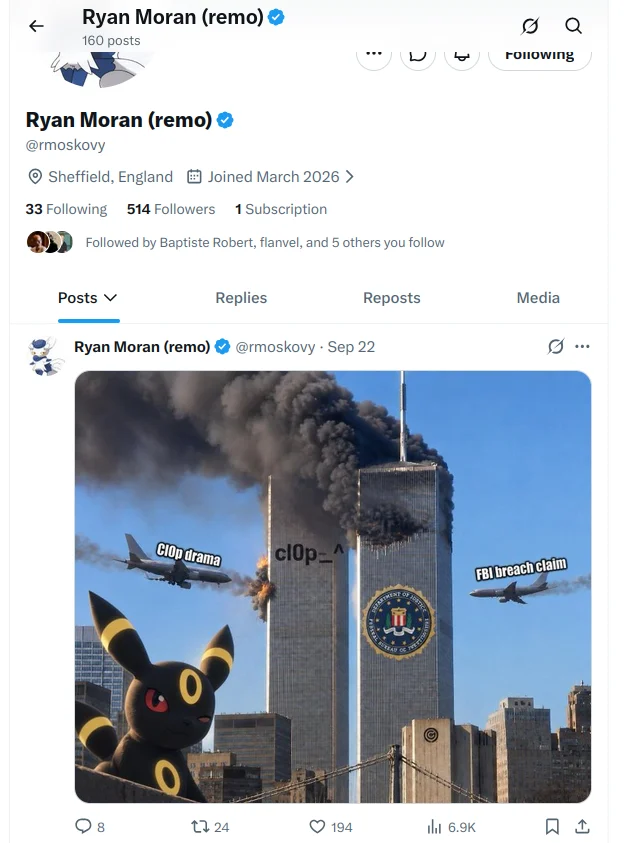
Rey’s name surfaced once more in late September during coverage of a high-profile European law enforcement operation. Dutch police arrested 24-year-old convicted cybercriminal Pepijn van der Stap on September 15 on suspicion of providing material assistance to ShinyHunters in their ongoing data theft and extortion campaigns. According to security investigations, immediately following the Dutchman’s dramatic nighttime arrest—which reportedly involved local tactical units deploying flash-bang grenades—Rey seized control of the legacy ShinyHunters brand. From there, he began publicly boasting about breaching highly sensitive networks, including systems tied to the FBI, and attempting to shake down the notorious Cl0p ransomware operation.
To mock his targets, Rey uploaded a series of taunting memes to his long-standing Twitter/X account. In a calculated maneuver designed to throw investigators off his trail, he embedded images of the avatar once used by Van der Stap under his former hacker alias, "Umbreon," attempting to frame the Dutch national for the brazen federal and corporate hacks.

The breaches themselves traced back to a critical vulnerability tracked as CVE-2026-35273. Discovered as a zero-day exploit in June, the flaw targeted PeopleSoft, a widely deployed software-as-a-service platform from Oracle utilized across the corporate world for managing payroll, human resources, hiring, and employee benefits. Although Oracle rapidly issued security patches, and cybersecurity firm Mandiant released stopgap web application firewall (WAF) rules for organizations unable to immediately update their infrastructure, ShinyHunters quickly adapted.
According to threat intelligence reports released in late September by Mandiant and the Google Threat Intelligence Group (GTIG), the group employed a well-known URL-encoding technique to bypass Mandiant’s protective WAF rules. This allowed them to mass-exploit the PeopleSoft vulnerability across dozens of networks spanning higher education, technology, healthcare, agriculture, transportation, and government sectors. While the hackers initially told reporters their June exploits were intended to breach the FBI’s own PeopleSoft database—an effort they claimed was unsuccessful at the time—subsequent attacks proved far more damaging.
By early October, additional reporting revealed that the FBI had removed a contractor from consulting firm Accenture after investigators determined the contractor failed to properly patch the targeted FBI recruitment website. That oversight exposed sensitive personnel records belonging to more than 5,000 FBI employees, including specific unit assignments, operational specializations, and confidential medical and psychiatric records.
"Rey" Means King, as in Royal
Investigators quickly realized that the scope of Rey’s activities extended far beyond internet trolling. Sources close to the probe disclosed that when Jordanian authorities moved in to apprehend Khader, ShinyHunters was in the final stages of a high-stakes extortion attempt targeting a digital aviation and navigation unit previously owned by Boeing. The potential compromise of this specific division lent immediate urgency to the FBI’s investigation, as stolen data from the unit could pose significant operational safety and security risks.
In statements provided to security researchers, Boeing acknowledged the attempted extortion, confirming that the targeted information related to Jeppesen ForeFlight, a aviation subsidiary that Boeing sold in November 2025 to private equity firm Thoma Bravo for $10.55 billion. Representatives for Jeppesen ForeFlight maintained that their internal investigations showed no adverse impact on ongoing operations or customer products, asserting a resilient proactive security posture.

The nexus between Rey and the aerospace sector drew heightened scrutiny due to his family background. While independent confirmation proved difficult, Rey claimed on Telegram channels in early 2025 that his father worked as an airline pilot. Furthermore, forensic analysis of a password-stealing malware infection on the Khader family’s shared computer revealed that Rey’s father had repeatedly used identical credentials to access multiple online portals for Royal Jordanian Airlines employees.
When contacted by journalists seeking comment prior to the September 28 disclosure, Rey’s father did not respond. However, within hours of the outreach, Rey systematically began scrubbing his digital footprint, deleting numerous social media profiles—including the Twitter/X account he used to taunt federal agents and cyber syndicates alike.
Despite the digital purge, Rey’s personal cybersecurity blog hosted on GitHub remained online. A lengthy investigative post published on the blog in March 2026 attempted to doxx two Russian men whom Rey identified as the core developers and mastermind operators behind the Cl0p ransomware platform.
Murder-for-Hire Allegations Surface in the Netherlands
While federal agents interrogated the teenage suspect in Jordan, Dutch media outlets unveiled shocking new allegations concerning Pepijn van der Stap, whose post-prison reintegration into the legitimate tech sector had previously been celebrated by some technology publications.
According to a report published on September 29 by Dutch broadcaster RTL, criminal investigators suspect that Van der Stap attempted to orchestrate at least two murders. Authorities believe the targeted attacks were intended to be executed abroad, and that Van der Stap directly issued orders for the hits.

Van der Stap had recently been released after serving the majority of a four-year prison sentence handed down for lucrative data theft and extortion schemes that prosecutors estimated netted between 1.5 million and 2.7 million euros. Following his release, he secured employment as an "offensive security lead" at Neo Security, an Amsterdam-based cybersecurity firm where his responsibilities included testing client networks for security weaknesses.
Benjamin Korper, the owner of Neo Security, told reporters that he immediately retained an outside forensic firm to investigate whether Van der Stap had compromised the company or its clients. While those audits found no evidence of insider malicious activity against Neo Security, Korper confirmed that Dutch law enforcement officers executed a dramatic raid on his office on the night of September 15, resulting in Van der Stap’s arrest.
Before his initial 2023 conviction, Van der Stap maintained a dual life: working as a software engineer for Amsterdam startup Hadrian and volunteering with the Dutch Institute for Vulnerability Disclosure (DIVD), all while secretly infiltrating and extorting major corporate entities. Asked by journalists why anyone should trust a self-described reformed cybercriminal, Van der Stap argued that his technical output was all he had left to offer.
"You can throw a bunch of nice words at someone, but you can’t convince them if they don’t want to be convinced," Van der Stap stated in an interview. "I’m doing what I can to repay victims, and that’s all I can do."
Franchising and Burning a Brand
The broader history of ShinyHunters stretches back to at least 2019, with the collective linked to dozens of major data breaches involving billions of compromised records. However, security analysts emphasize that the individuals operating under the banner today bear little relation to the group’s original core members—most of whom are French citizens who have previously faced arrest and prosecution.

Instead, cybersecurity experts view modern iterations of ShinyHunters less as a cohesive gang and more as a loose franchise model. Functioning similarly to the legendary "Dread Pirate Roberts" persona from fiction—where succession is driven by law enforcement arrests rather than death, and multiple operators can claim the mantle simultaneously—the group relies on a revolving cast of freelance cybercriminals. These affiliates feed stolen SaaS credentials to whichever broker holds the brand in exchange for a percentage of any eventual ransom payments.
In the wake of Van der Stap’s arrest and the subsequent takedown of the ShinyHunters darknet portal, rival hackers on underground Telegram channels openly mocked Rey. Commentators accused the teenager of purchasing legacy PGP keys and forum databases simply to larp as ShinyHunters, generating quick profits by negotiating corporate ransoms while ultimately trashing the group’s darknet reputation.
A specialized Telegram tracking channel known as "The Battle" relentlessly doxxed and criticized Rey and his associates, characterizing the teenager as an inexperienced greenhorn trying to exploit a notorious brand. According to channel administrators, Rey allegedly caused over $200 million in estimated damages while helping several small cells monetize stolen data by operating under the ShinyHunters name in exchange for a 25 to 30 percent cut of ransom negotiations.
The group’s operational motivations were further highlighted in interviews with trade publications like The Register, where ShinyHunters members asserted that their decision to target the FBI was a deliberate public relations and marketing maneuver. The hack was allegedly executed to counter a May 2026 FBI flash notice that warned organizations against paying ransoms and detailed the group’s aggressive harassment tactics—which have historically included threatening phone calls, text messages, swatting incidents, and fabricated claims regarding sensitive or compromising victim media.
While the hackers argued that demonstrating their technical prowess served to refute what they termed misinformation from federal agencies and security researchers, industry experts maintain that public pressure, targeted law enforcement operations, and the steady compromise of key affiliates have severely hobbled the syndicate’s operational viability.

Comments (0)