


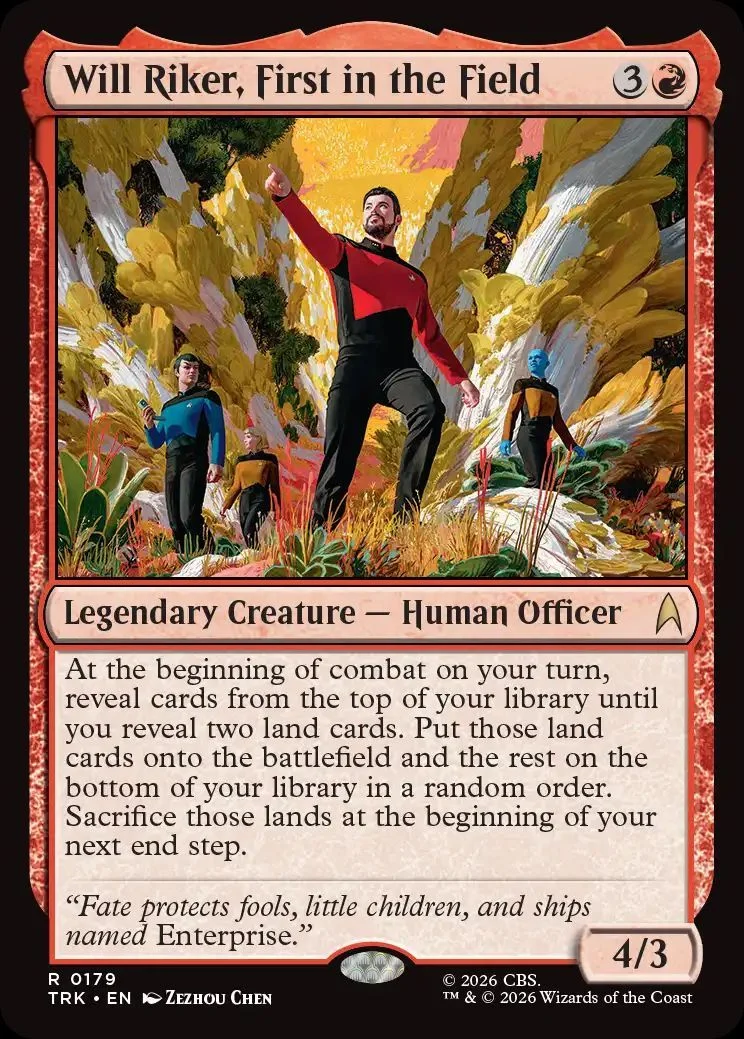
When Wizards of the Coast announces another massive crossover for Magic: The Gathering under its Universes Beyond banner, the reaction from the trading card game’s sprawling community is usually mixed. Past experiments have ranged from universally praised mechanical adaptations to poorly received pop-culture drops that felt more like cynical corporate synergy than heartfelt tributes. However, the newly released Star Trek set—available now for both tabletop play and Magic: Arena—appears to have cracked the code, transforming the optimistic, exploratory ethos of science fiction’s most enduring franchise into functional, engaging mechanics.
Road-testing the cards alongside a dedicated franchise enthusiast reveals that the set’s success goes far beyond mere Easter eggs and deep-cut references. While die-hard fans will undoubtedly appreciate subtle nods to animated spin-offs like Star Trek: Prodigy or the alternate Kelvin timeline films, the true triumph of the expansion lies in how its mechanics mirror the core themes of Gene Roddenberry’s universe. Instead of merely pasting famous character portraits onto standard templates, the design team has woven the concepts of interstellar diplomacy, diverse exploration, and collective crisis management directly into the rules of the game.
The most prominent example of this thematic translation can be found in the blue-green deck archetypes built around the "Strange New Worlds" mechanic. Rather than encouraging players to optimize their mana pools by simply stacking identical basic lands like Islands and Forests, this mechanic rewards a varied and eclectic portfolio of territories. During testing, utilizing cards like "Deep Space Scan" allowed players to draw a single card for each uniquely named land they controlled. Simultaneously, those diverse lands directly reduced the activation costs required to power up utility cards like the "Astute Terraformer."

Complementing the philosophy of planetary exploration is the "Federation" mechanic, which provides distinct tactical bonuses when a player maintains a diverse array of creature types on the battlefield. By fielding Vulcans, Klingons, and Romurans side by side—though notably excluding the relentless, homogeneous Borg—players are mechanically incentivized to construct crews that reflect the utopian, multi-species collaboration central to Starfleet’s mission. The design naturally pushes participants toward assembling an inclusive crew before sending them out to venture into what one literal card in the expansion describes as the "final frontier."
The expansion also integrates innovative spacecraft mechanics originally introduced in the Edge of Eternities series, adapting them to fit the iconic starships of Starfleet. Under these rules, starships enter the battlefield with severely limited initial capabilities. To unlock their full potential—such as the ability to fly and engage in combat—players must "station" the vessels by tapping active creatures on the board to accumulate charge counters. Character cards like Lieutenant Commander Geordi La Forge serve as powerful force multipliers within this system, effectively doubling the rate at which charge counters are added and allowing starships like the Enterprise to enter active combat twice as fast.
Among the various iterations of the franchise’s legendary flagship available in the set, the "U.S.S. Enterprise-A, Free Spirit" stands out for its tactical utility and a clever nod to television history. Deploying this specific card grants the player three red 1/1 officer tokens instantly. These tokens not only serve to accelerate the process of stationing the ship by providing immediate crew members to tap, but they also function as entirely disposable assets meant to absorb incoming attacks—a transparent and humorous mechanical tribute to the infamous expendable redshirts of the original television series.
Other mechanics lean heavily into the narrative tropes of the franchise. The "Beam Me Up" mechanic enables players to retrieve a card from their discard pile, though it requires the balancing cost of returning a card currently active on the battlefield back to their hand. Meanwhile, the "assimilate" mechanic provides a darker, tactical alternative for Borg-themed decks, allowing players to strip opposing creatures of their native creature types and convert them into controlled artifacts.

Yet, it is the overarching emphasis on teamwork and collective resolve that truly captures the spirit of the source material. Cards like "Common Goal" enable two separate creatures to combine their damage output against threats, while a wider suite of synergistic cards triggers enhanced effects whenever a player launches an attack with a combined creature power totaling eight or more. During competitive test matches, cards like Worf, Honor-Bound Warrior—who doubles his individual attack power when participating in these coordinated offensives—frequently served as game-winning centerpieces for red-and-white deck builds.
Ultimately, what resonates through these gameplay loops is the optimistic, stars-in-its-eyes philosophy that has defined the franchise for decades. Rather than feeling like an awkward corporate crossover, the set manages to evoke the utopian ideal of diverse individuals pulling together to overcome a crisis. For seasoned players and casual viewers alike, the resulting expansion demonstrates that the final frontier translates remarkably well to the tabletop.




Comments (0)