


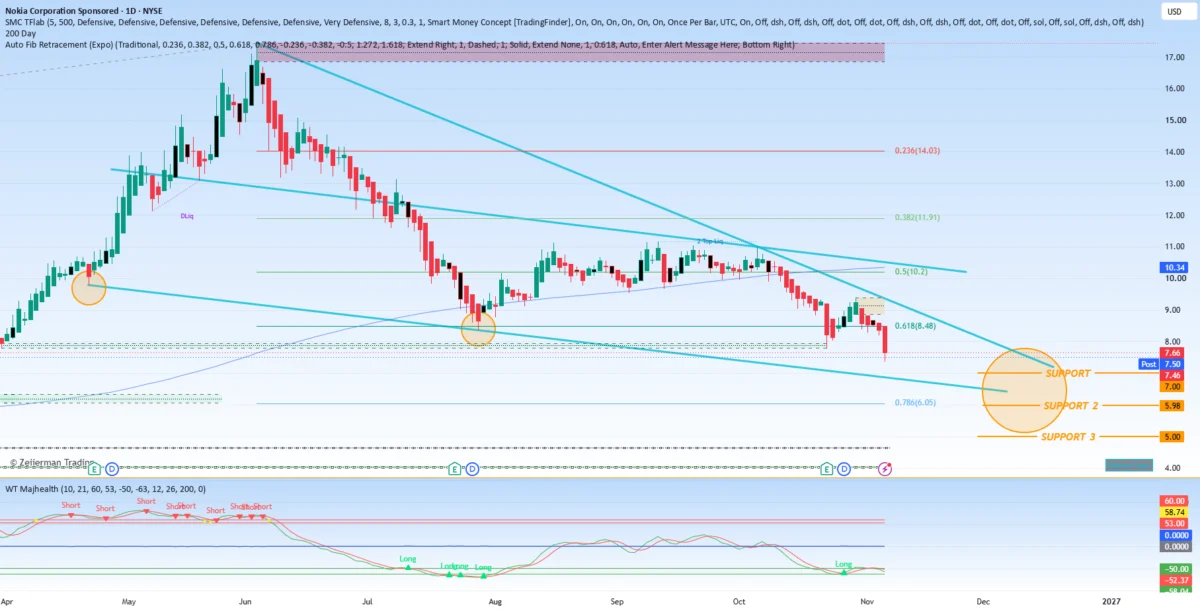
Over the past three years, Nokia shares have experienced a dramatic re-rating, underscored by an impressive surge of approximately 129.1%. This explosive multi-year share price gain has rewarded patient shareholders who weathered the company’s structural transitions away from legacy consumer mobile markets toward heavy-duty telecommunications infrastructure and enterprise networking solutions. However, this level of capital appreciation places considerable weight on whether Nokia’s fundamental earnings profile can sustainably support such an elevated valuation. In the world of equity markets, rapid multiple expansion often borrows against future growth, leaving little room for operational missteps or macroeconomic headwinds.
The heart of the valuation debate lies in the divergence between long-term strategic promise and near-term financial reality. While a 129.1% three-year gain reflects immense optimism regarding the company’s turnaround efforts, portfolio managers and market analysts are increasingly scrutinizing the quarterly income statements to verify if the profit generation matches the market capitalization. The recent market pullback serves as a natural cooling-off period, forcing a recalibration of expectations and inviting a rigorous examination of whether the stock’s previous highs were driven by sustainable fundamental momentum or transient market sentiment.
Several recent strategic developments and operational pivots complicate this evaluation, acting as both catalysts for future growth and variables that increase the complexity of the financial outlook. Chief among these themes are advancements in artificial intelligence-focused networking, high-profile satellite communications initiatives, including critical technological work tied to Ukraine, and an expanding web of broader telecommunications partnerships across global markets. Each of these elements carries distinct implications for how investors assess Nokia’s future profitability, ongoing capital expenditure requirements, and the long-term durability of its earnings base.
The emergence of AI-focused networking represents a compelling frontier for legacy infrastructure providers. As hyperscalers and enterprise data centers demand ultra-low latency, massive bandwidth, and increasingly sophisticated network architectures to support intensive artificial intelligence workloads, equipment vendors like Nokia are positioning themselves to capture a slice of this high-growth ecosystem. Similarly, the company’s involvement in satellite communications work in Ukraine demonstrates its technological resilience, adaptability, and capacity to deliver mission-critical connectivity solutions under extraordinary geopolitical and infrastructural constraints. Furthermore, ongoing consolidation and restructuring within broader telecom partnerships highlight Nokia’s enduring role as a foundational pillar of global digital communication, even as traditional telecom operators rein in capital spending to protect their own balance sheets.
These thematic tailwinds undoubtedly support the longer-term investment case for Nokia, painting a picture of a technologically relevant company deeply integrated into the modern digital economy. However, they also raise the bar significantly for corporate execution. To justify the valuation levels achieved during its multi-year rally, Nokia must consistently demonstrate that these advanced technological initiatives translate into high-margin, predictable revenue streams that can reliably catch up with the lofty expectations currently embedded in its share price.
Against that macroeconomic and operational backdrop, the recent pullback in Nokia’s share price places the core valuation debate front and center for market participants. Rather than relying on the general sentiment surrounding artificial intelligence optionality or long-term technological contracts alone, investors are demanding clearer, empirically grounded evidence that Nokia’s underlying profit trajectory is robust enough to support its current market value. As the company navigates the remainder of the fiscal year, the market will closely monitor upcoming earnings reports and operational updates to determine whether the recent price correction represents a temporary consolidation phase in a continuing bull market or a necessary market reality check for an overextended stock.
Disclaimer: The information and publications are not meant to be, and do not constitute, financial, investment, trading, or other types of advice or recommendations supplied or endorsed by TradingView. Read more in the Terms of Use.

Comments (0)