



Crypto and broader risk assets are continuing to display notable weakness as the year draws to a close, offering little in the way of holiday cheer for investors and market participants. Across traditional and digital financial landscapes, risk assets are actively searching for a fundamental floor. This search is heavily reliant on structural fundamental flows, which are increasingly being supported by institutional exchange-traded funds or direct protocol-level token buybacks as market participants try to ascertain where sustainable demand will finally materialize.
Indices

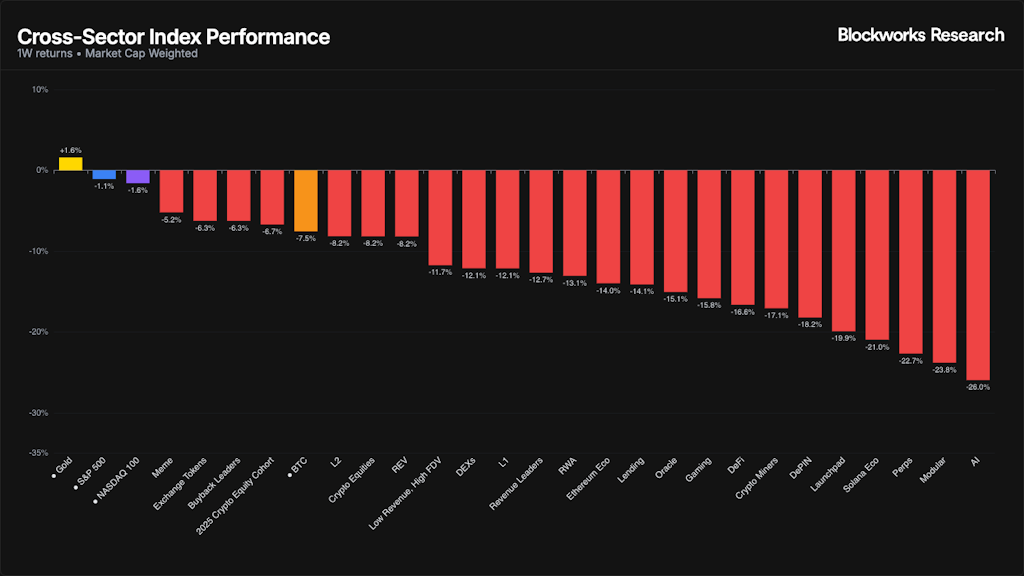
The trading week closes out with continued weakness across the board, affecting traditional equities and crypto risk assets in particular. Both the S&P 500 and the Nasdaq 100 drifted more than one percent lower over the course of the week. In stark contrast, gold emerged as a notable outlier, standing out as virtually the sole major financial instrument demonstrating underlying strength amid widespread risk-off sentiment.
Concurrently, every single cryptocurrency index tracked by analysts traded lower throughout the week. A closer look at the intra-week performance reveals distinct pockets of relative resilience. Specifically, exchange-specific utility tokens, buyback leaders, and the cohort of crypto equities slated for 2025 all managed to outperform Bitcoin on an intra-week basis. Meanwhile, nearly every other sector underperformed relative to the market leader, underscoring a selective flight to perceived quality or structural cash-flow generation within the digital asset ecosystem.
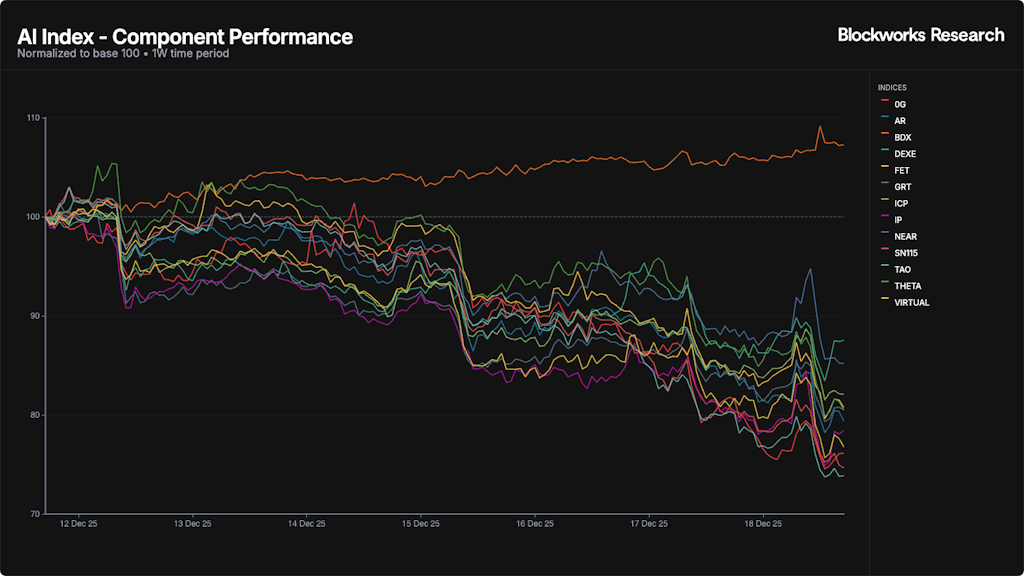
The artificial intelligence sector experienced the most severe downturn on the week, absorbing a sharp 26% decline across its associated tokens. This downward pressure was spearheaded by TAO, which slumped to fresh multi-month lows. The reversal is particularly striking given that TAO had reigned as one of the market’s top-performing assets just a couple of months prior in October, highlighting the fickle and high-beta nature of thematic crypto sectors during broader market corrections.
Broadly speaking, the wider cryptocurrency market continues to grind lower within an established downtrend. Major digital assets such as Bitcoin, Ethereum, and Solana are all exhibiting unmistakable technical weakness. At the same time, longer-tail alternative tokens are experiencing much larger magnitude moves to the downside, reflecting a classic risk-off flight away from illiquid assets.
The broader risk complex remains in search of a definitive fundamental floor. Market observers note that prices may continue to drift lower until prevailing valuations and programmatic buyback mechanisms become too compelling for value-driven capital to ignore. Once price levels reach that threshold, organic buyback flows generated by underlying protocol cash flows could finally establish a durable market low. Similarly, major layer-1 assets like Bitcoin and Ethereum may require a meaningful uptick in institutional exchange-traded fund inflows to put in a bottom. Unfortunately, the localized support provided by these institutional investment vehicles has remained decidedly anemic over the past several weeks, leaving spot markets vulnerable to further corrective pressure.
Weekend Reading
Taking a Step Back to Step Forward
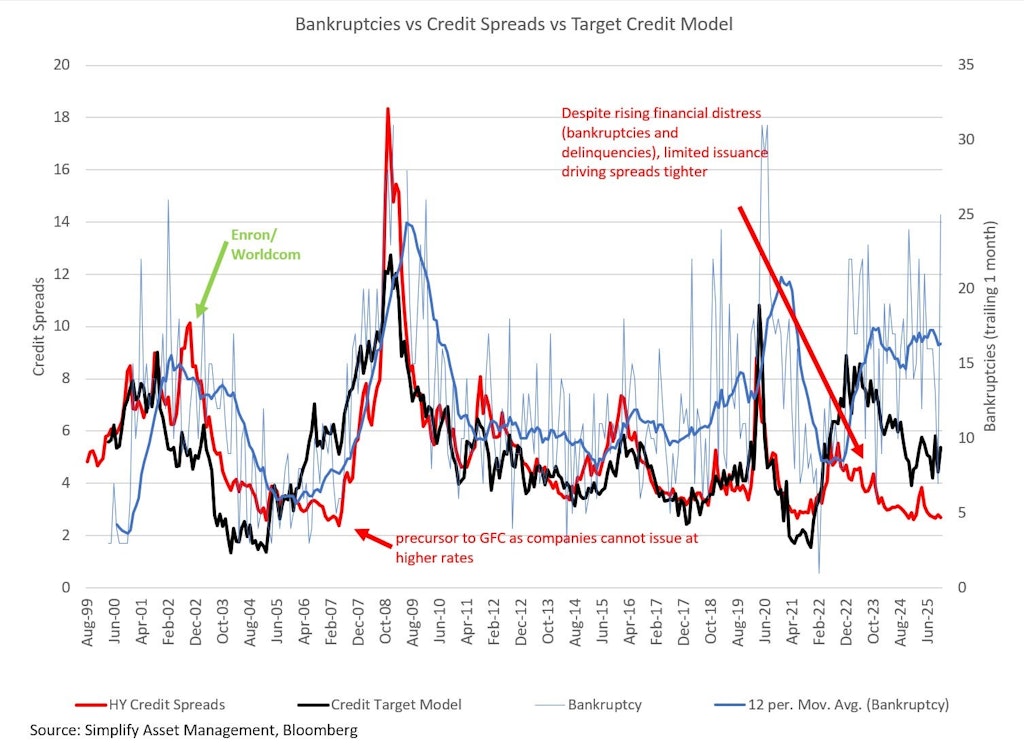
In a newly published blog post titled "Taking a Step Back to Step Forward," financial analyst Michael W. Green has reframed the precarity of the United States economy through an intricate structural and mathematical lens. Drawing heavily upon Ole Peters’ theoretical framework known as the "Equation of Life," Green argues that wealth naturally tends to concentrate in the absence of aggressive redistribution mechanisms. He contends that this systemic tendency inevitably drives long-term economic inequality.
Furthermore, Green offers a scathing critique of distorted consumer price index measures, widespread technocratic complacency, and persistent housing scarcity, characterizing all of them as institutional mechanisms of economic extraction. Pointing out that credit spreads have remained artificially tight despite a simultaneous rise in underlying defaults, he warns that the modern financial system is characterized by extreme structural fragility. Concluding his analysis, Green issues a passionate call for heightened civic engagement and institutional accountability, setting the intellectual stage for a planned series of subsequent essays and political interviews focused intensely on systemic economic reform.
Annual State of Sky Ecosystem
The Sky Frontier Foundation has released a comprehensive research report titled "Annual State of Sky Ecosystem," detailing the protocol’s major operational achievements and robust financial growth throughout 2025. According to the report, the Sky Ecosystem experienced a remarkable 86% expansion in the total circulating supply of its USDS stablecoin, pushing total supply to $9.86 billion and outpacing the growth rate of the broader stablecoin market.
From a financial standpoint, the Sky Protocol demonstrated significant commercial viability, generating $435 million in total revenue and $168 million in net profits. This strong financial performance fueled substantial SKY token buybacks and attractive staking rewards for ecosystem participants. Looking ahead, bolstered by newfound regulatory clarity stemming from the GENIUS Act and the ongoing rollout of multiple Sky Agent applications, the report projects strong institutional adoption and continued protocol expansion heading into 2026. These developments collectively position Sky as a leading force within the decentralized, yield-bearing stablecoin sector.

Beware the Lofty Promises of TradFi Firms Embracing Tokenization
Prominent crypto commentator Omid Malekan has published a thought-provoking blog post titled "Beware the Lofty Promises of TradFi Firms Embracing Tokenization." The piece offers a sharp critique of traditional financial institutions—including entities such as the Depository Trust and Clearing Corporation, Visa, SWIFT, Stripe, and PayPal—for selectively adopting the operational benefits of blockchain technology while simultaneously ignoring or undermining the existential threats that decentralized networks pose to their legacy business models.
Malekan argues that while these legacy firms eagerly tout the concept of tokenization, they systematically avoid true decentralization. In doing so, they run the risk of co-opting crypto’s core values for their own centralized ends. He warns that the deployment of permissioned enterprise blockchains and heavy regulatory lobbying efforts threaten to dilute the foundational principles that made cryptocurrency revolutionary in the first place. Although he acknowledges the necessity of constructive engagement with traditional finance, Malekan urges the native crypto community to fiercely defend public, permissionless networks and resist any temptation to compromise decentralization merely for the sake of mainstream corporate adoption.

It’s Not “No One Wants Non-USD Stables” – It’s “No Banks Want Non-USD Inventory”
An insightful commentary published on social media by market observer @DeFi_Cheetah tackled the prevailing narrative surrounding foreign currency stablecoins, arguing that the true barrier to non-USD stablecoin adoption is not a lack of organic demand, but rather severe structural limitations embedded within the global banking system. The analysis dissects how stringent international banking rules such as Basel III regulations, persistent liquidity constraints, and global systemically important bank capital penalties actively discourage traditional financial institutions from holding non-USD inventories or servicing emerging market corridors.
The direct consequence of these regulatory and structural burdens is a severe liquidity vacuum within non-USD foreign exchange markets. To solve this dilemma, the author advocates for the creation of native decentralized finance solutions capable of bootstrapping non-USD stablecoin liquidity from the ground up. The piece issues a stark warning that relying on legacy foreign exchange infrastructure to solve modern cross-border liquidity problems is bound to fail by design.





Comments (0)