



Financial markets closed with a distinct risk-off tone, as equities, technology sectors, cryptocurrencies, and digital asset miners all faced downward pressure. Amid a broader macroeconomic pullback driven by shifting investor sentiment and jitters within the tech sector, safe-haven assets found brief respite, while alternative sectors continued to navigate high volatility. At the same time, the financial technology landscape is witnessing a structural shift, underscored by Robinhood’s aggressive expansion into prediction markets during its latest corporate keynote event.
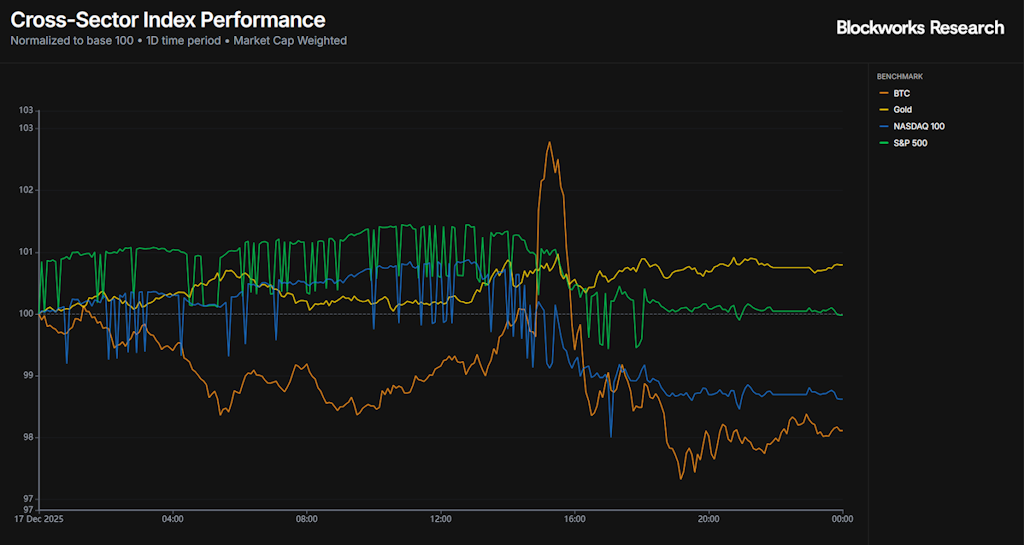
The trading day concluded with broad weakness across major risk assets. Gold served as the lone bright spot, managing to eke out a 0.8% gain as investors sought traditional stores of value. Meanwhile, the broader S&P 500 index finished the session flat, masking underlying turbulence. The technology-heavy Nasdaq Composite dropped 1.38%, and the flagship cryptocurrency, Bitcoin, declined by 1.89%.

The underlying market drivers remained consistent with recent weeks, characterized by a continued rotation away from the artificial intelligence trade that had previously powered technology indices to record heights. Market sentiment took an additional hit following unverified reports that a prominent Oracle investor had reportedly pulled out of a major data center project. Although Oracle subsequently disputed the claim, the headline proved sufficient to rattle already cautious market participants, prompting them to shift further into defensive positioning.
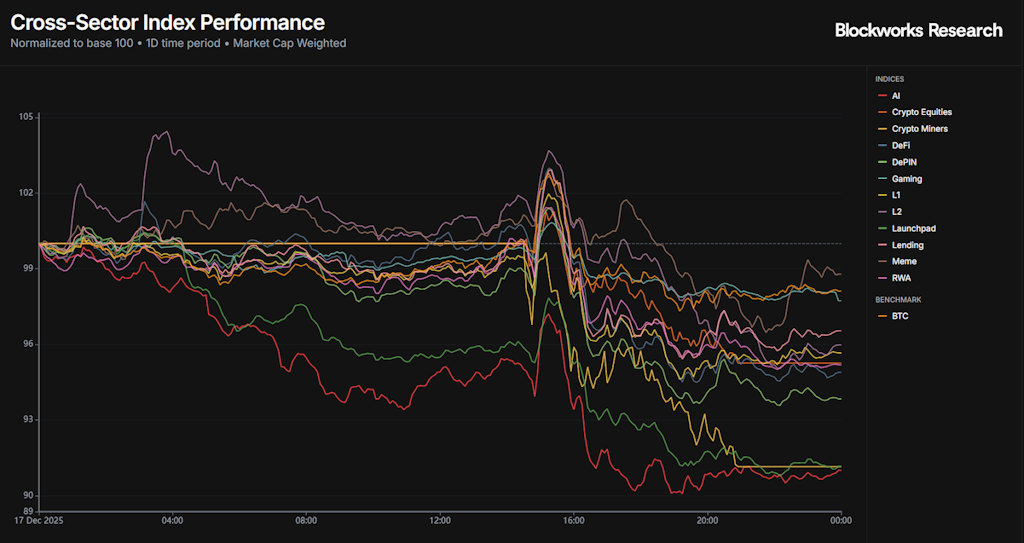
This persistent weakness quickly spilled over into the digital asset ecosystem, leaving every major crypto sector in negative territory by the closing bell. However, the meme token sector emerged as a surprising relative holdout. Despite typically ranking among the most sentiment-sensitive corners of the digital asset market, the meme index declined by a relatively modest 1.2%. This resilience was largely supported by MemeCore, which stood out as the sole constituent within the index to close in the green, posting a 1.96% gain for the session.
Conversely, the hardest-hit sectors within the crypto ecosystem were digital asset miners and artificial intelligence tokens, both of which suffered severe drawdowns approaching 9%. Crypto miners continue to grapple with growing fears that the broader artificial intelligence trade is rolling over, pulling related equities down with it. For instance, mining firm IREN has seen its valuation slide by 31% over the past month alone. Within the AI token index, Bittensor proved to be the weakest performer, shedding 9% of its value despite the recent execution of its network halving event.
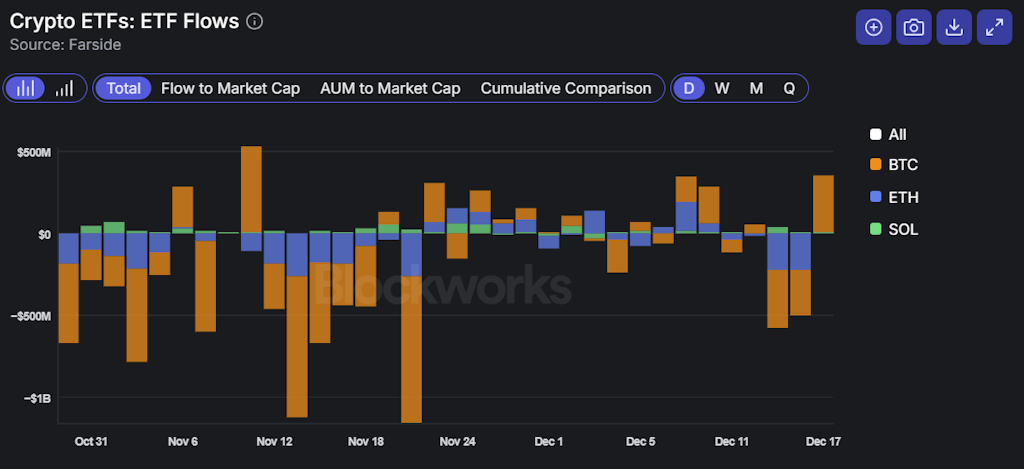
Despite the prevailing negative market sentiment and downward price action, institutional interest in digital assets displayed resilience through traditional investment vehicles. Bitcoin exchange-traded funds flipped back into positive territory, recording $346.1 million in net inflows during the session. Market participants are closely watching to see whether this renewed institutional accumulation can sustain momentum across consecutive trading sessions to close out the year on a stable footing.
Against the backdrop of macroeconomic volatility, the structural evolution of alternative trading products continues to accelerate. It has become commonplace for major financial platforms to introduce significant developments in prediction markets on a regular basis, and the latest iteration came from Robinhood during its keynote showcase. This growing institutional and retail focus is hardly surprising, given that prediction markets have rapidly evolved into Robinhood’s fastest-growing product category by revenue, having facilitated the trading of 11 billion contracts among more than one million active users.
Sports-related contracts remain the definitive volume driver for the entire sector. Sports prediction markets currently account for approximately 35% of total trading volumes on Polymarket and nearly 90% of overall volume on Kalshi. When analyzing the annualized sports volumes generated across both platforms over the past four weeks, the figures approach an estimated $74.5 billion. To put this scale into perspective, leading traditional sports betting operator FanDuel recorded approximately $50.7 billion in wagers throughout 2024, while DraftKings saw roughly $49.4 billion. These metrics illustrate that prediction markets are no longer a niche, speculative novelty operating on the fringes of finance; they are now directly competing with entrenched Web2 gambling and speculation incumbents.
Despite this explosive growth, a critical component has historically been missing from prediction market platforms: parlays. In the traditional sports betting industry, parlays account for roughly 30% of total handle and nearly 60% of overall industry revenues. These instruments bundle multiple distinct wagers into a single, combined bet, offering substantially higher potential payouts while carrying significantly lower statistical odds of winning. This risk-and-reward dynamic is precisely what makes parlays exceptionally lucrative for operators.
Robinhood is now moving aggressively into this territory to capture that lucrative revenue stream. The platform announced that users will soon gain the ability to trade combinations of outcomes, point totals, and point spreads for individual National Football League games. Looking further ahead to early 2026, the company plans to allow users to construct custom combinations of up to ten distinct outcomes for football matchups. Furthermore, Robinhood will introduce trading functionality focused on individual player performance metrics, commonly known as prop bets. This represents a meaningful leap beyond the basic binary win-or-lose markets currently offered, opening the floodgates to elevated speculation and dramatically higher trading volumes. Management has indicated plans to extend these advanced features beyond football and eventually expand into non-sports categories entirely.
A lingering question for market observers is how Robinhood intends to architect its underlying infrastructure for these new offerings. Industry participants are closely monitoring whether these complex products will be developed through continued partnerships with established entities like Kalshi or brought entirely in-house. That inquiry gained heightened relevance following Robinhood’s recent announcement of plans to build proprietary prediction market infrastructure via a newly formed joint venture with Susquehanna International Group.
The competitive landscape intensified further as Coinbase entered the fray, announcing a strategic partnership with Kalshi to roll out integrated prediction market products to its own user base. The corporate arms race to capture market share in decentralized and regulated forecasting is clearly underway.
Sports-focused prediction markets have definitively achieved product-market fit over the past year. Equipped with massive retail distribution networks at scale and increasingly sophisticated financial products, Robinhood’s latest strategic moves could grant the brokerage a decisive edge in the race for retail engagement. As the industry looks toward the future, the rapid convergence of traditional finance, digital assets, and event-based forecasting points toward a transformed landscape for retail speculation.





Comments (0)