



Published August 19, 2026
The ongoing evolution of the artificial intelligence sector has expanded beyond the initial battlegrounds of user interfaces, workflow integrations, and go-to-market strategies. Increasingly, industry leaders and investors point to a much deeper competitive frontier: a direct fight for control over the intelligence layer itself.
The industry-wide conversation regarding who should control the foundational intelligence of a business has intensified in recent months. Prominent technology leaders have begun publicly questioning the long-term viability of relying entirely on external frontier models. Palantir CEO Alex Karp recently urged enterprises to "own the means of production," echoing a growing sentiment that over-reliance on third-party labs carries hidden strategic costs. Similarly, Microsoft CEO Satya Nadella cautioned that purchasing intelligence from a frontier lab amounts to paying a double tax—paying once with capital and a second time by revealing proprietary knowledge and operational data required to make that intelligence useful.

This debate does not suggest that companies should completely abandon frontier labs. For many generalized enterprise workloads, third-party APIs and off-the-shelf agents remain the most practical and efficient choice. However, a significant shift is underway across the technology sector. An increasing number of companies are choosing to build their own custom AI capabilities for core product components, vertically integrating their operations to own and shape model weights directly.
This strategic direction was a central theme at a recent industry gathering hosted by venture capital firm Sequoia, which brought together AI founders and technical builders to discuss the mechanics of owning the enterprise AI stack. Representatives from legal tech leader Harvey provided a customer-centric perspective, while technical leaders from firms such as Mercor, LangChain, Trajectory, and Fireworks detailed the building blocks of the post-training stack. Across these presentations, a cohesive operational playbook began to emerge for companies looking to transition from renting to owning their intelligence infrastructure.
Two major developments have accelerated this trend toward proprietary AI ownership. First, the open-weight frontier has advanced at a pace that far exceeded initial expectations, with models like Kimi K3 and GLM 5.2 demonstrating exceptional performance. Previously, building on open models felt like running on a treadmill; companies might spend months fine-tuning an open-source model, only to have a subsequent frontier release instantly erase their hard-earned gains. Today, development can begin from a baseline that sits remarkably close to the absolute frontier of artificial intelligence capability.
Second, the independent post-training ecosystem has matured significantly. Companies can now access a complete research-grade technology stack spanning training, inference, and both human and synthetic data generation. Combined with rigorous evaluation frameworks, harness engineering, post-training, and online learning capabilities, modern open models are increasingly capable of outperforming generalized frontier models within specific, domain-optimized applications. While choosing open weights previously meant sacrificing performance for cost or control, it has rapidly evolved into an existential and strategic imperative. The modern battleground is no longer just about user-facing products or model weights; it is about controlling the intelligence that drives them.

Deciding when to make the leap from renting third-party intelligence to building in-house is a complex calculation with no universal solution. Beyond raw performance metrics, companies frequently encounter limitations when renting intelligence due to rising cost structures. As an AI-powered product scales and achieves commercial success, inference costs scale directly with usage, making model ownership an effective safeguard for operational margins.
Speed is another critical catalyst. In performance-sensitive domains such as automated code completion or real-time cybersecurity threat detection, a small, highly distilled custom model often outperforms a massive, generalized model simply because execution speed is paramount.
Furthermore, proprietary data sensitivity drives many organizations toward ownership. When user feedback, performance evaluations, customer interactions, and deeply guarded domain data serve as the primary drivers of system improvement, enterprises increasingly prefer to keep that proprietary flywheel safely within their own operational walls.
Finally, the boundary between the application layer and the intelligence layer is actively blurring. Foundation labs are increasingly pushing upward into end-user products, while application companies are moving downward into the training loops that dictate how those products think and reason. Consequently, owning a product increasingly requires controlling the underlying learning loops and the intelligence itself, a strategy championed by forward-thinking firms such as Harvey Research, RampLabs, Glean, and Factory.
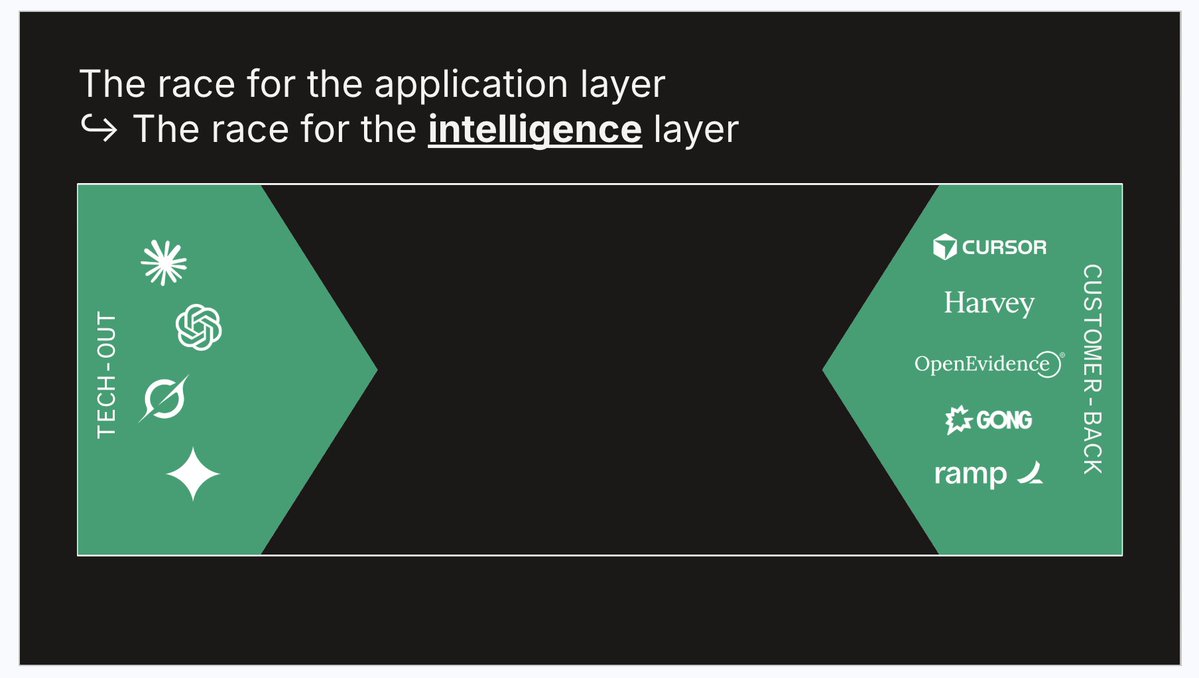
For organizations that decide to pursue a hybrid strategy of owning select components of their AI stack, the initial hurdle lies in executing a successful transition from zero to one. Industry experts emphasize the importance of assembling small, focused teams rather than relegating AI ownership to a generalized platform engineering group. Cultivating an environment where teams play offense—building rigorous evaluations, shaping proprietary datasets, experimenting with open-source models, and refining harness architectures—yields significant results. Notably, legal tech pioneer Harvey advanced much of its foundational research utilizing a dedicated team of just seven people.
Making technical and research work legible to the broader ecosystem has also become a powerful differentiator. As enterprise buyers evaluate competing AI solutions, published research, transparent benchmarks, and technical engineering posts often serve as the ultimate tiebreaker. Sharing internal breakthroughs back with the developer community helps establish credibility and industry leadership.
Executing the technical steps requires a structured approach across four core pillars: evaluations, harness and context engineering, post-training, and online learning.
Establishing robust evaluations—or evals—must precede any decision to own intelligence. As Gabe Pereyra of Harvey noted, lacking a reliable benchmark makes systematic model training impossible. An evaluation framework measures whether a system can execute specific tasks accurately through prompts, contextual data, and automated or rubric-based graders. While evaluations often originate from qualitative, founder-led vibe checks, scaling requires transforming those subjective judgments into repeatable, quantitative tasks. Harvey’s Legal Agent Benchmark, for example, translates complex legal work into thousands of discrete agent tasks spanning dozens of practice areas, graded against rigorous expert-written rubrics. Having a comprehensive eval in place transforms model selection from an educated guess into an empirical, measurable decision.

Once evaluations are established, harness and context engineering govern the product logic surrounding the model, handling routing, tool integrations, memory, retrieval systems, and fallback mechanisms. As Harrison Chase of LangChain observed, the primary function of a harness is to deliver the right context to the model at precisely the right moment. Off-the-shelf harnesses often struggle when handling tasks that fall outside a model’s primary training distribution. A well-designed custom harness allows engineering teams to route specific sub-tasks to the most optimal model, reuse standardized evaluations across different architectures, and inspect system behavior by tracing inputs, tool calls, and execution bottlenecks.
When models require behavioral or performance adjustments, post-training techniques provide the necessary levers depending on the specific deficit. Lin Qiao of the AI ecosystem noted that if a model is simply missing factual knowledge, expensive post-training is unnecessary; standard retrieval-augmented generation or context injection suffices. However, if output formatting or behavioral consistency is flawed, supervised fine-tuning is required. When the challenge involves subjective product taste, preference tuning becomes necessary, while specialized task execution demands reinforcement learning. For models that are excessively slow or resource-intensive, distillation provides a viable path to efficiency, allowing teams to apply the lightest touch required to improve their metrics while continuously measuring quality, latency, and cost.
The final operational pillar involves online learning, capturing continuous improvements directly from production environments. Arjun Karanam highlighted that while foundational models grow increasingly intelligent with every generation, interacting with them often feels like the model’s first day on the job. Without domain-specific experience, even the most capable general intelligence will initially underperform compared to specialized human professionals. Agents accumulate this vital experience during runtime.
By capturing a complete trajectory—including the context observed, the tools and sub-agents invoked, the generated output, and user modifications or retries—engineering teams can build a continuous production improvement loop using orchestration tools like LangSmith. In this framework, a failed task is automatically converted into a new evaluation benchmark, missing information is channeled into context or memory, and flawed tool responses trigger immediate harness corrections.

Ultimately, choosing to own an enterprise’s intelligence layer opens a strategic Pandora’s box. The closed-model stack offers simplicity, allowing teams to rely on a frontier model, an out-of-the-box harness, and standard prompting to ship products quickly. While this path provides a high baseline, it imposes a hard ceiling on long-term differentiation.
Conversely, taking ownership of the technical stack introduces higher initial complexity and a more demanding development cycle, but it fundamentally raises the strategic ceiling. The major labs will undoubtedly continue building massive foundational brains, and enterprises will continue to utilize them where appropriate. Yet, in parallel, innovative product companies are successfully cultivating their own specialized models: fast, opinionated, domain-obsessed systems tuned precisely to the unique workflows they encounter daily. As more organizations take direct ownership of their intelligence, the broader technology ecosystem flourishes, proving that domain individuality and specialized engineering can triumph in the age of artificial intelligence.




Comments (0)