



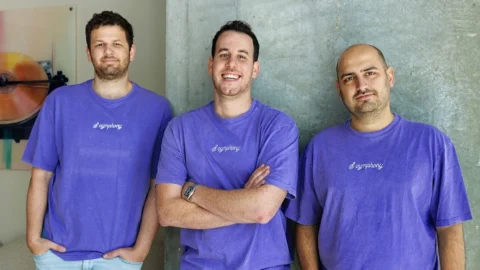
The journey of Yair Saban and Niv Hoffman began before they had incorporated a company, settled on a name, or finalized a product. When venture capital backers ran references on the pair across the Israeli cybersecurity ecosystem, a consistent narrative emerged: they were poised to become one of the most formidable founding teams in the country. One former commander of Unit 8200 remarked that Yair was the only individual they had ever encountered who possessed every single quality required to one day command the elite intelligence unit—serving as about as strong an endorsement as exists within the Israeli technology sector. Meanwhile, Niv is recognized as a technical outlier who previously led Unit 8200’s most critical vulnerability research department, where he successfully cultivated a network of elite technical talent. The speed at which this team operates is underscored by a simple timeline: Yair finished his military service on a Thursday, and a handshake agreement on a seed investment was reached that very Saturday.
Long before Yair and Niv began developing a commercial defensive security product, they engineered MOAK, colloquially known as the "Mother of All KEVs." MOAK is an agentic workflow designed to autonomously produce working exploits for newly published vulnerabilities with zero human intervention. In a striking public demonstration, MOAK successfully exploited a React vulnerability in just 21 minutes, contrasting sharply with the roughly six days it typically takes a standard enterprise to test and roll out a software patch. They released the tool publicly with the deliberate intention of ringing an alarm bell across the tech sector. Their goal was to highlight that the industry was severely underestimating the leverage attackers could extract from artificial intelligence, and to signal that defensive tooling urgently needed to evolve.
The fundamental architecture of software security shifted the moment modern developers stopped writing every line of code themselves and began importing third-party packages. That transition created the modern software supply chain. It subsequently took two decades, alongside a series of painful and disruptive security incidents ranging from Log4j to SolarWinds, for the industry to construct robust machinery capable of inspecting incoming software components. Autonomous agents now face an identical structural vulnerability, with a critical distinction: their supply chain is assembled dynamically at runtime, and in many cases, no one is inspecting it at all. A modern enterprise agent continuously consumes specialized skills, plugins, Model Context Protocol (MCP) servers, sub-agents, hooks, commands, and rules. Each of these components typically executes with the agent’s own elevated permissions, directly inside a user’s environment, and against sensitive user data. Frequently, these extensions are installed with the casual lack of scrutiny that an average user might apply to a basic browser extension.
Over the past several months, Air has dedicated itself to demonstrating the high stakes of this architectural blind spot. The team engineered a deliberately malicious skill and watched as multiple AI marketplaces casually approved it as safe. Their subsequent research, titled "The Story of Skills," documented how a researcher-built malicious skill successfully reached more than 26,000 active agents through a combination of trusted marketplaces and social media channels, completely bypassing every public security scanner along the way. Following that revelation, they published "SkillJacking," a study revealing that 925 live skills were pulling their underlying dependencies and operational prompts from dead web links. Air proactively registered those abandoned links and seized control of approximately 134,000 agents that had previously installed the compromised skills. In every instance, existing public security scanners failed to detect the underlying flaws entirely.
Demonstrating a rapid cycle of identification and remediation, the same day those findings were published, Yair and Niv shipped ScanAir, an OWASP-aligned vulnerability scanner specifically designed for agentic skills. That operational pattern—identifying a systemic security hole, proving its viability, publicly disclosing the risk, and immediately shipping the tooling required to close it—is what ultimately drew strong institutional backing to the team.
Today, Air offers a comprehensive suite of three distinct products designed to cover the full operational lifecycle of an AI agent’s add-ons. The first layer, Air Filter, vets every prospective add-on before an agent is ever permitted to consume it, leveraging a combination of static code analysis, dependency checks, and sandbox detonation. It then actively intercepts unsafe installations in real-time, offering safe alternatives in their place. The second layer, Air Defend, monitors the actual runtime behavior of agents once they are active, providing enterprise security operations teams with advanced detection and response capabilities for autonomous agent activities. Finally, Air Control manages enterprise posture and policy, offering comprehensive visibility into which agents exist, what data and systems they are allowed to access, and the ability to instantly revoke a compromised skill across thousands of agents simultaneously. The architecture can be conceptualized similarly to residential security: Air Filter functions as the physical locks and childproofing mechanisms, Air Defend operates as the security cameras and the personnel monitoring them, and Air Control serves as the primary control panel by the entrance—ensuring every entry point is accounted for, every code is assigned, and all permissions can be revoked at a moment’s notice.
Every few years, the premier cyber talent emerging from Unit 8200 consolidates around a select group of exceptional startup teams. In previous waves, that talent concentrated around companies such as Wiz, Cyera, and Island, followed by subsequent cohorts including Eon, Glow, Decart, and Kela. Today, that mantle has been taken up by Air. Yair and Niv have demonstrated themselves to be sharp, driven natural leaders with a proven ability to attract extreme talent density, assembling a high-caliber team in a remarkably short span of months. Sequoia Capital, which previously led the company’s seed funding round, is now doubling down with a Series A investment.
As modern enterprises increasingly move toward granting artificial intelligence agents real operational authority over critical underlying systems, Chief Information Security Officers across industries will inevitably face difficult questions: What code is our agent actually running? Where did those components originate? And who verified their safety? At present, very few organizations possess complete answers to these inquiries. However, Air is rapidly constructing the foundational system of record designed to provide them.




Comments (0)