



Macroeconomic realities have finally delivered a sharp reminder to the cryptocurrency market that broader financial conditions still matter immensely. After weeks of optimistic momentum, the digital asset ecosystem was forced to confront a tightening global liquidity landscape following the Federal Reserve’s latest policy decisions.
The Federal Reserve delivered a widely anticipated 25-basis-point interest rate cut, but the accompanying guidance struck a notably hawkish tone. Central bank officials signaled a much tighter path ahead, projecting only a single rate cut for the entirety of next year. Policymakers pointed to a cooling labor market, inflation that stubbornly remains above target, and economic growth that continues to prove resilient. The clear message to markets was that global liquidity is not opening up nearly as quickly as many optimistic investors had hoped.

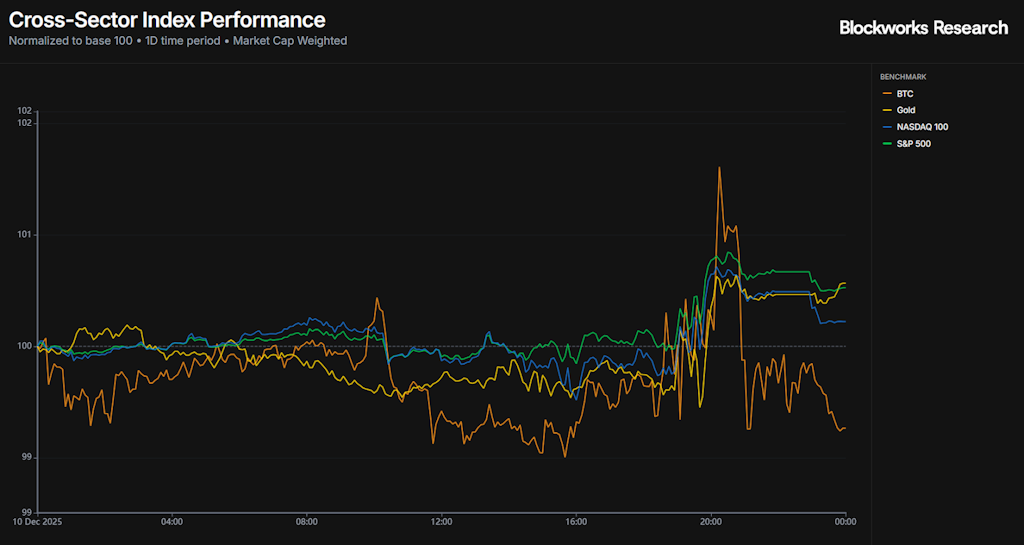
That sobering reality was enough to knock Bitcoin off its early-session strength and reinforce a broader narrative of market consolidation. Bitcoin finished the session down 0.73%, hovering near the $90,000 threshold as the market found itself caught in neutral. Meanwhile, traditional benchmarks managed modest gains, with gold, the S&P 500, and the Nasdaq closing up 0.57%, 0.53%, and 0.22% respectively. Until the broader macroeconomic environment picks a definitive direction, the cryptocurrency market appears content to drift alongside traditional financial indicators.
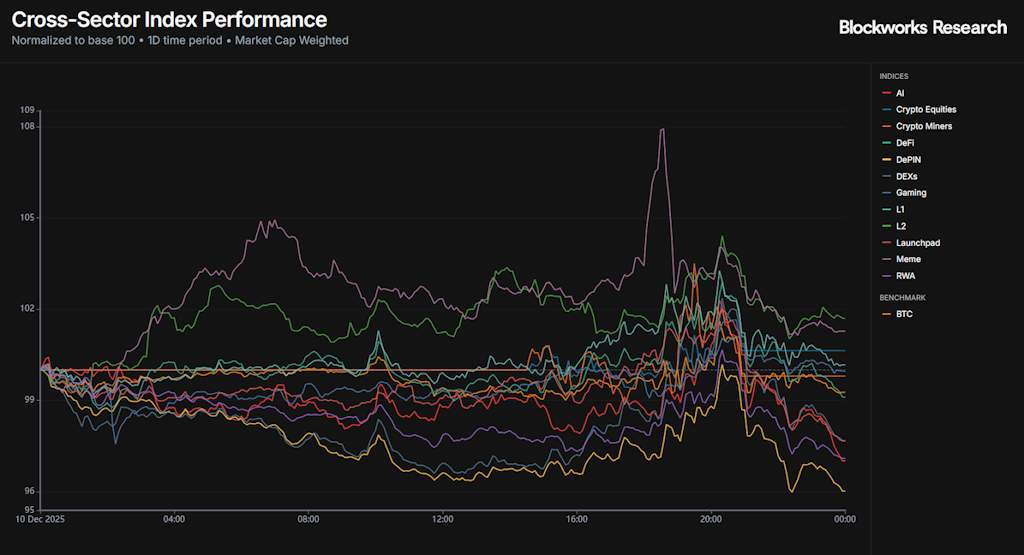
Across various digital asset sectors, performance remained mixed as capital rotated selectively. Layer-2 networks and meme-focused tokens managed to post gains of 1.70% and 1.27% respectively. The strength within the Layer-2 sector came almost entirely from MNT, which surged 4.5% and now accounts for nearly one-third of the sector’s total index weighting. The meme sector told a remarkably similar story, driven by M (MemeCore), which climbed 6.2% while the majority of alternative meme assets traded lower. On the other end of the spectrum, artificial intelligence and decentralized physical infrastructure networks lagged behind, registering losses of 3% and 4% respectively. AI tokens were weighed down by notable declines in IP and ICP, which fell 6% and 7.9%, while DePIN weakness stemmed from FIL and HNT, dropping 4.9% and 5.6%.
The Evolving Perp Wars and the Shifting Fortunes of HYPE
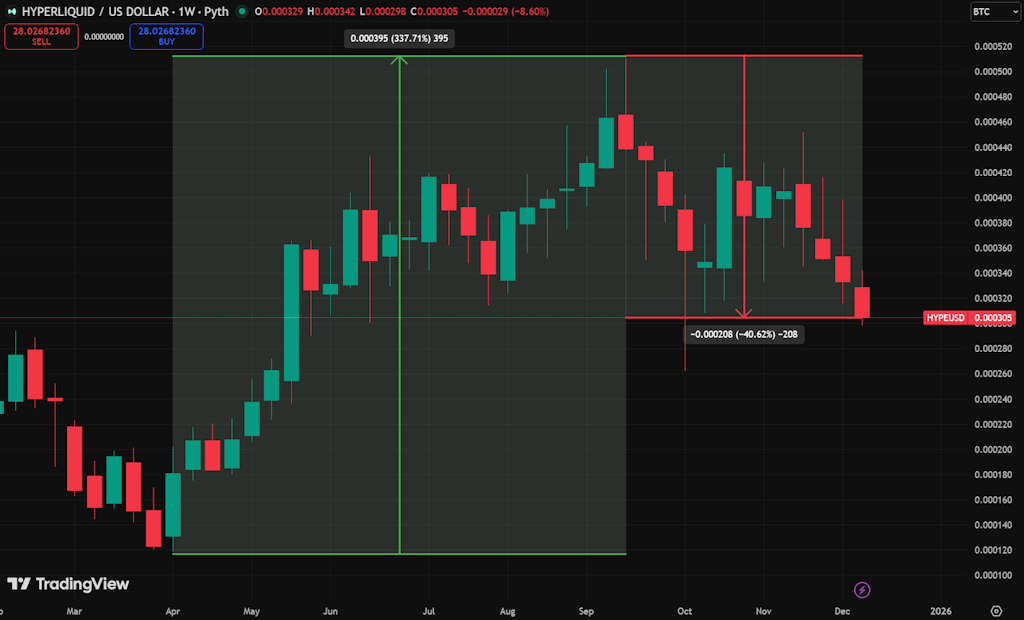
Beneath the macro-driven consolidation, the decentralized perpetual exchange landscape—commonly referred to as the perp wars—is heating up dramatically. A central question dominating traders’ minds centers on whether the momentum behind Hyperliquid’s native token, HYPE, is genuinely fading. Over a recent seven-day stretch, HYPE slumped 20% while Bitcoin dropped just 3%, struggling to keep pace with broader market recoveries. When examining weekly HYPE-to-Bitcoin returns over a longer horizon, it becomes evident that HYPE has surrendered nearly half of its outperformance accrued since the April market lows, following a sharp peak in mid-September.
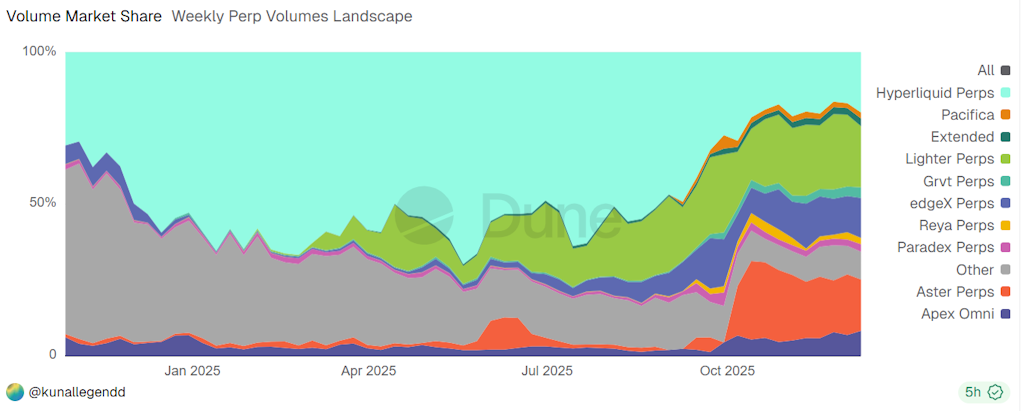
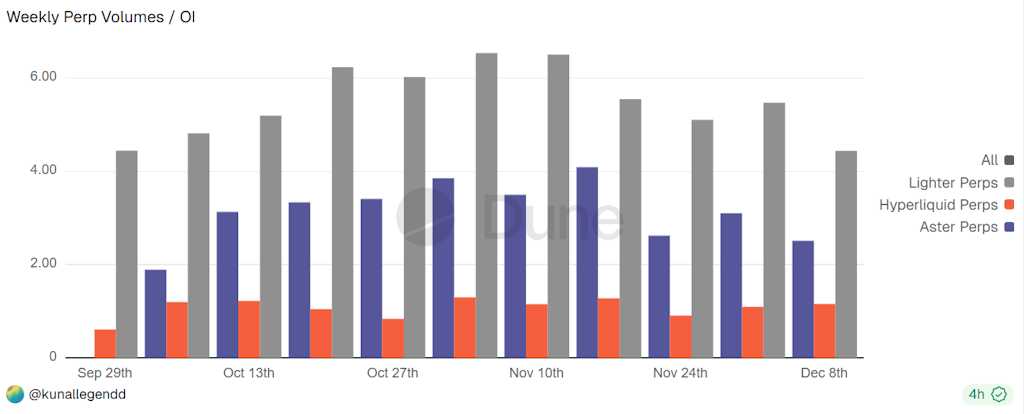
The primary catalyst behind this shift is intensifying competition. The peak in HYPE’s relative performance coincided almost perfectly with the launch of Aster, a rival perpetual exchange that rapidly captured market share and trader attention. Since mid-September, Hyperliquid’s share of total perpetual trading volume has contracted from 49% down to 19%. The vast majority of that displaced market share has migrated toward Aster and another rising competitor, Lighter, with the latter even managing to slightly edge out Hyperliquid in weekly trading volume since mid-October.
However, raw trading volume alone fails to paint the complete picture of market health. A comparative analysis of weekly trading volume relative to open interest reveals that both Lighter and Aster maintain significantly higher ratios than Hyperliquid. Extremely high volume-to-open-interest ratios point to a rapid turnover of outstanding positions, which frequently signals inorganic market activity driven heavily by yield farming and incentive programs. Both Aster and Lighter have been actively running points programs, suggesting a substantial portion of their current activity could dissipate as promotional incentives cool down. With Lighter approaching its upcoming token generation event, the broader market will soon receive its first genuine test regarding how much of that platform’s activity represents sticky, organic volume versus short-term farming.
For an extended period, many market participants assumed Hyperliquid would effortlessly dominate the perpetual exchange sector as a winner-take-all monopoly. The current landscape, however, looks far more competitive and fragmented. Industry analysts increasingly suggest that the market will not be winner-take-all; instead, the dominant perpetual platform will ultimately be determined by whoever can consistently deliver the lowest fees, deepest liquidity books, widest market selection, and most seamless trading experience.
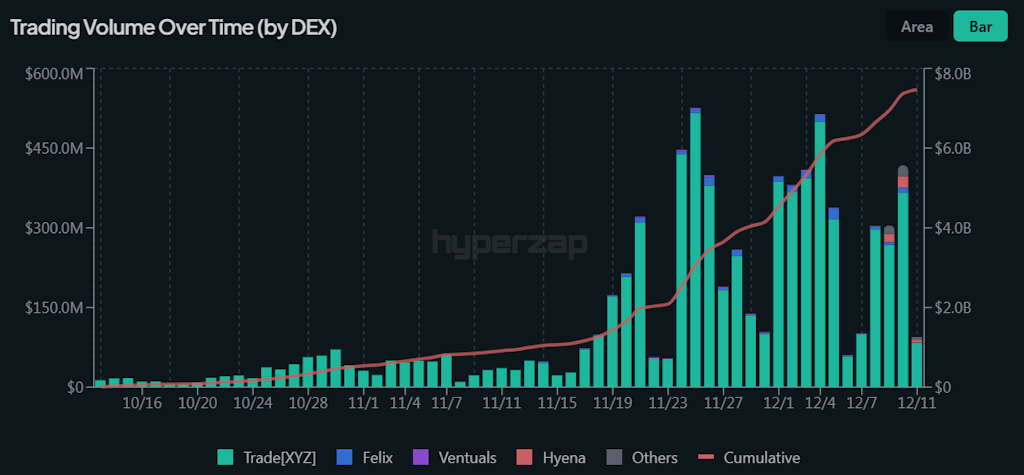
Lighter currently leads the fee battle by offering zero maker and taker fees, a dynamic amplified by the rise of perpetual aggregators capable of routing order flow directly to low-cost venues. Nevertheless, liquidity depth and market variety remain equally critical, and Hyperliquid continues to maintain an advantage in both categories. That lead was further reinforced by the introduction of HIP-3, which brought equity perpetual markets to the platform and generated strong early traction.
Recent headwinds, including scheduled team token unlocks and emerging debates surrounding Hyperliquid’s automated deleveraging design, have certainly weighed on short-term market sentiment. Even so, the protocol’s core fundamentals remain exceptionally robust. Hyperliquid consistently generates between $10 million and $20 million in weekly revenue, a substantial portion of which is actively utilized to buy back HYPE tokens. Very few protocols across the entire digital asset industry possess that level of tangible, cash-generating economic engine. While market dominance is never guaranteed, dismissing Hyperliquid prematurely overlooks a formidable competitive moat as the battle for perpetual exchange supremacy accelerates.
Fixing Broken Investor Relations for a Maturing Asset Class
The broader cryptocurrency industry has matured at an unprecedented pace, evolving from a market dominated purely by speculative infrastructure plays into a diversified ecosystem of revenue-generating economic streams. Across the industry, monthly protocol revenue—excluding stablecoins—averaged $175 million over the past year, representing a staggering 133% year-over-year increase compared to the $75 million recorded previously.
The unprecedented capacity for global coordination on decentralized networks has unlocked growth metrics previously unseen in traditional markets. Hyperliquid became the fastest team in history to scale to $1 billion in annualized recurring revenue, Tether secured a massive valuation during fundraising rounds, and newer DeFi applications like Axiom achieved tens of millions in monthly revenue within months of launching. Supported by consistent monthly venture capital raises ranging from $500 million to $2 billion, the industry continues to expand aggressively.
Despite this remarkable operational and financial growth, navigating the crypto landscape has arguably become more complex than ever, particularly for traditional finance investors looking to diversify portfolios. Although digital assets have largely transformed into ownership-based instruments that function similarly to cash-generating businesses, their unique cryptographic characteristics make rigorous due diligence extraordinarily difficult.
Consider platforms like Pendle Finance, a prominent fixed and variable rate swap yield-optimizing protocol. Within traditional finance, the equivalent interest rate derivatives market trades an astonishing $7.9 trillion per day. While professional allocators instantly recognize the immense scale of the opportunity, translating that framework to crypto introduces dense, unique nuances. This inherent complexity extends across almost every product category in the fast-evolving digital asset economy. Allocators constantly grapple with intricate structural questions, such as evaluating the advantages of central limit order book models versus automated market maker designs, weighing the trade-offs between modular and monolithic lending architectures, or determining the true stickiness of various user acquisition models.
For a professional institutional allocator, the current workflow is fundamentally broken. Critical information required for proper financial analysis is frequently fragmented and constrained behind multiple scattered dashboards, dense GitHub repositories, and private community communication channels. This information barrier creates three distinct hurdles: a lack of standardized financial reporting, difficulties in translating raw on-chain governance activity into investment committee-ready research, and a severe absence of centralized roadmap communication between development teams and capital allocators.
To bridge this growing divide between crypto-native projects and professional capital, infrastructure providers are beginning to build institutional-grade tooling. Initiatives designed to professionalize the connection between token issuers and financial allocators aim to replace fragmented workflows with gated, standardized environments. By shifting away from open, unverified aggregators toward high-fidelity on-chain metrics, converting raw governance data into structured research, and centralizing roadmap updates, the industry is slowly building the professional investor relations infrastructure it has long lacked. Starting within high-activity ecosystems like Solana, these platforms represent a crucial step in enabling crypto-native projects to effectively communicate their underlying business fundamentals to the broader institutional financial world.





Comments (0)