



Tokenization is rapidly beginning to reshape traditional financial markets, with corporate equities increasingly stepping into the spotlight. Much of the mainstream attention has naturally centered on the staggering $3.3 billion in tokenized equities now operating on-chain, according to data from RWA.xyz. However, industry analysts and market observers suggest that one of the most profound innovations taking place isn’t just the underlying technology itself, but rather when these assets are traded—specifically, what happens in the hours before Wall Street opens its doors in the morning and long after it closes its bell-ringing sessions in the afternoon.
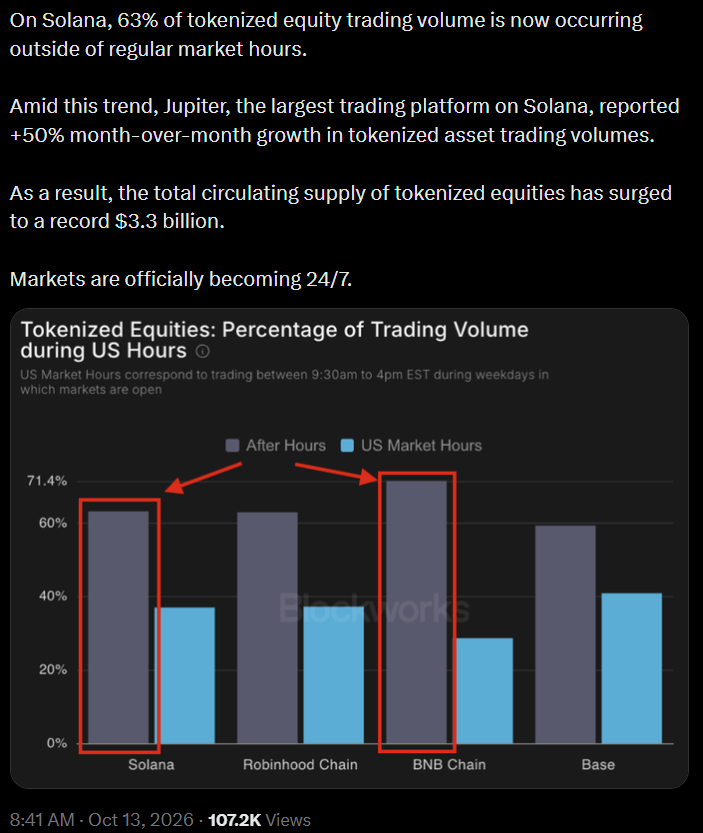
According to the latest industry data and tracking metrics, more than 70% of all tokenized stock trading volume on the BNB Chain now occurs completely outside regular United States market hours. Similar patterns are swiftly emerging across other high-performance public blockchains, including Solana and Base. This fundamental shift means that tokenized equities are effectively allowing everyday and institutional investors to trade traditional US stocks seamlessly across global time zones, completely bypassing the rigid constraints of traditional exchange schedules and potentially altering how global liquidity is distributed throughout the entire twenty-four-hour trading day.
Despite this surging international enthusiasm, however, many of the specialized platforms driving this on-chain activity remain strictly off-limits to American investors. This regulatory gap persists even as US financial regulators begin to tentatively make room for tokenized stock trading within domestic perimeters.
This week’s edition of Crypto Biz takes a comprehensive look at this evolving landscape, examining the cross-border phenomenon of tokenized stock trading, the complex and capital-intensive economics of Bitcoin mining, a proposed US accounting rule change that could make it significantly easier for major corporations to treat stablecoins as cash equivalents, and Strive’s continued aggressive expansion of its corporate Bitcoin treasury.
Tokenized Stocks Find an Audience Beyond Wall Street’s Trading Hours
The vast majority of tokenized stock trading activity happening across networks like Solana and BNB Chain now takes place well outside regular United States market hours. This striking development strongly suggests that around-the-clock, continuous access is quickly becoming the single most compelling selling point for equities issued on public blockchains.
According to proprietary Blockworks data recently highlighted by The Kobeissi Letter, more than 70% of all tokenized stock trading volume on the BNB Chain occurs outside the traditional 9:30 am to 4:00 pm Eastern Standard Time trading window. This phenomenon is hardly isolated to a single network; the figure sits at an impressive 63% on Solana and nearly 60% on Base, demonstrating broad user demand across multiple blockchain ecosystems for continuous, uninterrupted market access.
Overall transactional activity is also picking up significant momentum across the board. Decentralized finance aggregator Jupiter recently reported a notable 50% month-over-month increase in its tokenized asset trading volume. Simultaneously, comprehensive analytics from RWA.xyz revealed that the total aggregate value of tokenized stocks climbed by roughly 15% over the past 30 days alone, bringing the market capitalization of these on-chain traditional assets to nearly $3.3 billion.

This accelerating trend arrives precisely as the US Securities and Exchange Commission introduces temporary innovation exemptions designed to open the door for qualifying platforms to trade tokenized US-listed stocks directly on public blockchains. These experimental pathways, however, remain tightly bound to strict disclosure, transparency, and shareholder protection requirements. Because of these complex regulatory frameworks, existing prominent offerings such as xStocks and Ondo Global Markets remain largely unavailable to retail and institutional investors based inside the United States, thereby limiting domestic participation in an otherwise burgeoning global market.
Strive Adds 3,311 Bitcoin as Investors Exercise $208 Million in Warrants
In the corporate treasury sector, Bitcoin-focused firm Strive dramatically increased its digital asset holdings by more than 11% over the course of a single week, utilizing the proceeds generated from aggressive warrant exercises to expand its cryptocurrency reserves while simultaneously driving up Bitcoin exposure per share for its equity holders.
In an official regulatory filing submitted to the US Securities and Exchange Commission, Strive disclosed that it successfully purchased 3,311 Bitcoin during the week ending October 9. The digital assets were acquired at an average price of roughly $84,500 per coin. These substantial, strategic acquisitions brought the company’s total cumulative Bitcoin holdings to an impressive 32,773 BTC. With this sizable reserve, Strive has firmly cemented its position as the fifth-largest publicly traded corporate holder of Bitcoin globally.
Strive Chief Executive Officer Matt Cole explained that the capital used to fund these purchases came as investors actively exercised $208 million worth of corporate warrants. He noted that approximately $15.3 million in warrants still remained outstanding ahead of an impending expiration deadline.
Alongside its aggressive treasury expansion, Strive also amended its foundational governing documents to establish a binding $100 minimum issuance price for its SATA preferred shares, which were recently changing hands at $99.40 in the open market. Meanwhile, the broader spot price of Bitcoin hovered near $83,300, trading slightly below Strive’s average purchase price for the week. The company’s common stock, traded under the ticker ASST, remained relatively steady, closing the session little changed at $27.52.
Bitcoin Miners Face Steep Financing Costs in AI Expansion
Even as digital asset treasuries aggressively accumulate capital, traditional Bitcoin mining companies that are attempting to pivot toward or expand into artificial intelligence and high-performance computing are running into substantial economic hurdles. Specifically, these firms face a widening gap in borrowing costs as major lenders closely examine the operational risks, capital requirements, and long-term viability of large-scale data center projects.
According to research published in BlocksBridge Consulting’s industry publication, Miner Weekly, successfully securing enterprise artificial intelligence customers is only one piece of a much larger, highly complex puzzle. Mining operators also desperately require billions of dollars in upfront capital to construct physical facilities, purchase advanced specialized computing equipment, and secure reliable, long-term power infrastructure. Consequently, financing terms have become increasingly stringent, depending heavily on the creditworthiness of the prospective AI client and the calculated statistical likelihood of project completion.
The stark financial disparities are readily apparent in recent market transactions. Bitcoin miner IREN previously secured a massive $3.65 billion financing package at a blended interest rate of 6%, which was followed later by another $2.4 billion debt agreement carrying a fixed interest rate of 9%. Because these complex credit agreements cover entirely different infrastructural projects and timelines, direct financial comparisons remain difficult, yet they underscore the escalating costs of debt.
The overall capital requirements facing the sector are immense. A comprehensive June analysis by BlocksBridge, which heavily cited market projections from VanEck, estimated that publicly traded Bitcoin miners collectively required upwards of $50 billion in external funding to successfully execute their ambitious AI infrastructure pivots. IREN alone faced a daunting $21.1 billion funding gap at the time of the study, followed closely by industry peers Riot Platforms with a $7.2 billion shortfall and HIVE Digital Technologies facing a $4.6 billion funding gap.
US Accounting Proposal Could Give Stablecoins a Corporate Boost
Looking toward regulatory developments that could profoundly influence corporate finance, a newly proposed change to United States accounting standards could soon make payment stablecoins vastly more attractive to mainstream corporate treasuries. According to a detailed report from payments blockchain firm Tempo, the proposed rules would allow qualifying digital tokens to be officially treated as cash equivalents directly on corporate balance sheets.
Under current, traditional accounting practices, stablecoin holdings frequently fail to qualify as cash or cash equivalents, regardless of how securely they are backed. This technical exclusion can negatively affect a company’s reported liquidity ratios, working capital metrics, and complex commercial loan covenants, even when the tokens in question are fully backed one-to-one by United States dollars and short-term treasuries.
The progressive proposal, put forward by the Financial Accounting Standards Board, aims to bridge this gap, though Tempo noted that interested corporations would still need to meet specific criteria—such as maintaining direct, unencumbered redemption rights with the original stablecoin issuer—to qualify for the favorable accounting treatment. For instance, simply purchasing a digital asset like USDC through an intermediated cryptocurrency exchange or secondary market would not necessarily satisfy the strict requirement on its own.
A handful of forward-thinking enterprises have already begun adapting their internal classifications. Coinbase notably classified USDC and other primary payment stablecoins directly as cash equivalents within its annual financial reporting, a move backed by its direct operational and redemption arrangements with Circle.
The broader FASB proposal remains open for formal public comment, giving industry stakeholders, accountants, and corporate executives until November 19 to submit feedback. Following the close of the comment window, the accounting board will review the industry responses before determining the final wording, compliance parameters, and official effective date of the new rules.





Comments (0)