


RouteMesh has reached a major operational milestone, integrating thousands of individual nodes into its network infrastructure. This extensive coverage has provided the platform with a unique vantage point to observe, analyze, and quantify the underlying software client landscape of blockchain networks across the digital asset ecosystem. Historically, comprehensive data detailing which software clients power specific blockchain networks has been notably scarce, leaving developers, infrastructure providers, and researchers with limited visibility into how distributed ledger technology operates at the infrastructure layer.

To bridge this information gap, RouteMesh has begun leveraging its massive node network to map out the software configurations, client types, and version distributions powering the modern blockchain economy. Every time a new node is integrated into the RouteMesh ecosystem, the platform subjects it to rigorous benchmarking procedures designed to extract maximum technical data. While future reports will delve deeper into the specific performance metrics and benchmarks uncovered by these tests, the platform’s initial findings focus squarely on node client types and market share dynamics.

Operating a blockchain network requires specialized software applications known as clients, which communicate with other nodes to maintain consensus, validate transactions, and enforce network rules. The most prominent and widely adopted client software in the Ethereum ecosystem is geth, an abbreviation for go-ethereum. However, over the years, the client landscape has expanded significantly. When blockchains feature distinct consensus rules, operational parameters, or architectural mechanisms, developers either adapt the foundational geth codebase or engineer entirely new client software from scratch. Furthermore, for major blockchain networks, independent development teams frequently author competing software client implementations. This practice, widely known as client diversity, enhances network resilience by preventing a single software bug from taking down an entire chain.

Because RouteMesh currently monitors thousands of active nodes across the ecosystem, the platform is uniquely positioned to quantify client diversity in a manner that has not previously been possible. By continuously pinging and re-discovering the operational state of its nodes every few days, RouteMesh tracks critical infrastructure shifts, including client version updates and configuration adjustments made by node providers.

For industry participants seeking granular transparency, RouteMesh has made its comprehensive client data publicly accessible online. With more than thirty prominent Remote Procedure Call (RPC) providers integrated into its network, RouteMesh maintains high confidence in the breadth of its ecosystem coverage. Although the dataset remains an incomplete picture of every single node in existence—given the sheer impossibility of indexing every node globally—it serves as an exceptionally robust proxy for the broader blockchain infrastructure market.

An initial examination of the integrated RPC providers reveals that a substantial majority of the monitored nodes operate on geth. While analysts might have anticipated a more evenly distributed market share across various client implementations, the overwhelming dominance of geth came as a surprise to the research team. Trailing far behind in second place is reth, an emerging client spearheaded by Paradigm. A subtle nuance within the data is that RouteMesh measures market share by absolute node counts rather than the volume of RPC requests handled by each client. Nevertheless, absolute node deployment and request volume remain closely intertwined metrics within the infrastructure sector.

Sorting the data by individual blockchain networks rather than raw market share reveals a fascinating cross-section of industry dependencies. Geth emerges as the undisputed cross-chain champion, acting as the foundational backbone for the crypto RPC industry. According to RouteMesh data, geth serves as the active client software across roughly 427 different blockchain networks spanning the entire crypto-verse. Following geth, a smaller cohort of alternative clients captures secondary market share, while a variety of multi-chain or specialized clients—such as cdk-erigon, Nethermind, skaled, zkSync, erigon, go-opera, OpenEthereum, and bor—populate specific niches within the broader ecosystem.

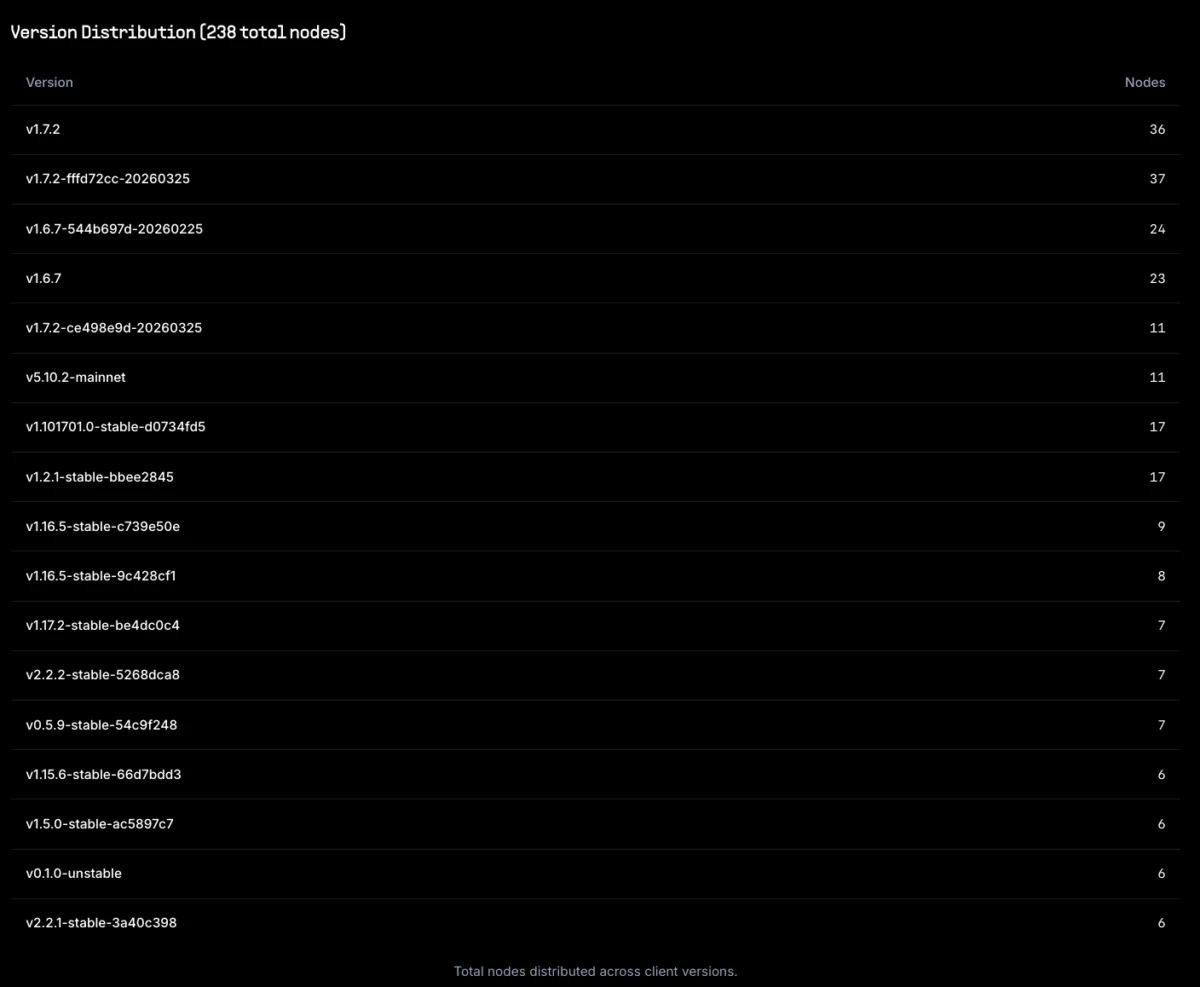
A deeper dive into the version distribution of these clients highlights significant variations in how quickly infrastructure providers adopt software updates. Geth versions, for instance, display a wide and fragmented spread across the provider fleet. The newest major iteration, version 1.7, was initially released in February 2026, yet older versions continue to occupy substantial portions of the market. Most notably, version 1.7.2—originally released on October 14, 2017—remains surprisingly prominent in the dataset. If a centralized infrastructure provider relied on a single node running such an outdated version, that node would represent a vulnerable single point of failure. However, RouteMesh’s decentralized routing model effectively mitigates this risk by incorporating robust automatic fallbacks.

The introduction of geth version 1.17 brought crucial performance improvements tailored for heavy RPC query workloads. The fact that a significant portion of nodes have yet to transition to these newer releases underscores the persistent operational challenges inherent in managing RPC infrastructure. Maintaining optimal performance depends entirely on how diligently an individual provider updates its node client versions across every supported blockchain network.

The granularity of the RouteMesh dataset extends even further, allowing researchers to examine which specific providers operate particular client versions and network counts. While major players like Alchemy and QuickNode are only partially represented in the system—owing to the financial costs associated with querying additional commercial nodes—the available visibility provides unprecedented insight into enterprise fleet management. Conversely, the data can be inverted to analyze the exact client software and version ranges deployed by individual providers. For example, examining Alchemy’s node fleet reveals a calculated distribution of client versions, demonstrating the exact level of transparency that RouteMesh advocates for the wider blockchain industry.

Analyzing alternative clients provides additional context regarding developer adoption and provider responsiveness. Reth, the Paradigm-backed execution client, exhibits a distinct geographic and network footprint. The leading blockchain network supported by reth is Base, followed closely by Ethereum, Optimism, Base Sepolia, Ethereum Sepolia, and Binance Smart Chain. Unlike the fragmented version distribution observed with geth, reth deployments display a much higher degree of version alignment. Infrastructure providers appear to keep their reth fleets significantly more up to date, offering a reassuring indicator of client health and maintenance.

Although the major version reth 2.0 was released just last month, it currently registers as one of the least adopted iterations among monitored nodes. Instead, version 1.11.3 stands out as the most dominant release, having debuted in March 2026 alongside version 1.10.2 from February. This empirical evidence suggests that infrastructure providers systematically observe a stabilization period of a few months before migrating their production environments to newly launched client versions.

A similar pattern emerges when evaluating Nitro, a client implementation heavily dominant within the Arbitrum ecosystem. Nitro node runners demonstrate a strong proclivity for maintaining relatively fresh software installations. While version 3.9.9 exists in the wild, version 3.9.8 commands the highest market share across the network. A review of public code repositories confirms that version 3.9.8 represents the most recent stable release, whereas version 3.9.9 functions primarily as an ongoing release candidate undergoing iterative testing. This tighter synchronization suggests that the Arbitrum ecosystem benefits from strong coordination between core client developers and infrastructure operators, with Nitro successfully powering a vast array of niche and experimental networks.

The pipeline through which client developers author software improvements, followed by the measured adoption timeline of RPC providers, illustrates the gradual and deliberate nature of infrastructure upgrades. Because RPC providers form the foundational bedrock of the digital asset economy, developing a comprehensive understanding of their operational habits grants the entire ecosystem vital transparency regarding how transaction requests are processed and managed. Investigating the lower-level mechanics of blockchain operations reveals intricacies that rarely enter public discourse. By continuously tracking live data across multiple client implementations and active blockchain networks, RouteMesh aims to foster a more transparent, resilient, and well-informed infrastructure landscape.




Comments (0)