


As the artificial intelligence boom matures, the industry is confronting a series of critical bottlenecks. While early conversations focused heavily on semiconductor shortages, energy grid limitations, and specialized engineering talent, a more fundamental constraint is now emerging at the heart of the market: access to capital. Specifically, the future of the artificial intelligence revolution will be determined not by equity or corporate cash reserves, but by the global credit markets.
When the massive AI infrastructure buildout first commenced a few years ago, the vast majority of capital expenditures were funded directly from corporate balance sheets. This approach was clearly reflected in the financial performance of major hyperscalers, which burned through substantial cash reserves and faced intense scrutiny from Wall Street as their free cash flow turned negative. Tech titans largely bypassed external debate by deploying their own capital however they saw fit, setting the stage for the initial wave of high-performance data centers.
However, corporate cash piles were only ever meant to finance the start of the journey. As the immense capital requirements of training and running next-generation models became apparent, financing naturally shifted toward equity markets. High-profile examples include massive equity raises and secondary offerings by tech giants like Alphabet and Meta, which diluted existing shareholders to secure additional funding. Investors who firmly believed in the long-term track records of these market leaders were initially more than willing to back their capital-intensive expansion plans. Yet, even these multi-billion-dollar equity injections ultimately proved insufficient to satisfy the insatiable appetite of the expanding technological infrastructure.
This reality has forced the industry to turn to the world’s deepest reservoir of funding: the credit markets. The global credit landscape dwarfs traditional equity capital in sheer size, making it the logical next step for financing the ongoing compute buildout. However, transitioning from equity and balance-sheet financing to debt introduces entirely new dynamics, rigorous underwriting standards, and complex risk assessments.
While cash on balance sheet requires zero external visibility and equity offerings rely primarily on investor faith in management track records, credit markets operate under a strict framework of accountability. Lenders require absolute certainty that they will recover their principal plus interest on exact, promised terms, backed by robust legal recourse if agreements are breached. To justify deploying capital at this unprecedented scale, lenders must establish a coherent set of core beliefs regarding demand permanence, asset depreciation, and hardware utilization.
A critical hurdle facing the credit ecosystem is a deep-seated skepticism among market bears who view the current artificial intelligence wave through the lens of a traditional capital expenditure bubble. Critics frequently point to two primary concerns: the risk of an aggressive overbuild resulting in excess capacity, and the assumption that rapid software efficiencies and algorithmic improvements will drastically reduce future hardware requirements.
Proponents of the infrastructure boom argue that these concerns fundamentally misunderstand the nature of modern compute demand, which is expanding at a staggering pace. Agentic AI demand, for instance, is compounding rapidly year over year, while manufacturing supply can realistically double at most over the next several years. This growing supply gap is further underscored by the fact that advanced memory components are sold out far into the future, and major technology executives continue to warn that global shortages are worsening. Aggregate compute commitment contracts currently span trillions of dollars, with leading infrastructure providers sitting on backlogs worth hundreds of billions.
Because advanced semiconductor supply cannot be expanded overnight, and the integration of artificial intelligence across the broader economy is rapidly accelerating, large segments of the market will face persistent structural deficits. Industries ranging from automated logistics and molecular drug discovery to autonomous systems and enterprise-wide process optimization operate with virtually unlimited appetite for computational power. For these organizations, compute is no longer a discretionary line item, but a fundamental means of production that provides an insurmountable competitive advantage over slower-moving rivals.
Consequently, the risk of a systemic overbuild appears minimal. If compute demand is treated as a finite resource, one would have to assume a sudden, unnatural halt in technological adoption, economic stagnation, or a scenario where intelligence becomes so inexpensive that its utility abruptly drops to zero. Real-world data, however, points to the exact opposite phenomenon. Historical precedent demonstrates that every time the cost of artificial intelligence drops significantly, overall usage expands at an even greater multiple, continually unlocking novel use cases through the economic principles of induced demand.
Despite these strong demand fundamentals, traditional lenders often approach compute financing with flawed mental models, frequently drawing inaccurate parallels to commercial real estate. In traditional real estate markets, the pool of potential tenants is strictly bounded by physical geography and local economic conditions. Compute, by contrast, is a vastly more fungible asset class that can be redeployed, networked, and monetized globally.
In an attempt to mitigate risk, many credit institutions have become hyper-fixated on securing investment-grade off-take agreements, routinely demanding lengthy multi-year contracts alongside substantial down payments ranging from thirty to fifty percent. Lenders frequently believe this approach guarantees safety by ensuring the counterparty can fulfill contractual obligations. In practice, however, this insistence on rigid security often backfires.
In a market environment where compute demand severely outstrips supply and is projected to remain constrained for years, a default by one customer is immediately absorbed by a long line of eager replacements. Hardware availability remains severely restricted, and rental prices for high-end processors have climbed significantly over recent quarters. By forcing long-term contracts at steep discounts in exchange for perceived security, lenders inadvertently position themselves as net-short on compute. This miscalculated bet prevents them from capturing the upside of rapidly appreciating market rates and can actually extend payback periods far beyond what could have been achieved in a more flexible financing structure.
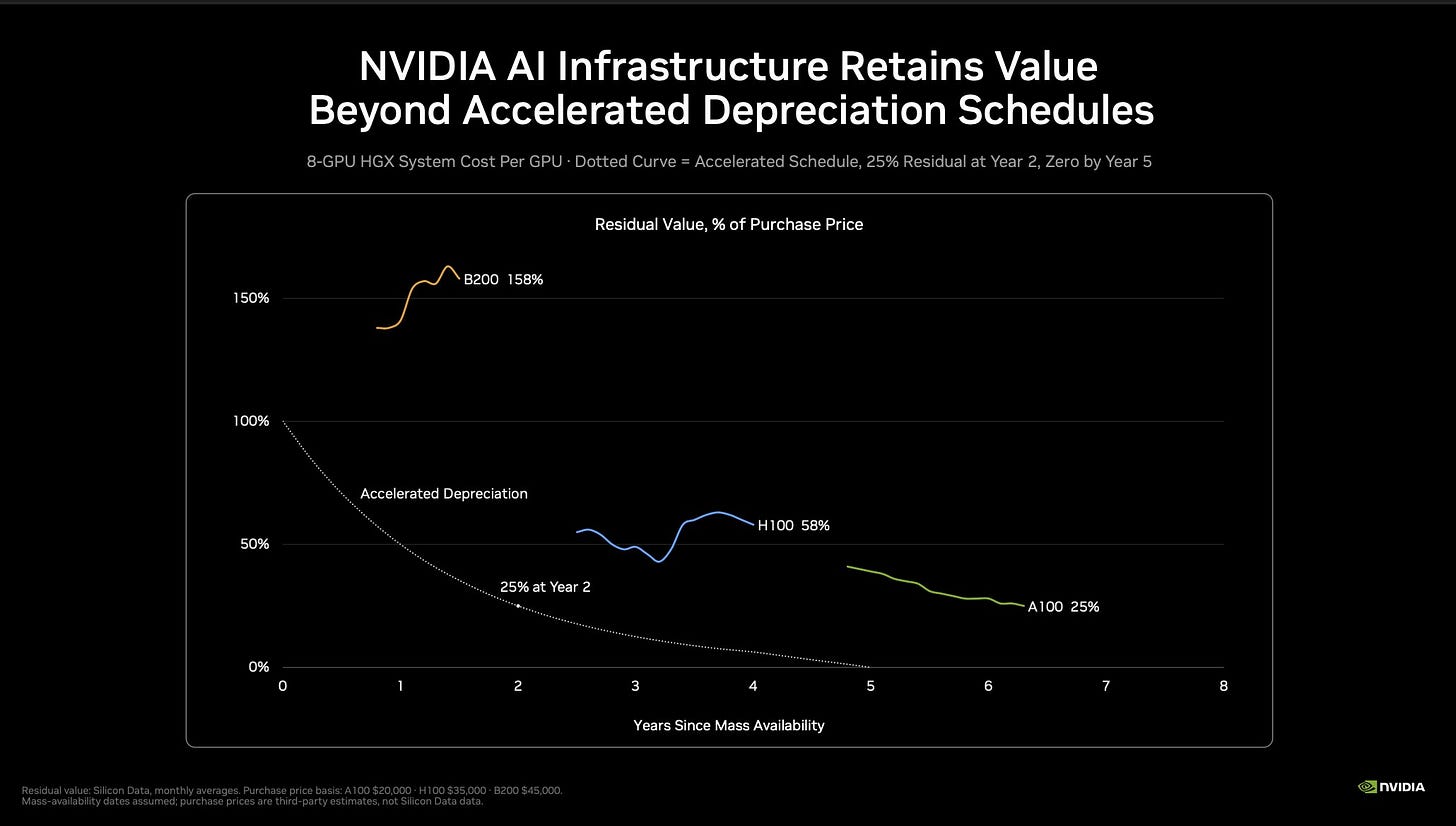
Another prominent misconception among skeptics concerns hardware depreciation schedules. Critics frequently argue that specialized artificial intelligence chips suffer from rapid obsolescence, rendering them financially worthless within a few years and necessitating constant, expensive replacements. Empirical evidence, however, challenges this assumption. Older generation hardware, such as graphics processing units deployed years ago, remains heavily utilized and actively rented out in data centers, establishing a proven operational lifespan approaching a decade for enterprise-grade hardware.
Furthermore, secondary market values for advanced accelerators have defied standard depreciation models. Newer hardware iterations often command robust valuations well above their initial release prices, while older architectures continue to retain substantial residual value long after traditional depreciation schedules would have written them down to zero. While newer chips undeniably offer greater efficiency, real-world deployments are constrained by physical manufacturing limitations, power availability, and the staggering scale of global demand.
As credit-backed financing begins to scale up to meet the unprecedented demands of the artificial intelligence infrastructure buildout, market participants are being forced to adapt to a brand-new financial asset class. The intersection of advanced technology and sophisticated credit markets represents a multi-decade structural shift, one that is poised to transform the global economic landscape as compute increasingly establishes itself as foundational infrastructure for the modern world.




Comments (0)