


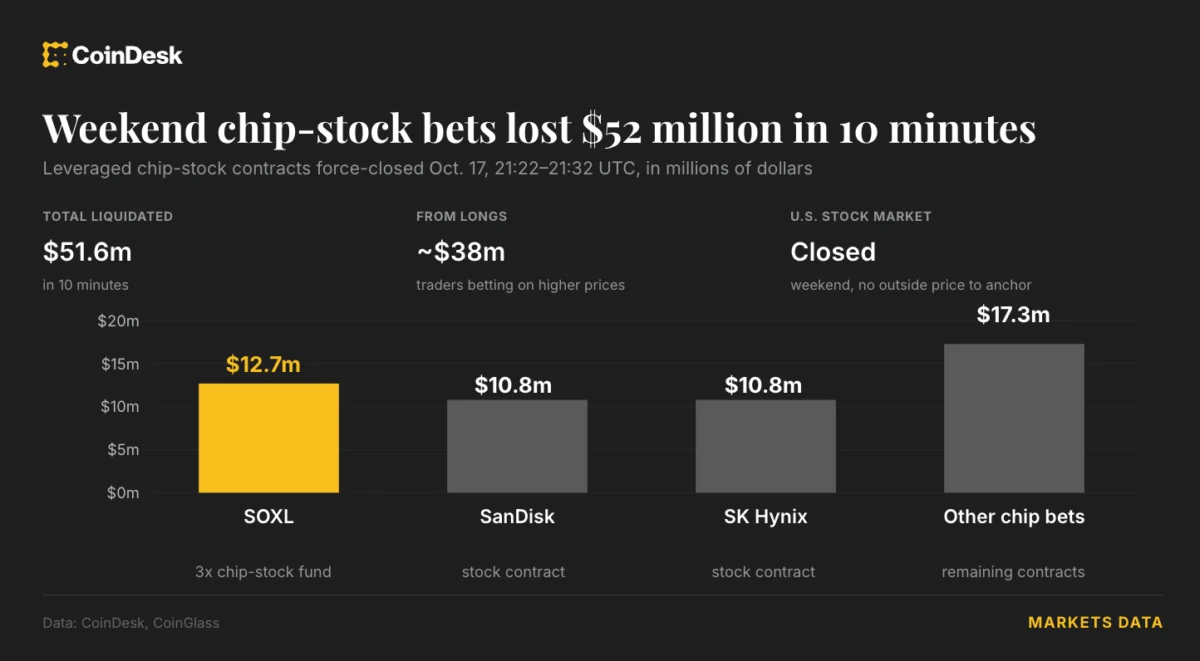
A violent, lightning-fast wave of liquidations tore through crypto-based derivatives markets late Saturday, erasing nearly $52 million in leveraged bets tied to semiconductor stocks in just 10 minutes. The sudden market flush occurred while traditional U.S. stock exchanges remained shuttered for the weekend, leaving traders heavily exposed to round-the-clock contracts and entirely detached from underlying share prices.
The heavy losses hit investors who utilized perpetual futures—complex financial instruments that track the price performance of major equities and trade 24 hours a day, seven days a week on decentralized and centralized cryptocurrency exchanges. These products allow retail and institutional speculators to buy and sell exposure to traditional tech giants like Nvidia, Micron, and SanDisk on a Saturday night, long after Wall Street trading desks have closed their doors for the weekend.
However, the convenience of round-the-clock exposure comes with severe systemic risks. When a trader borrows capital from a platform to amplify their purchasing power through leverage, any adverse price movement consumes their deposited margin. Once those losses eat entirely through the collateral, the protocol automatically executes a forced closure of the position. This mandatory sell-off dumps assets back into the order book, driving prices downward and triggering a cascade effect that immediately threatens the next leveraged trader in line.
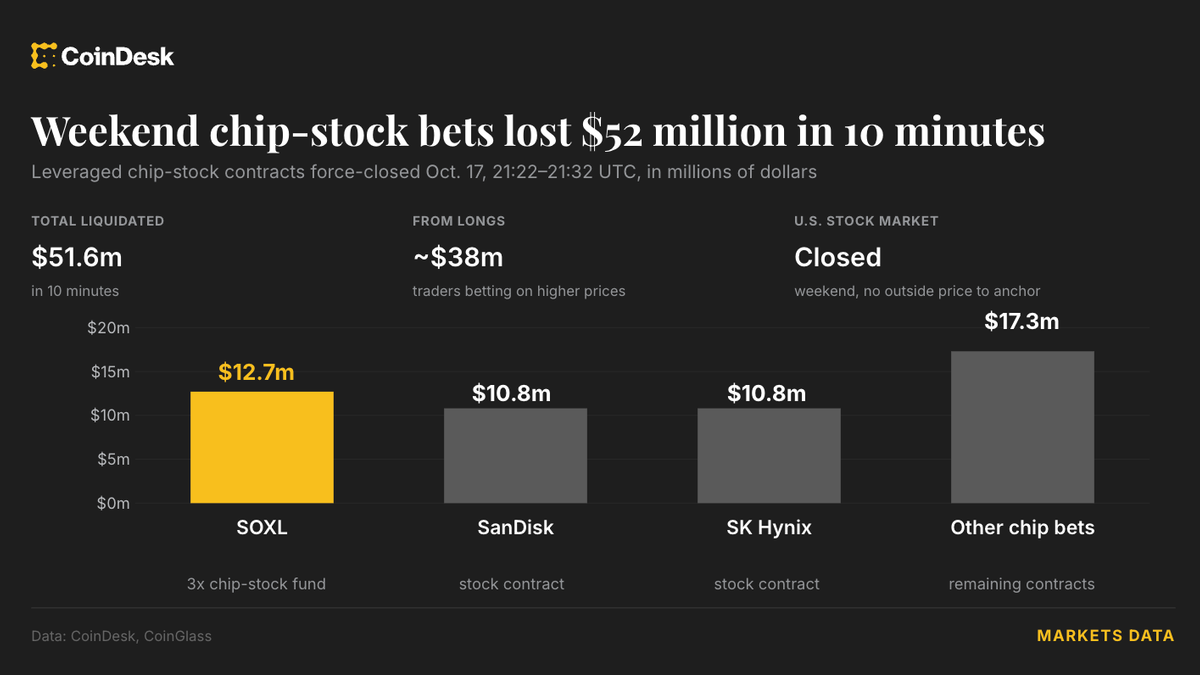
Market data from CoinGlass highlights the sheer speed and scale of the weekend turmoil, revealing that approximately $51.6 million in positions tied directly to semiconductor equities and leveraged chip funds were force-closed between 21:22 and 21:32 UTC. The overwhelming majority of those casualties—roughly $38 million—belonged to optimistic speculators who had bet on higher prices through bullish long positions, only to be caught completely off guard by the sudden downward sweep.
The fallout was distributed across several high-profile semiconductor instruments. The Direxion Daily Semiconductor Bull 3X Shares (SOXL), a popular exchange-traded fund product designed to triple the daily percentage movements of underlying chip shares, absorbed the heaviest blow, accounting for roughly $12.7 million in liquidated capital. Contracts tied to SanDisk and South Korean memory giant SK Hynix followed closely behind, each suffering approximately $10.8 million in forced liquidations as the downward momentum accelerated.
According to a detailed technical review of the market activity conducted by David Jeong, chief executive of trading firm Tread.fi, the aggressive sell-off originated on major centralized cryptocurrency platform Binance. Jeong noted that he personally observed the placement of the first large-scale sell orders for SanDisk and Micron on Binance at precisely 21:21:59 UTC, setting off the chaotic sequence of events.
Less than a second after the initial wave hit Binance, automated trading algorithms and arbitrage bots rapidly transmitted the selling pressure to Hyperliquid, an alternative crypto derivatives platform where Trade XYZ lists its stock-tracking perpetual contracts. Within a remarkably tight window of just 1.8 seconds, approximately 10 distinct wallet addresses rushed to open aggressive short positions against six different chip-linked contracts, capitalizing on the emerging downward spiral.
The geographic and platform distribution of the trading volume underscored the sudden nature of the liquidity crunch. Binance alone absorbed about $21.9 million of SanDisk trading volume during that volatile opening minute, dwarfing the $3.1 million recorded on Trade XYZ over the same timeframe.
The weekend shockwave did not happen in a vacuum. Memory-chip stocks and the broader semiconductor sector were already stumbling out of a difficult week of traditional trading. Investors had spent the preceding days digesting growing macroeconomic anxieties and weighing the implications of intensifying competitive pressures from ChangXin Memory Technologies (CXMT), a prominent Chinese state-backed memory chipmaker that has been steadily expanding its market footprint and raising concerns among western competitors.
Ordinarily, derivative contracts tracking traditional equities remain anchored to the real-world value of those companies through continuous price discovery on regulated exchanges like the Nasdaq or the New York Stock Exchange. However, because the traditional stock market was closed for the weekend, there was no baseline share price for these perpetual contracts to follow. Trapped outside regular trading hours, market participants were left trading in a vacuum, reacting exclusively to each other’s orders and platform-specific liquidity dynamics.
Under the operational rules governing Trade XYZ, the platform’s internal mechanics allow trading activity to establish its own reference prices independently whenever outside stock quotes are unavailable. This self-contained pricing mechanism can create severe distortions during periods of sudden stress, amplifying volatility and detaching digital derivatives far away from where the actual corporate equities are fundamentally valued.
The ultimate test for these weekend contracts will arrive when traditional U.S. financial markets reopen for regular trading on Monday morning. Only then will investors discover the true divergence between Saturday night’s panicked digital liquidation prices and where the underlying semiconductor shares actually open on Wall Street.





Comments (0)