


The United Kingdom has launched severe economic sanctions against Cryptomus, a chameleonic cryptocurrency platform that blockchain intelligence experts and investigators identify as a primary conduit for ransomware payments, narcotics trafficking, darknet markets, and cybercrime services helping Russia circumvent international financial restrictions.
Announced on October 8, the U.K. Treasury’s new sanctions target Cryptomus—which has previously operated under the names Certa Payments and Xeltox Enterprises—for processing high-volume financial transactions that directly benefit the Russian government and its sanctioned financial institutions. The sweeping measures immediately freeze any assets held by Cryptomus at British banks and strictly prohibit U.K. companies from providing any form of commercial or virtual business services to the platform. Alongside Cryptomus, the U.K. government also clamped down on several associated virtual payment platforms, specifically naming VexPay, TokenSpot, and the Tsunami Payments service.
The crackdown follows extensive tracking by investigative journalists and blockchain analysis firms detailing how Cryptomus evolved into a foundational payment processor for dozens of Russian cryptocurrency exchanges and underground websites peddling cybercrime infrastructure. Since emerging in 2022, the platform has frequently altered its corporate identity to evade law enforcement and regulatory penalties. Most recently, it launched an offshoot brand known as "Heleket" last year, attempting to distance itself from operations after Canada slapped the platform with a record-breaking CAD $176 million fine for severe anti-money laundering violations.

Major blockchain intelligence firms have praised the U.K. move, emphasizing that traditional monetary fines have historically proved inadequate against agile cybercrime operations. Chainalysis noted in an October 8 blog post that the U.K. sanctions target the broader, highly resilient infrastructure supporting Russia’s wartime economy. According to Chainalysis data, Cryptomus and its spin-off Heleket rapidly grew into massive payment hubs for illicit activity, receiving more illicit funds across tracked categories than the specialized cryptocurrency mixers in their dataset, with illicit counterparties surging past 900 in a single month in late 2025.
Parallel findings from TRM Labs in April 2026 revealed that Cryptomus had processed more than $7 billion in cumulative transactions since its inception. This staggering volume included significant financial flows tied to the distribution of child sexual abuse material, terrorist financing networks, and international human trafficking operations. TRM analysts observed that while Cryptomus experienced a temporary cratering in transaction volume after instituting stricter "know your customer" (KYC) rules, the platform swiftly bypassed these hurdles by launching Heleket as a parallel service designed to maintain no-KYC payment processing for high-risk clients.
Richard Sanders, a seasoned blockchain analyst and investigator who spent months mapping out the inner workings of Cryptomus’s payment infrastructure and transacting directly with its customer base, noted that the U.K. sanctions represent a critical turning point precisely because Canada’s massive financial penalty was ultimately unenforceable and uncollectible. Writing on LinkedIn, Sanders emphasized the operational distinction between fines and targeted government sanctions, stating that financial penalties alone cannot stop a dedicated crypto payment processor, whereas official sanctions effectively dismantle the operation.
Investigators previously uncovered that Cryptomus initially shared a modest Vancouver office address with dozens of other foreign currency dealers and money transfer businesses—none of which appeared to have any actual physical presence at the location. Following the imposition of Canada’s CAD $176 million fine for systemic money laundering failures, Cryptomus formally appealed the penalty while simultaneously spinning up Heleket to continue processing massive volumes of suspicious transactions without interruption. Furthermore, industry observers point out that these sanctions mark the first known instance of a "Five Eyes" intelligence-sharing nation—comprising Australia, Canada, New Zealand, the United Kingdom, and the United States—placing direct economic sanctions on a cryptocurrency entity incorporated within another jurisdiction of the Five Eyes alliance.

The murky origins of how entities like Cryptomus and Heleket acquired the legitimacy to offer international financial services trace back to an elaborate corporate structure involving fake financial institutions overseen by a phony regulatory body positioned in a disputed territory. Investigations into the platform’s ownership revealed that the sole shareholder of Cryptomus parent company Certa Payments was a 25-year-old Ukrainian woman. She concurrently headed several other firms, including the WS Management and Advisory Corporation, an organization that publicly billed itself as an exclusive regulatory body overseeing licensing for cryptocurrency, foreign exchange, and online gaming businesses incorporated in the disputed region of northwestern Africa known as the Western Sahara.
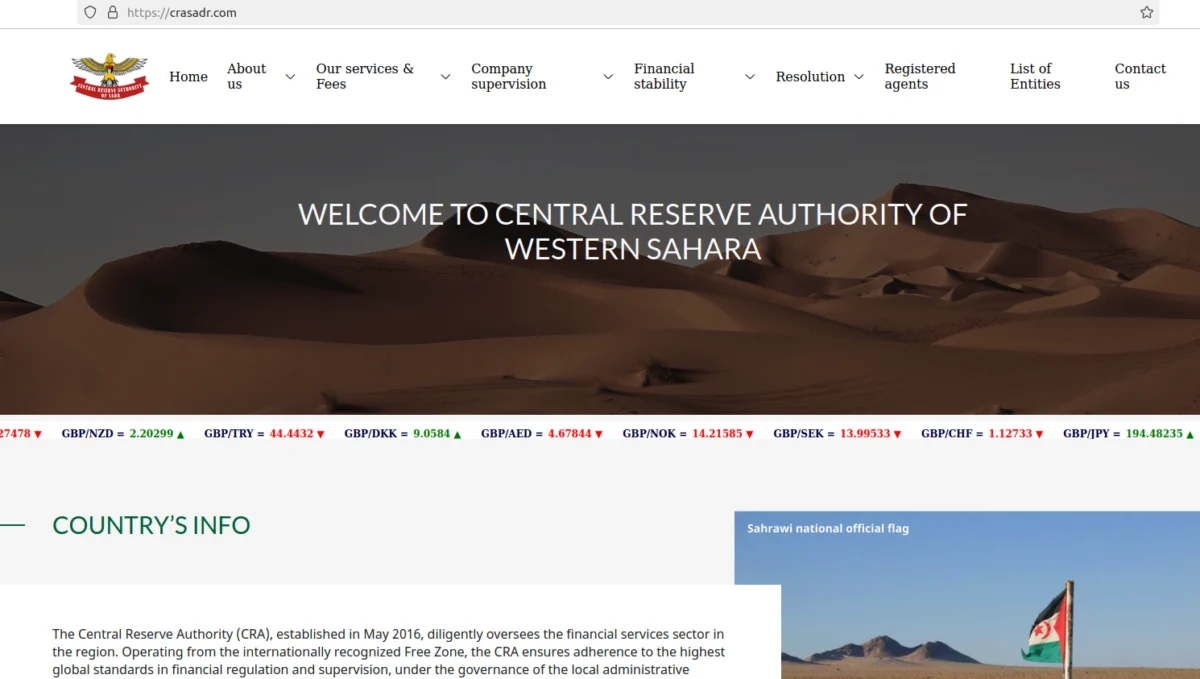
Corporate registries and web infrastructure records tied this regulatory front to the domain crasadr.com, which served as the official website of the Central Reserve Authority of Western Sahara, an unrecognized administrative body that supposedly granted operational licenses to various digital asset and foreign exchange services. Historical infrastructure data showed that one of Certa Payments’ former web properties shared a server with over a dozen other domains, including rasd-state.ws, which acted as the digital front for the self-proclaimed reserve authority. With the U.K.’s new economic restrictions now in full effect, international watchdogs and blockchain analysts anticipate a severe disruption to the network of shell companies and virtual payment rails that have long enabled illicit capital flows and Russian sanctions evasion.





Comments (0)