



For years, the consumer data broker Radaris.com maintained a notorious reputation for systematically ignoring requests to remove personal information from its vast, sprawling network of online people-search services. That operational defiance finally caught up with the company in a courtroom battle centered on New Jersey’s strict privacy statutes. Faced with repeated stonewalling, jurisdictional shell games, and evasive legal tactics from defense attorneys, a judge ordered that the radaris.com domain and more than a dozen sister data broker domains be transferred directly to the plaintiffs.
The legal reckoning began in February 2024, when Atlas Data Privacy Corp filed a lawsuit against Radaris. The action targeted the company for alleged violations of Daniel’s Law, a New Jersey statute enacted in the wake of a tragic family murder involving a federal judge. The legislation provides robust protections for state law enforcement officials, government personnel, judges, and their immediate families, granting them the legal right to have their personal data completely expunged from commercial data brokers and people-search registries. Furthermore, the statute imposes severe financial penalties of $1,000 per violation against companies that disregard lawful removal requests.
Just weeks after the initial lawsuit was filed, investigative reporting from KrebsOnSecurity exposed the individuals behind the operation: Russian-born brothers Igor and Dmitry Lubarsky, who reside in Massachusetts and operate a vast web of people-search companies alongside Russian-language dating sites and affiliate marketing programs.
Attorneys representing the Lubarsky brothers quickly threatened a defamation lawsuit, demanding a formal retraction and public apology. Their counsel insisted that the reporting was completely inaccurate and claimed the true owners were actually Ukrainian nationals living in Ukraine. However, subsequent investigative findings dismantled those claims, revealing that the brothers built and managed Radaris and its affiliates using a fictitious CEO named "Gary Norden." Radaris’s own legal counsel later admitted in court proceedings that the executive persona was entirely fabricated and had even been featured in past press releases distributed to lure potential investors.
As legal pressure mounted, Radaris defense teams routinely waited until the absolute final deadlines to make court appearances, initially arguing that Atlas had failed to properly serve the true international entities controlling the network. In June 2025, Atlas refiled the action, significantly expanding the scope of the lawsuit to include a broader cluster of corporate affiliates accused of violating Daniel’s Law.
Matt Adkisson, president and CEO of Atlas, described the defense strategy as a textbook corporate shell game. He noted that the defendants continually altered their corporate paper trails and privacy policies, shifting management entities across offshore jurisdictions such as the Marshall Islands, the British Virgin Islands, and the Seychelles.
According to Adkisson, when the defendants updated their terms of service to claim management under a newly minted Marshall Islands entity, local investigators discovered that the named company did not even exist at the time of the filing. Similar jurisdictional maneuvers had previously been deployed in a 2017 class-action lawsuit where Radaris failed to contest claims, leading a judge to order the transfer of radaris.com via Verisign before an appeal preserved the domain under a Cyprus-based firm called Bitseller Expert Limited, which was later replaced by a Marshall Islands entity named Andtop Company.
Raj Parikh, a partner at PEM Law in New Jersey who manages Daniel’s Law litigation for Atlas, noted that the data broker previously relied on a strategy of attrition, wearing down plaintiffs until they abandoned complex international legal battles. While recovering financial damages from overseas actors remains difficult, Atlas pursued the litigation aggressively to neutralize the persistent security threat posed to public officials in New Jersey.
By late August, the presiding judge ruled that the defendants had repeatedly squandered opportunities to mount a defense. While initial defense counsel Val Gurvits declined to comment and referred inquiries to attorney Victor Worms, Worms argued that the default judgment was legally void because "Radaris.com" is a domain name rather than a registered legal entity. Worms confirmed plans to pursue motions to vacate the judgment and challenge the domain forfeiture on constitutional grounds.
Although radaris.com still appears in search engine results for personal names, the domain no longer functions as a commercial people-search hub. Instead, visitors encountering the site are greeted by a public notice issued by Atlas detailing the court-ordered domain transfer.

Email Confirmations and Corporate Network Architecture
Internal communications and documentation obtained by Atlas throughout the litigation—totaling more than 10,000 emails and files—have corroborated earlier investigative findings regarding the centralized ownership of the Radaris ecosystem.
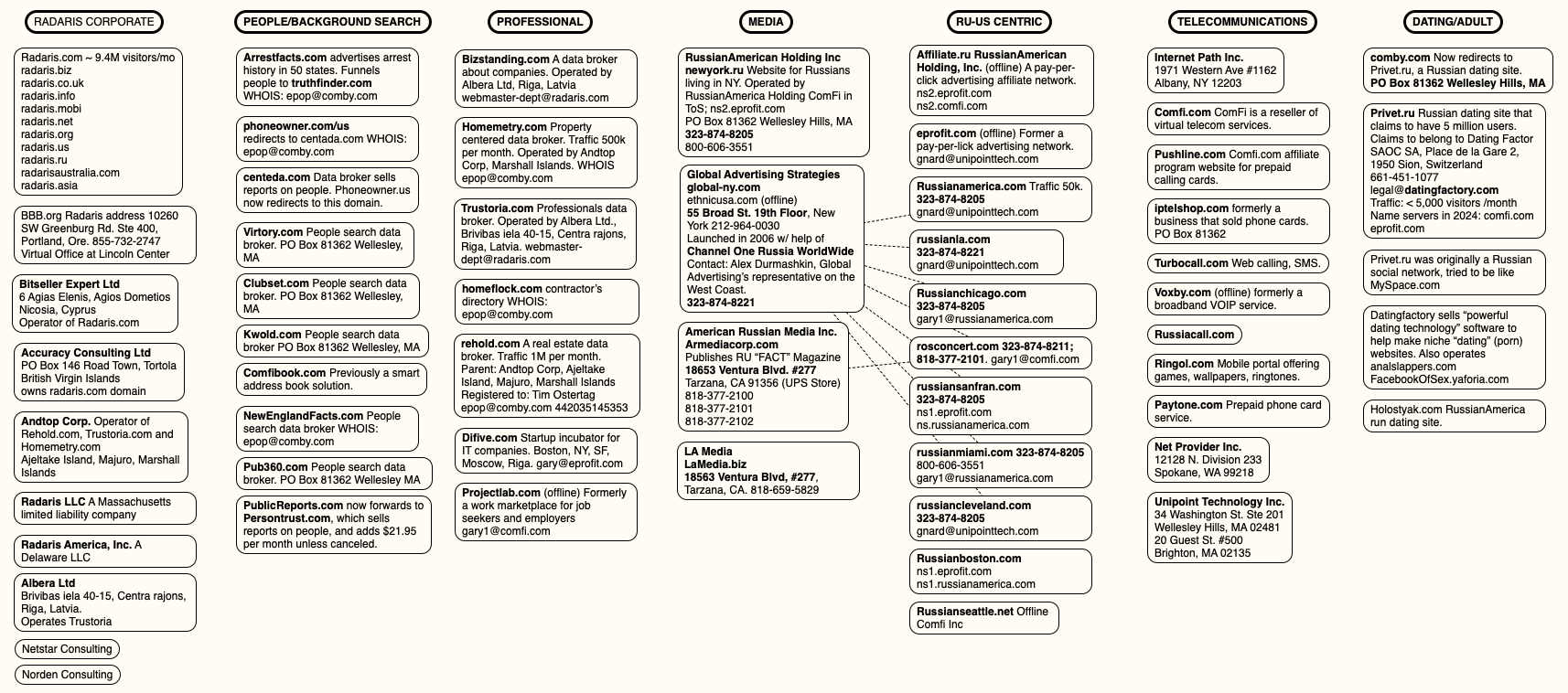
According to summaries shared by Atlas, the documents demonstrate that numerous nominal corporate vehicles, including Radaris America Inc., Bitseller Expert Limited, Digital Orbit Corp, Core Solutions Group Inc, Lucky Solutions Inc, Virtura Corp, Veripages Inc, Nuform Solutions Inc, Growth Data Advisors Inc, and Property Experts Inc, are actually operated by a small core group of administrators. These entities share unified banking channels, payment processing accounts, virtual office addresses, and administrative infrastructure routed through specific mail domains such as difive.com, centerex.com, scienteco.com, eprofit.com, realmo.com, and pub360.com.
The internal correspondence indicates that Radaris.com generated roughly $42,000 per month, while sister site Veripages.com brought in approximately $45,000 monthly through marketing partnerships with the Lifetime Value Company, operator of brands like PeopleLooker, PeopleSmart, NumberGuru, and Bumper. Furthermore, documents revealed that the Radaris network earned up to $25,000 monthly through partnerships with Onerep, a privacy-cleansing service whose founder was previously exposed for simultaneously operating multiple commercial people-search websites.
To date, the New Jersey court has ordered the transfer of 14 domain names associated with the Radaris corporate family to Atlas.
The Road Ahead for Privacy Legislation
While the Radaris affiliates face potential financial liabilities under Daniel’s Law, the statute itself is currently navigating a rigorous constitutional challenge. Approximately 150 consumer data brokers sued by Atlas have banded together to challenge the New Jersey law in federal court, arguing that the statute is overly broad and infringes upon First Amendment protections. The U.S. Court of Appeals for the Third Circuit has yet to deliver a ruling, and legal observers anticipate the dispute will ultimately reach the U.S. Supreme Court.
Despite constitutional hurdles in New Jersey and West Virginia—where a federal district court ruled a similar statute facially unconstitutional—at least 14 other states have enacted legislation modeled after Daniel’s Law, with additional jurisdictions considering comparable measures.
Privacy experts point out that state-level statutes operate within a fractured legal landscape. Justin Sherman, a privacy researcher and author examining the data broker industry, noted that federal legislative efforts continue to face intense lobbying opposition from major technology firms, social media giants, cryptocurrency entities, and artificial intelligence developers.
Sherman emphasizes that without comprehensive federal consumer data protection laws addressing modern realities, people-search enterprises will persist. Most state privacy frameworks explicitly exempt information classified as public or government records, including voter registration rolls, property deeds, marriage licenses, motor vehicle files, court records, and professional licensing data. Without federal limits on how public and acquired personal data can be processed, retained, or monetized by commercial entities, recurring systemic vulnerabilities will continue to impact consumer privacy nationwide.




Comments (0)