


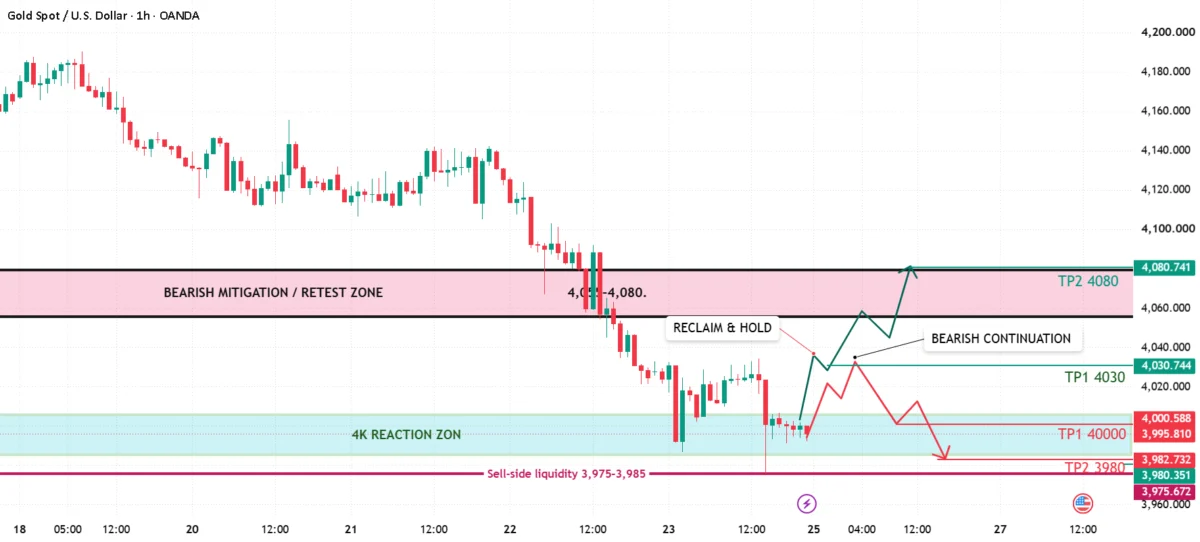
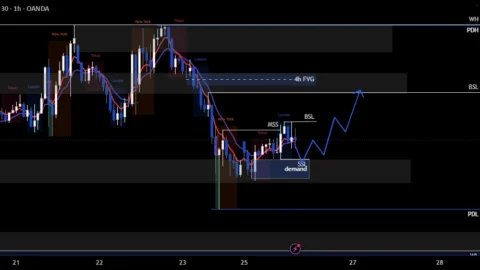
Gold prices have come under renewed and sustained selling pressure across shorter timeframes, bringing the precious metal down to test the heavily monitored $4,000 psychological threshold. Analyzing the hourly (1H) chart, market structure continues to flash distinctly bearish signals, characterized by a persistent sequence of lower highs and lower lows. Rather than attempting to preempt the next major directional swing amid heightened volatility, market participants are closely observing price action around this critical inflection zone to determine whether the current support can hold or if a deeper correction is underway.
The broader macroeconomic environment and intraday trading dynamics have converged to place the spotlight firmly on the $4,000 handle. Over recent sessions, sellers have successfully dictated the pace, driving prices downward and overwhelming intermittent buying attempts. This ongoing downside momentum has left technical analysts and day traders alike evaluating two distinct pathways for the market as it navigates this pivotal juncture. The unfolding price action in the coming hours is expected to dictate whether gold resumes its impulsive downward trend or carves out a temporary bottom that allows for a corrective recovery.
Bearish Scenario and the Risk of a Failed Reclaim
In the primary bearish outlook, the prevailing downward structure remains intact, with sellers maintaining their structural advantage. Market observers note that if gold attempts a corrective recovery back toward the $4,020 to $4,030 resistance band but encounters firm selling pressure that prevents a sustained hold, bearish market participants are likely to reclaim total control of the tape.
Under this scenario, a renewed rejection near those higher levels would validate the continuation of the dominant trend. Should prices slide back beneath the psychological $4,000 mark following a failed recovery attempt, downside pressure could accelerate rapidly. Technical attention would immediately shift toward the recent swing lows established in the $3,985 to $3,975 region. A breach of those established floors would confirm the preservation of the hourly downtrend, reinforcing the broader bearish narrative that has dominated recent trading sessions.
Bullish Scenario and Potential for a Relief Bounce
Conversely, an alternative bullish perspective centers on the possibility of a relief bounce if buyers manage to mount an effective defense around the immediate support parameters. Analysts tracking the order flow note that if the $3,985 to $4,005 reaction zone successfully absorbs the selling volume and repels further downside attempts, conditions could ripen for a short-term counter-trend rally.

For this bullish relief scenario to materialize, prices would first need to consolidate above the immediate support zone before mounting a successful reclaim of the $4,020 to $4,035 resistance corridor. Achieving and sustaining trade above that threshold would signal a shift in short-term momentum, potentially opening the door for an extension toward higher upside targets. Under such conditions, technical projections point to a potential relief bounce stretching into the $4,055 to $4,080 zone, offering respite to market participants caught on the long side of the recent sell-off.
Market Outlook and Risk Management
Despite the intriguing setup around the $4,000 threshold, the overarching market structure on the hourly timeframe remains explicitly bearish. Market participants emphasize that while psychological and technical support zones offer logical areas for potential price reactions, entering positions without definitive confirmation carries substantial risk.
Traders and analysts continue to monitor volume, candlestick formations, and momentum indicators closely to gauge the true strength of buyers and sellers at these levels. Rather than rushing into premature predictions or forcing trades in a consolidating market, the prevailing approach among disciplined market watchers is to wait for clear confirmation signals before drawing definitive conclusions about the next major leg of price movement.
As always in technical analysis and active trading environments, unexpected market shifts remain a constant factor. Proper risk management practices and strict adherence to predefined trading plans are essential for navigating the heightened volatility surrounding key psychological levels like the $4,000 zone in gold.

Comments (0)